

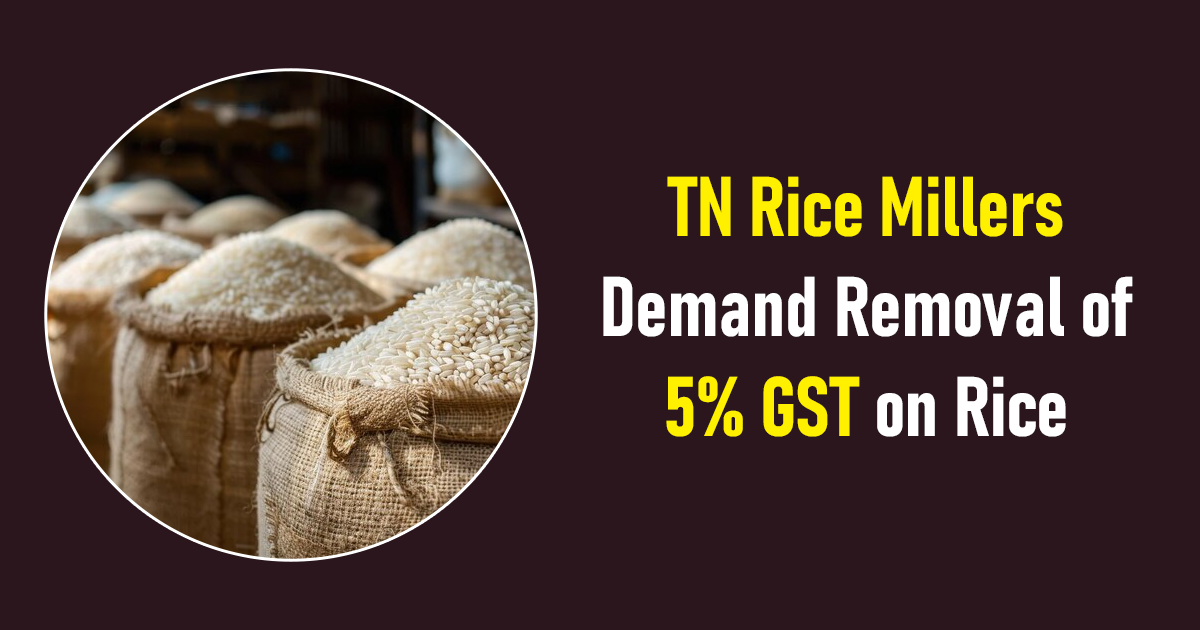
Paddy and rice millers have urged Chief Minister C. Joseph Vijay to request the Centre and the GST Council to remove the 5% Goods and Services Tax (GST) on rice, as it is considered an essential commodity.
D. Thulasingam, president of the Federation of Tamil Nadu Rice Mill Owners and Paddy Rice Federation, stated that the case is expected to be raised at the forthcoming 57th GST Council meeting.
Real Impact on Customers
- Rice packs weighing less than 26 kg are subject to 5% GST, which affects poorer households and daily wage earners who buy small quantities.
- Approximately 15 to 20 per cent of consumers buy rice in small quantities.
- Before the implementation of GST, states such as Karnataka and the former united Andhra Pradesh imposed a tax rate of only 1–2%.
- Thulasingam said GST has added to the rise in rice prices.
Federation secretary A.C. Mohan said that the rice is not ordinary, as its prices often fall after harvests, even though costs for fertilisers, labour, and minimum support prices keep increasing.
He said that shortages do not cause higher prices instead, premium varieties like Sona Masoori, White Ponni, and BPT, which is obtained from the States of Karnataka and Andhra Pradesh, have become costlier. In Tamil Nadu, the growth of these varieties is less, so brands depending on them have raised their selling costs.
Read Also: AP AAR Applies GST on rice bags up to 25 KG When Exporting to Buyers Abroad
According to a report by The Hindu, the Federation has urged the state government to discontinue the 1% marketing fee on paddy imported from other states, as these states already collect this fee. They proposed that the fee should apply only to paddy brought in by local farmers to the market yards in Tamil Nadu.
The Goods and Services Tax (GST) is India’s unified indirect tax system, which was introduced in July 2017. It supersedes multiple central and state taxes with a single framework based on the principle of “One Nation, One Tax.”
The upcoming 57th GST Council meeting, expected to take place in late July 2026, will focus on simplifying compliance, addressing inverted duty structures, and considering sector-specific relief measures, such as tax waivers for rice.