

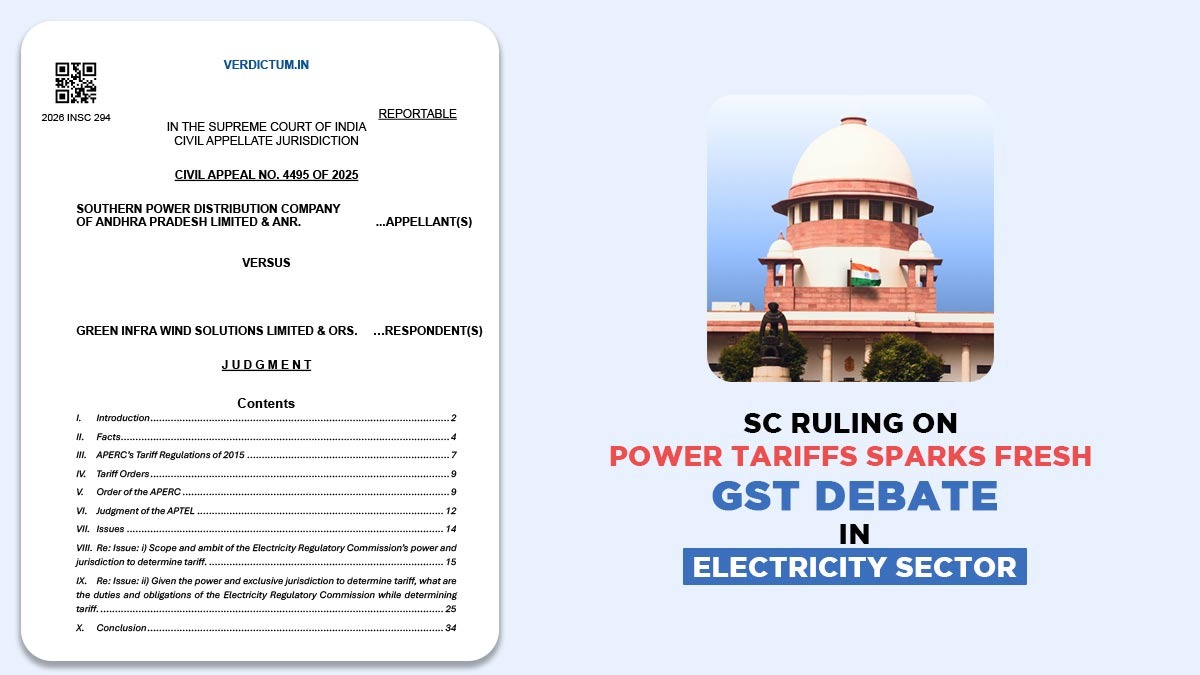
In Southern Power Distribution Company of Andhra Pradesh Limited & Anr. vs. Green Infra Wind Solutions Limited & Ors., the Supreme Court ruled that Generation-Based Incentive (GBI) constitutes a separate financial entitlement for power generators and cannot be offset against tariffs set by State Electricity Regulatory Commissions.
From the judgment, transparency towards tariff structuring for renewable energy developers has been given; however, it raises a crucial and unresolved question under the Goods and Services Tax (GST) framework: whether Incentives Are ‘Consideration for Service’?
The court stated GBI is an additional payment made to the generator over and above the tariff. It promotes policy objectives like renewable energy generation and energy transition.
It outlined that these incentives cannot be utilised by distribution companies (DISCOMs) to lessen the tariff payable under power purchase agreements. This explanation has the revenue expectations of developers, especially in the wind and renewable energy sectors.
Important: What If Electricity Comes Under GST in India?
In this decision, the classification of GBI as a distinct payment raises a deeper tax conundrum. The electricity supply is waived under GST; however, GBI is not included in the tariff and is instead paid separately by the government. The same structural separation rolls out ambiguity for its tax treatment.
The definitions of “supply,” “service,” and “consideration” are notably broad under the Goods and Services Tax regime. Tax authorities can claim that activities performed via generators, like setting up renewable projects, generating electricity, and feeding it into the grid under government schemes, include a service to the government. GBI, in this case, may be seen as consideration for that service, hence drawing GST.
Meanwhile, the nature of GBI does not sit with a conventional service contract. The main supply remains electricity to DISCOMs, which continues to relish the GST exemption. The government is not the direct purchaser of electricity under power purchase agreements. Instead, GBI seems to function as a policy-driven incentive or grant based on compliance with scheme conditions, rather than a quid pro quo arrangement.
Also Read: Chhattisgarh HC: No GST ITC on Compensation Cess for Power Supplied to Employee Township
This duality creates uncertainty in interpretation. On one hand, the GBI could be seen as a non-taxable subsidy or grant that does not have a direct connection to any taxable supply. On the other hand, its association with specific performance conditions may raise concerns about it being treated as a taxable consideration.
The stakes are high for the power sector due to the significant incentives involved and the increasing dependence on such schemes to promote renewable energy capacity. Industry stakeholders can seek clarification from policymakers or pursue advance rulings to reduce potential litigation risks.
While the ruling addresses the tariff issue, it also shifts the focus to the implications for GST. This could lead to a new wave of disputes at the intersection of energy policy and indirect taxation.
Read More