

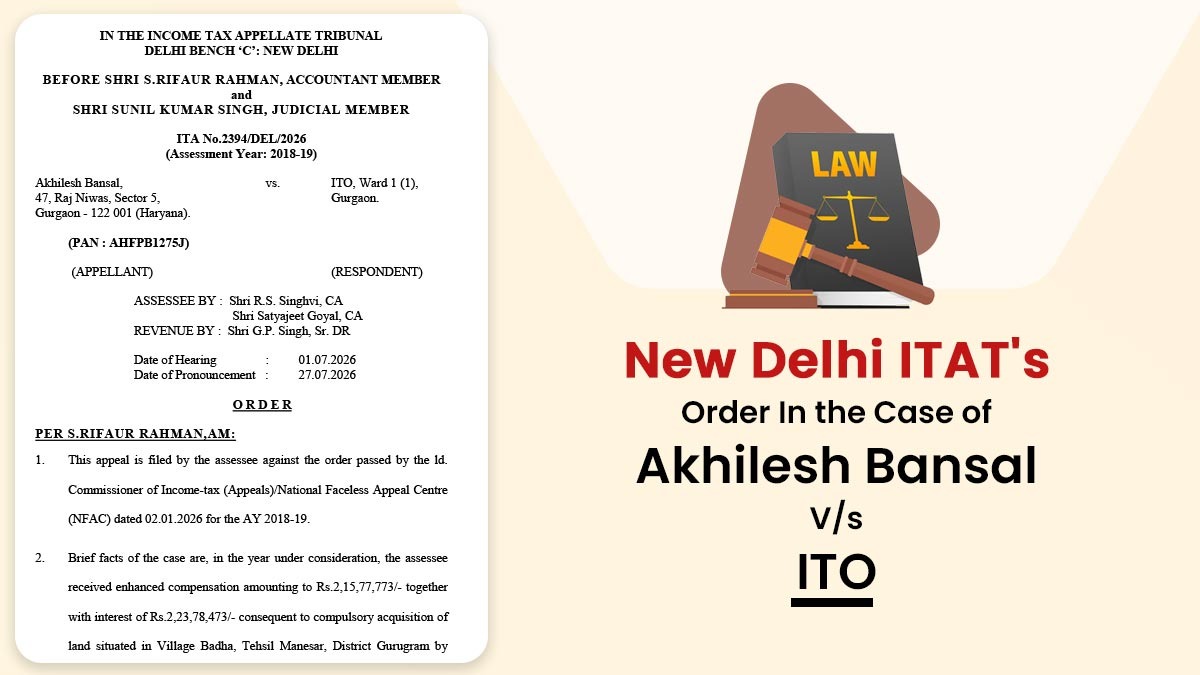
The New Delhi bench of the Income Tax Appellate Tribunal (ITAT) has stated that the interest given u/s 28 of the Land Acquisition Act, 1894 cannot be taxed separately as “Income from Other Sources”.
The taxpayer, Akhilesh Bansal, obtained enhanced compensation of Rs 2,15,77,773 and interest of Rs. 2,23,78,473 u/s 28 of the Land Acquisition Act towards compulsory acquisition of rural agricultural land. The purchase of land was in 2007, and was asserted to be outside the specified municipal limits and therefore not a capital asset u/s 2(14)(iii) of the Income Tax Act, 1961. Therefore, the taxpayer claimed the compensation and interest as exempt.
Also Read: ITAT Lucknow: Disallowance Under Rule 8D(2)(ii) Cannot Exceed Exempt Income Earned
The AO did not accept the claim and taxed the enhanced compensation u/s 45(5) and the interest under “Income from Other Sources.” The AO’s order has been upheld by the CIT(A). The dissatisfied taxpayer is in appeal before the Tribunal.
The consideration issue was whether the land compulsorily acquired by the Haryana Urban Development Authority (HUDA) constituted a “capital asset” within the meaning of section 2(14)(iii) of the Income Tax Act and, consequently, whether the enhanced compensation and the interest given u/s 28 of the Land Acquisition Act are chargeable to tax.
Recommended: All About I-T Section 54B of Capital Gain on Land Transfer
The taxpayer’s counsel said that once the land itself was not a capital asset, the enhanced compensation could not be charged to tax as per section 10(37) of the Income Tax Act, especially when the original/initial compensation was considered as exempt on the ground that the land was rural agricultural land in terms of section 2(14) of the Income Tax Act. Concerning the interest awarded u/s 28 of the Land Acquisition Act.
The counsel put reliance on the decision of the Coordinate Bench of the Tribunal in Satender Kumar vs. ITO and the judgment of the Supreme Court in CIT vs. Ghanshyam (HUF) to claim that this interest forms an integral portion of the compensation itself and consequently, where the compensation is not charged to tax, the interest also cannot be levied to tax.
The departmental representative of the Revenue supported the orders of the Assessing Officer and the CIT(A). The land was acquired by the Haryana Urban Development Authority for urban development and hence possessed all the attributes of urban land and as such the AO and the CIT(A) had rightly taxed the compensation u/s 45 of the Income Tax Act.
The Tribunal of S.Rifaur Rahman, Accountant Member and Sunil Kumar Singh, Judicial Member stated that “We hold that the land acquired from the assessee was rural agricultural land situated beyond the prescribed aerial distance of eight kilometres from the municipal limits and, therefore, did not constitute a capital asset within the meaning of section 2(14)(iii) of the Income Tax Act. Once the very asset transferred falls outside the definition of “capital asset”, the charging provisions contained in Chapter IV fail at the threshold and the provisions of section 45(5) have no application.”
“In the present case, we have already held that the land acquired was rural agricultural land falling outside the ambit of section 2(14)(iii) of the Income Tax Act and consequently the enhanced compensation itself is not eligible for tax. Therefore, applying the ratio laid down by the Coordinate Bench in Satender Kumar vs. ITO, we hold that the interest awarded under Section 28 of the Land Acquisition Act, being an integral component of such compensation, is likewise not chargeable to tax” the bench concluded.
| Case Title | Akhilesh Bansal Vs ITO |
| Case No. | ITA No.2394/DEL/2026 |
| Assessee by | Shri R.S. Singhvi, Shri Satyajeet Goyal |
| Revenue by | Shri G.P. Singh |
| New Delhi ITAT | Read Order |