

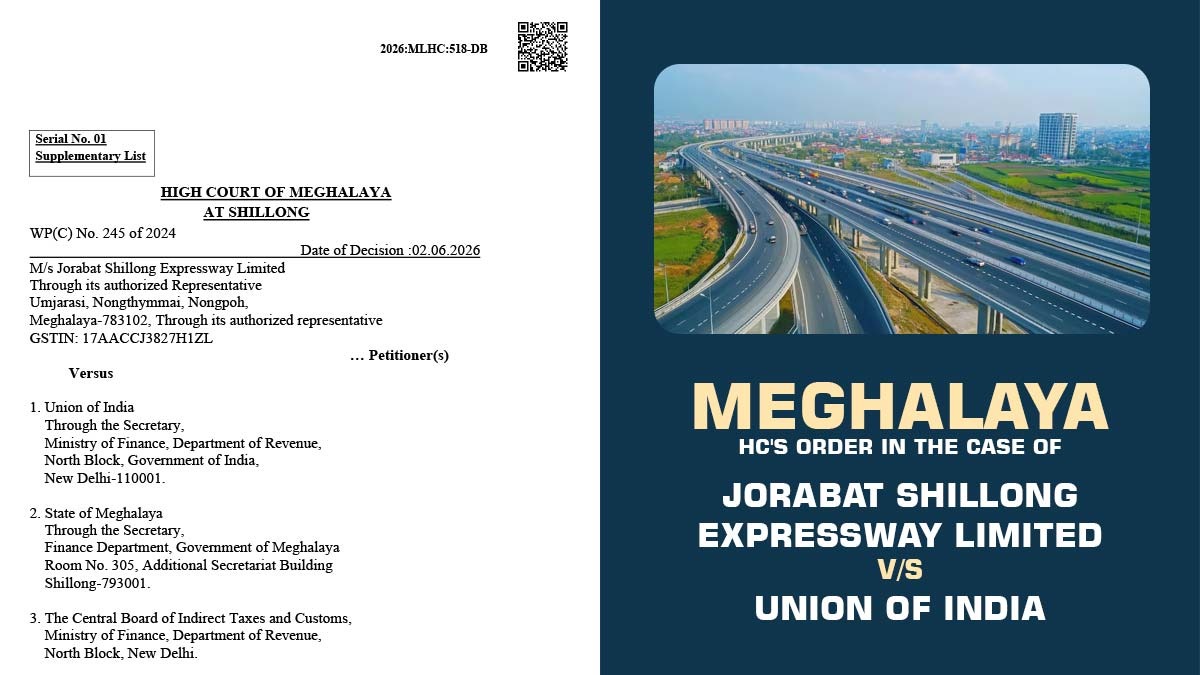
The High Court of Meghalaya did not entertain a writ petition submitted by Jorabat Shillong Expressway Limited. The appeal contested a GST demand of more than Rs 112.39 crore, holding that the issues of the classification of services and taxability should ordinarily be pursued via the regulatory appellate procedures furnished under the CGST Act.
A Division Bench, including Justice H.S. Thangkhiew and Justice B. Bhattacharjee, dismissed the writ petition while granting liberty to the taxpayer to file an appeal u/s 107 of the CGST Act.
The petitioner was established to carry out the Jorabat-Shillong highway project using the Built-Operate-Transfer (BOT) Annuity model. According to the concession agreement, the National Highways Authority of India (NHAI) retained the rights to collect tolls, while the petitioner received periodic annuity payments for the construction, financing, operation, and maintenance of the highway project.
The controversy began when the Directorate General of Goods and Services Tax Intelligence (DGGI) issued a show-cause notice u/s 74 of the CGST Act. They alleged that annuity receipts should be taxed as work contract services under SAC 9954.
Following this, the department issued an Order-in-Original that confirmed a GST demand amounting to Rs 112.39 crore. However, the petitioner argued that the annuity payments were exempt under Entry 23A, as they qualify as services related to access to a road or bridge, which fall under SAC 9967.
The applicant before the High Court contested the tax demand and questioned the jurisdiction of the officers who issued the SCN and adjudicated the proceedings. It claimed that they were not proper officers under the CGST framework. “The core controversy revolves around classification of services, characterisation of annuity receipts and determination of principal supply in a composite contract.”
The High Court did not accept the jurisdictional challenge and ruled that the Additional Director of DGGI was duly provided authority to issue the SCN as per Notification No. 14/2017-Central Tax. The court ruled that the Additional Commissioner of CGST has the authority to adjudicate proceedings based on the relevant statutory notifications that grant such powers.
Regarding the issue of maintainability, the court noted that the dispute required a thorough examination of contractual terms, the classification of services, the taxability of annuity receipts, and factual determinations arising from the concession agreement. The court pointed out that these issues are not merely questions of law that would justify direct intervention under Article 226 of the Constitution.
The Bench also said that the appellate authority u/s 107 has the authority to independently examine all legal and factual issues and is not bound by departmental circulars while deciding the appeal on merits. “Finding no violation of natural justice or inherent lack of jurisdiction, the Court declined to invoke its extraordinary writ jurisdiction.”
Finding that an effective alternative remedy existed under the CGST Act, the High Court dismissed the writ petition and granted the applicant 4 weeks to approach the appellate authority for appropriate relief.
| Case Title | Jorabat Shillong Expressway Limited Vs Union of India |
| Case No. | WP(C) No. 245 of 2024 |
| For The Petitioner | Mr S. Ghosh, Ms A. Agarwal, Ms M. Wariach, Mr Philemon Nongbri, Mr E. Lalsangluaia |
| For The Respondents | Dr N. Mozika, Ms M. Myrchiang, Mr N. Syngkon, Mr J.N. Rynjah |
| Meghalaya High Court | Read Order |