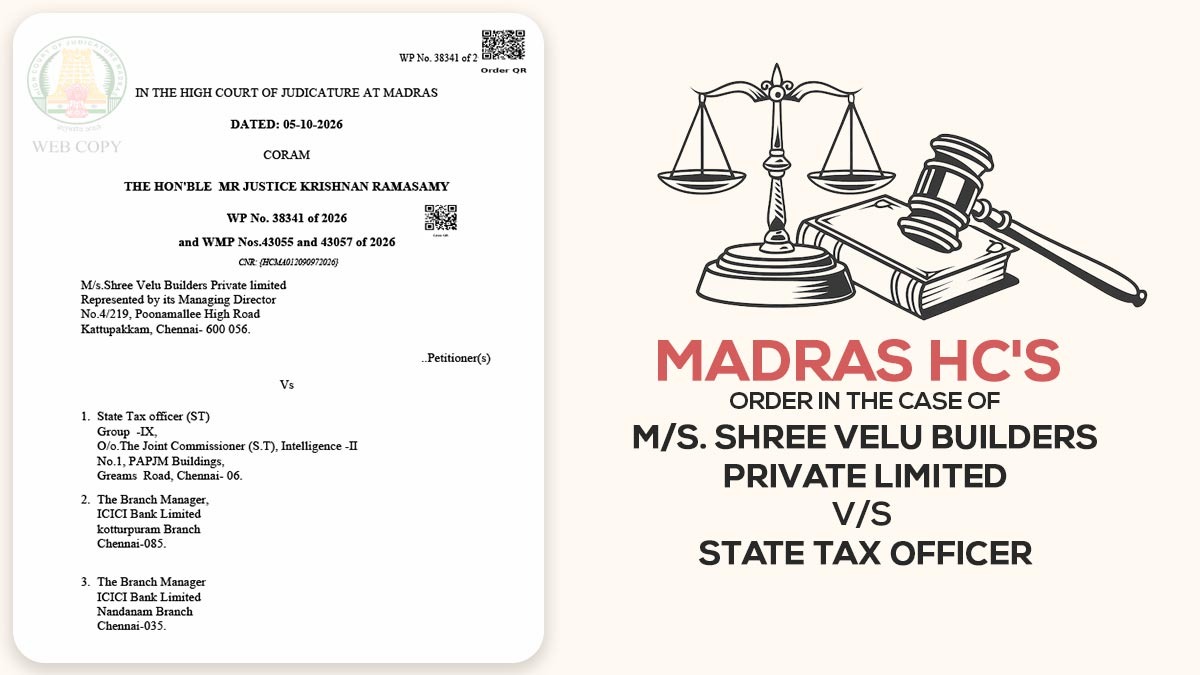


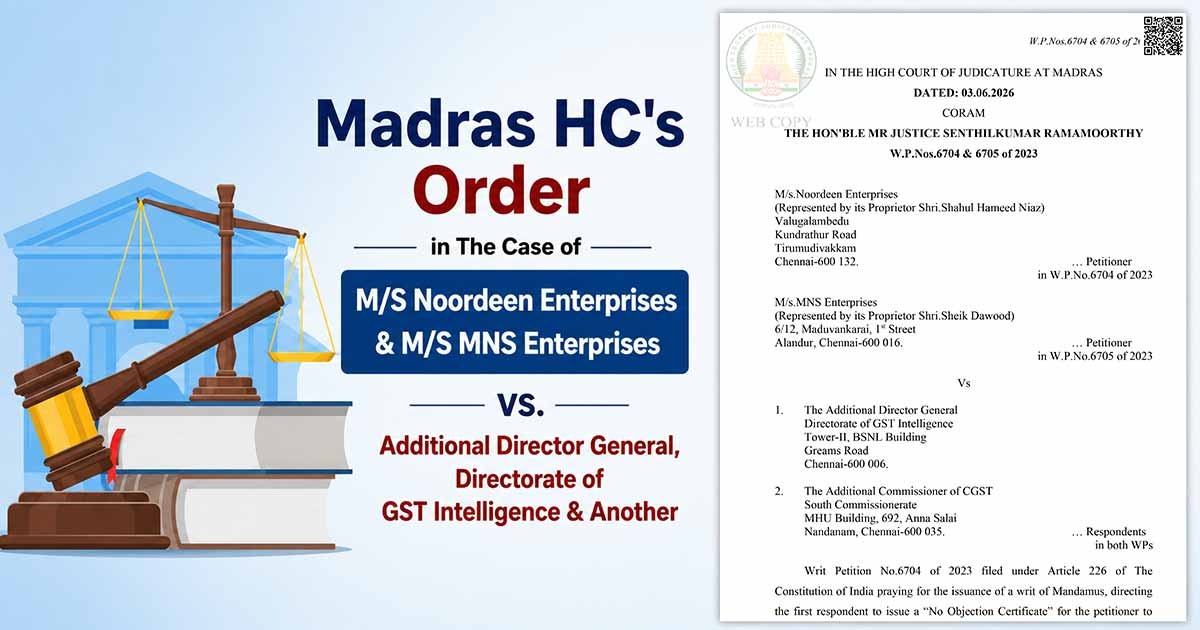
In a significant relief for businesses facing stringent tax enforcement measures, the Madras High Court has ruled that the GST department cannot seek recovery of alleged tax dues or intercept payments from a taxpayer’s customers before the taxpayer’s liability has been lawfully determined.
The Court emphasised that recovery proceedings cannot be initiated merely based on pending allegations and must await the final determination of tax liability in accordance with the provisions of the GST law.
Justice Senthilkumar Ramamoorthy ruled that sending aggressive recovery notices to a company’s clients based on mere “proposals” or ongoing investigations completely lacks legal backing.
The court emphasised that aggressive recovery mechanisms under Section 79(1)(c) and provisional attachments under Section 83 of the GST Act cannot be weaponised until a tax debt has officially “crystallised” through an adjudication order.
The issue came to light when a group of taxpayers approached the High Court seeking a No Objection Certificate (NOC) to clear lines of communication with their clients. GST officials had reportedly gone around the taxpayers, sending letters directly to their corporate customers. These letters ordered the customers to withhold payments or route those funds straight into the government’s coffers.
Spooked by the official mandate, one customer, Sumangala Steel Private Limited, complied and remitted ₹15 lakh directly to the GST authorities.
The taxpayers argued that this heavy-handed approach crippled their business cash flow long before any official tax demand was actually proven against them.
The petitioners backed their argument with a March 2022 Madras High Court precedent, which firmly established that the tax department cannot jump the gun on asset attachments or customer-end recoveries while liability is still just a theory.
Defending its actions, the GST department brought a few counterarguments to the table. They claimed that one of the taxpayers had actually instructed their own customer to deposit the money into the government account.
They pointed out that the taxpayer had failed to use the official refund mechanism (Section 54) to claw back the intercepted money, despite being legally permitted to do so earlier.
Finally, they noted that the entire argument was somewhat outdated, as formal tax adjudication orders were eventually passed on March 28, 2023 (which the taxpayer is fighting in a separate legal challenge).
The High Court was not convinced by the department’s retroactive justification. The bench pointed out a simple timeline flaw: when the GST department originally choked off the taxpayer’s income by writing to their clients, there was no finalised tax demand, only an ongoing investigation.
Any letters issued by GST authorities to a taxpayer’s clients before an official Order-in-Original are entirely invalid and cannot form the basis for any future recovery actions.
However, it wasn’t a total loss for the tax authorities. The court clarified that its ruling only applies to the department’s premature tactics. Now that formal adjudication orders have been passed, the GST department is legally free to pursue proper, lawful recovery options under Section 79(1)(c).
| Case Title | M/S Noordeen Enterprises & M/S MNS Enterprises vs. Additional Director General Directorate of GST Intelligence & Another |
| Case No. | W.P.Nos.6704 & 6705 of 2023 |
| For The Petitioner | Mr.G.Natarajan |
| For The Respondents | Mr.Sai Srujan Tayi |
| Madras High Court | Read Order |