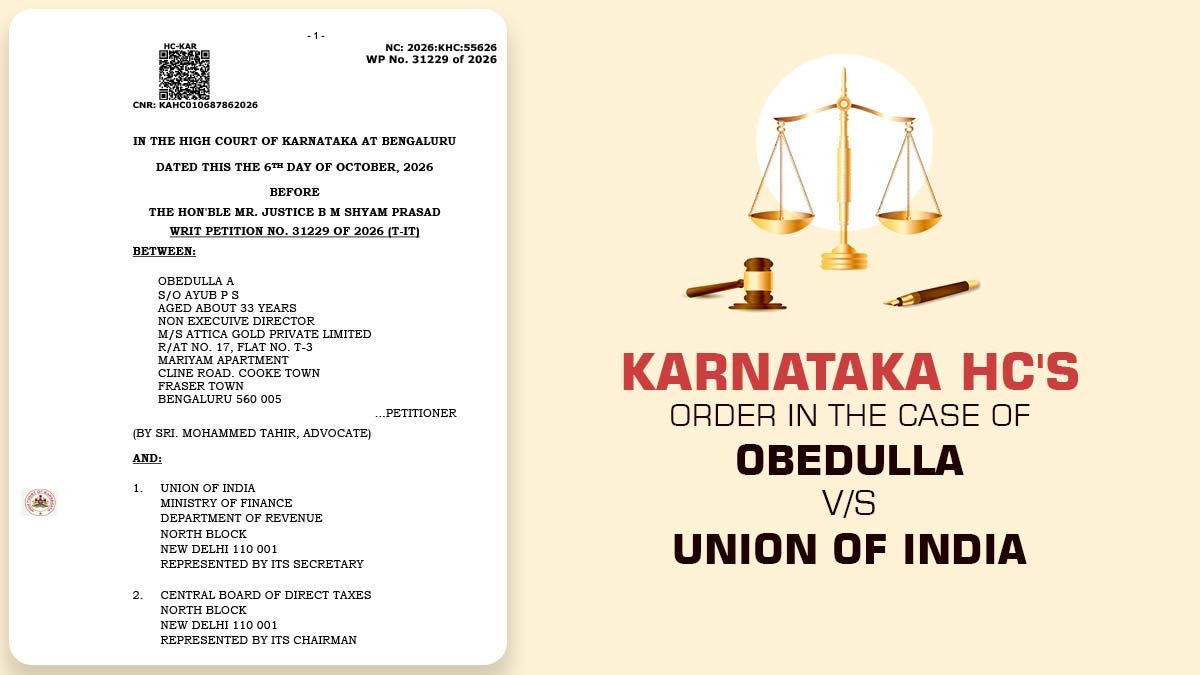


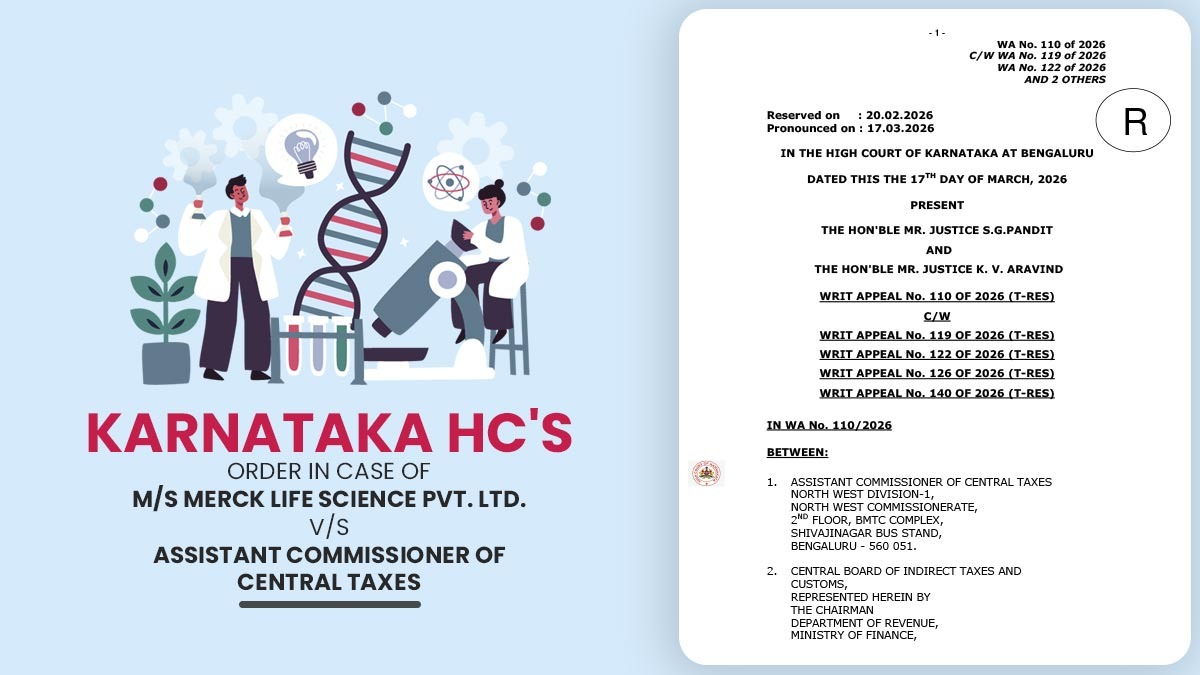
The Karnataka High Court has ruled that there is a strict two-year limit for filing claims for refunds of the Integrated Goods and Services Tax (IGST). The Court also stated that in certain situations, taxpayers can ask for help through their constitutional rights if they believe they have a good reason for needing relief.
The bench of Justice S.G.Pandit and Justice K. V. Aravind has cited that relaxing timelines arbitrarily will disrupt the relevant provisions like Sections 73 and 74 dealing with tax recovery.
The legal matter before the Court was whether the two-year limitation period under section 54 of the CGST Act is obligatory or merely directory.
As per the department, the time limit is stringent and binding; apart from that, any refund applications submitted after the same duration need to be denied. While the taxpayer claimed that procedural delays must not defeat the rights, particularly when the tax was filed incorrectly.
The issue is that when the taxpayer initially ministered certain services as export of services and paid IGST in October 2017. Thereafter, the transaction was reclassified as an intra-State supply and paid CGST and SGST. Filed a refund application for the incorrectly paid IGST dated March 30, 2024.
The tax authorities denied the refund claim as time-barred, quoting the two-year limitation u/s 54 and Rule 89(1A) of the CGST Rules. Previously, a single Judge of the High Court had permitted the refund, keeping the limitation period to be directory. Revenue had contested this order.
The Court held that the GST structure is a time-bound statutory regime. The two-year limitation is critical to the scheme of the act. Tax authorities do not have the authority to condone delay in the absence of an enabling provision.
An important gap has been observed by the Court that the CGST Act does not furnish any procedure for condoning the delay in the refund claims. Apart from the Income Tax Act, no authority has the authority to allow relief in genuine hardship cases.
The Court, even after keeping the limitation as obligatory furnished relief by considering that taxpayers can approach High Courts under Article 226 of the Constitution in genuine cases. The same is pertinent where the tax has been collected without the authority of law (Article 265).
The Court established a balanced system whereby if a delay in processing a refund is excused, the department is also granted a corresponding extension of time to initiate proceedings under Sections 73 or 74. The Court determined that a six-month delay in filing the refund claim was allowable and stated that the entitlement to the refund was undisputed.
The Court condoned the delay and asked the authorities to process the refund application within 60 days. But, it specified that this relief shall be as per the case rather than automatic.
| Case Title | M/S Merck Life Science Pvt. Ltd. Vs. Assistant Commissioner Of Central Taxes |
| Case No. | WA No. 110/2026 |
| For Petitioner | Sri Aravind V. Chavan |
| For Respondent | Sri Bharath B. Raichandani |
| Karnataka High Court | Read Order |