

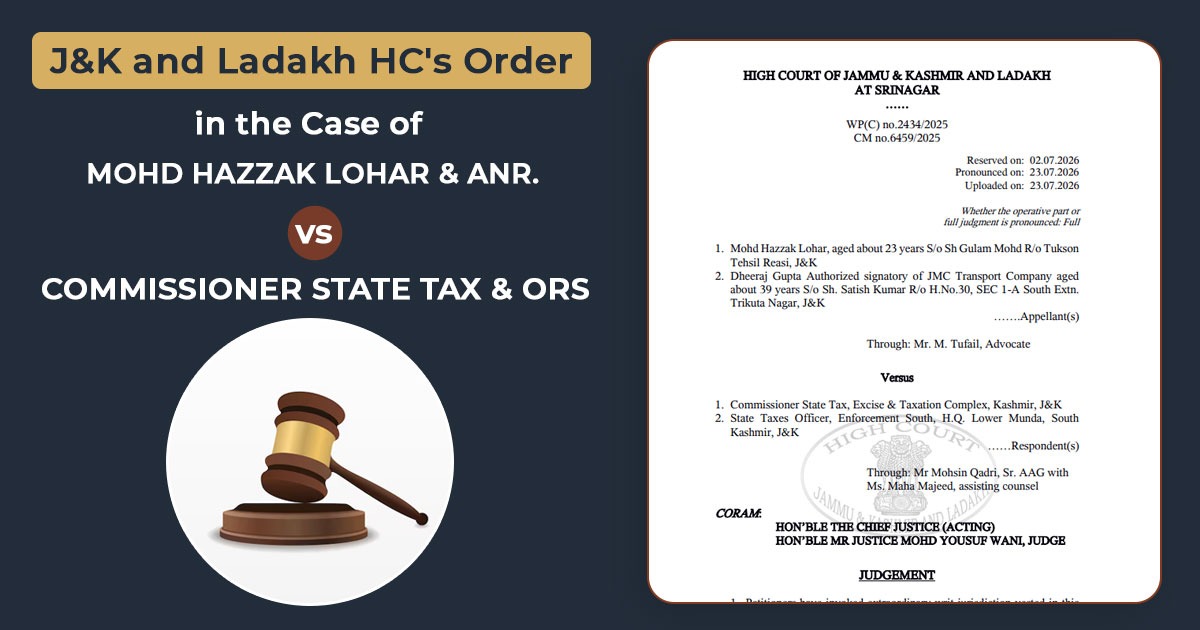
The Jammu & Kashmir and Ladakh High Court has stated that the 7-day timeline specified under Section 129(3) of the Jammu & Kashmir Goods and Services Tax Act, 2017, for issuing a penalty order is mandatory. The court emphasised that any penalty order issued even one day after this regulatory period cannot be upheld.
A Division Bench of Acting Chief Justice Sanjeev Kumar and Justice Mohd Yousuf Wani said that where the legislature has utilised the word shall while specifying timelines for the practice of authority, the requirement should be complied with. It mentioned that financial law needs to be construed.
The Court said that, “From the plain reading of Subsection (3) of Section 129 of the Act of 2017, it is abundantly clear that the legislature by using the expression “shall” in respect of show cause notice as well as notice for payment of penalty has signified its intent that adherence to timeline is mandatory. Otherwise also, the Act of 2017 is a fiscal statute and, therefore, required to be construed strictly. Indeed, Subsection (3) of Section 129 of the Act of 2017 does not provide for the consequence of non-adherence to the timelines, but that alone cannot be a determining factor to come to a conclusion that the seven-day period stipulated in Subsection (3) of Section 129 is not mandatory in nature.”
The petitioners approached the high court after state tax authorities intercepted their vehicle carrying goods and initiated penalty proceedings. An SCN u/s 129(3) was provided on September 14, 2025.
The law requires the proper officer to pass the penalty order within 7 days of service of the notice. Although the order was passed on September 22, 2025, one day after the prescribed period.
Read Also: Allahabad HC: No Penalty U/S 129(3) When There is Clear Evidence of Intentional GST Evasion
The State, while representing the tax authorities, said that the delay occurred after the applicants requested a revaluation of the seized goods. It stated that the Jammu & Kashmir Pollution Control Board declared some of the seized goods to be restricted plastic carry bags. As per the State, such developments delayed the proceedings.
The court was not persuaded. It said that the intervening situation did not excuse non-compliance with the obligatory timelines u/s 129(3). It mentioned that the provision authorises detention and seizure of goods, which are coercive measures. Consequently, the regulatory process should be complied with.
Important: How GST Software Helps Avoid Section-Wise Tax Penalties
The bench said that the timelines u/s 129(3) were rolled out to avert arbitrary detention, prolonged seizure, and harassment of traders. It stated that the lack of an explicit consequence for non-compliance did not render the requirement as merely directory.
The Court permitted the writ petition and set aside the penalty order dated September 22, 2025. It stated that the order had been issued after the regulatory period. The Court said that if there are any proceedings allowable under other provisions of the GST Act, it could still be pursued by the tax authorities.
| Case Title | Mohd Hazzak Lohar & Anr. vs. Commissioner State Tax & Ors |
| Case No. | WP(C) No. 2434/2025 |
| For Petitioner | Advocate M. Tufail |
| For Respondent | Senior Additional Advocate General Mohsin Qadri assisted by Advocate Maha Majeed |
| Jammu & Kashmir and Ladakh High Court | Read Order |