

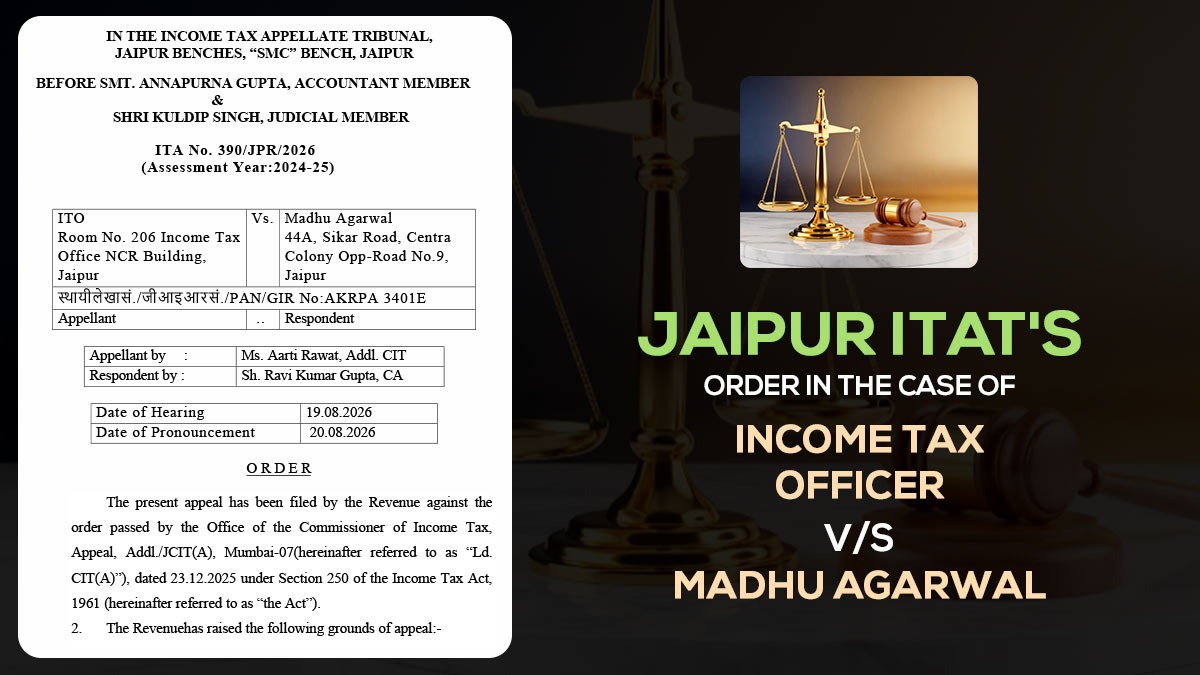
The Jaipur Bench of the Income Tax Appellate Tribunal (ITAT) ruled in favour of an assessee, allowing the Section 87A tax rebate against tax liability arising from Short-Term Capital Gains (STCG) under Section 111A.
For Assessment Year (AY) 2024-25, the Tribunal held that the statutory provisions contained no explicit bar or restriction prohibiting taxpayers from adjusting the rebate against special-rate capital gains tax under Section 111A.
The ruling has arrived in the case of Income Tax Officer v. Madhu Agarwal, ITA No. 390/JPR/2026. On 20 August 2026, the order was pronounced by the Jaipur Bench, including Accountant Member Annapurna Gupta and Judicial Member Kuldip Singh.
Reason for denying the taxpayer’s 87A rebate
A dispute arose when the Centralised Processing Centre (CPC) processed Agarwal’s ITR u/s 143(1) and refused her claim for the Section 87A rebate on tax payable for her Short-Term Capital Gains (STCG). Agarwal had claimed a rebate of ₹23,276.
For the Assessment Year 2024-25, her total income was ₹4,99,250, which included STCG of ₹3,61,100 and long-term capital gains of ₹44,082. She was assessed under the new tax regime outlined in Section 115BAC(1A). Since her total income was below ₹7 lakh, she qualified for the Section 87A rebate.
The Commissioner of Income Tax (Appeals) permitted the claim, holding that Section 87A, as applicable for AY 2024-25, did not clearly exclude tax payable on STCG u/s 111A. Thereafter, the Revenue had contested the decision before the ITAT.
ITAT specifies the law did not exclude STCG from the 87A rebate
The Tribunal observed that several ITAT benches had consistently concluded that Section 87A applies to the total tax liability calculated on total income.
This applies without making a distinction between income taxed at normal rates and income taxed at special rates, including Short-Term Capital Gains (STCG) u/s 111A.
The Tribunal outlined that the law specifies restrictions for LTCG u/s 112A, but no pertinent exclusion for STCG u/s 111A was there. The absence is regarded as legally important.
The restriction introduced later was prospective. The Finance Bill 2025 proposed new restrictions on Section 87A, effective from Assessment Year (AY) 2026-27. Thus, the Tribunal concluded that the subsequent amendment supported the view that the restriction did not apply to AY 2024-25.
Additionally, the Tribunal stated that an automated refusal via the CPC could not overrule statutory provisions. For AY 2024-25, there was no explicit prohibition in Section 87A or Section 111A averting a resident individual with a total income below ₹7 lakh from claiming the rebate on tax payable for STCG.
Hence, ITAT kept the order of CIT(A) and dismissed the appeal of the revenue.
Read Also: Top Income Tax Sections You Must Know in the New Law
The ruling is particular to the law applicable for AY 2024-25. It does not signify that the same treatment automatically applies to later assessment years, where the regulatory norms controlling the section 87A rebate have been revised.
| Case Title | Income Tax Officer vs. Madhu Agarwal |
| Case No. | ITA No. 390/JPR/2026 |
| Appellant by | Ms. Aarti Rawat |
| Respondent by | Sh. Ravi Kumar Gupta |
| Jaipur ITAT | Read Order |