

The implementation of the Invoice Management System (IMS) under the Goods and Services Tax (GST) framework has enhanced the accuracy and control associated with input tax credit (ITC) reporting. This system enables recipients to review invoices uploaded by suppliers and accept, reject, or place them on hold.
While this improvement improves compliance, it also introduces a challenge for taxpayers, particularly in managing records rejected by the IMS in GSTR-3B.
In this context, GST software becomes essential, as it automates necessary adjustments, reduces the likelihood of errors, and facilitates smooth reconciliation processes.
Understanding the Role of GST Software in Managing IMS-Rejected Records
This article delves into how GST software effectively manages IMS-rejected records during the filing of R-3B and highlights the importance of automation in contemporary GST compliance.
What Are IMS Rejected Records?
IMS rejected records refer to invoices or debit/credit notes that a recipient has explicitly rejected on the GST portal due to various discrepancies, including:
- Incorrect GSTIN (Goods and Services Tax Identification Number) of the recipient
- Mismatches in invoice numbers or dates
- Incorrect taxable values or tax amounts
- Duplicate or ineligible invoices
When an invoice is rejected via IMS, the Input Tax Credit (ITC) associated with that record becomes ineligible for claim in GSTR-3B. Taxpayers who inadvertently include such ITC run the risk of excessive credit claims, which could lead to scrutiny from authorities, as well as potential penalties or interest liabilities.
Impact of IMS Rejections on GSTR-3B
GSTR-3B serves as a summary return where ITC claims are based on eligible inward supplies. IMS rejections directly influence:
- Table 4(A): Eligible ITC
- Table 4(B): Ineligible or reversed ITC
If rejected invoices are not properly adjusted, it may result in discrepancies between ITC figures in GSTR-3B and the data generated by the system, heightening the likelihood of audits by tax authorities. The manual identification and reversal of these rejected records can be tedious and prone to errors, especially for businesses handling a high volume of invoices. This is where GST software proves invaluable.
How GST Software Identifies IMS Rejected Records
Modern GST software integrates seamlessly with data sourced from the GST portal managed by the Goods and Services Tax Network. Upon importing IMS data, the software:
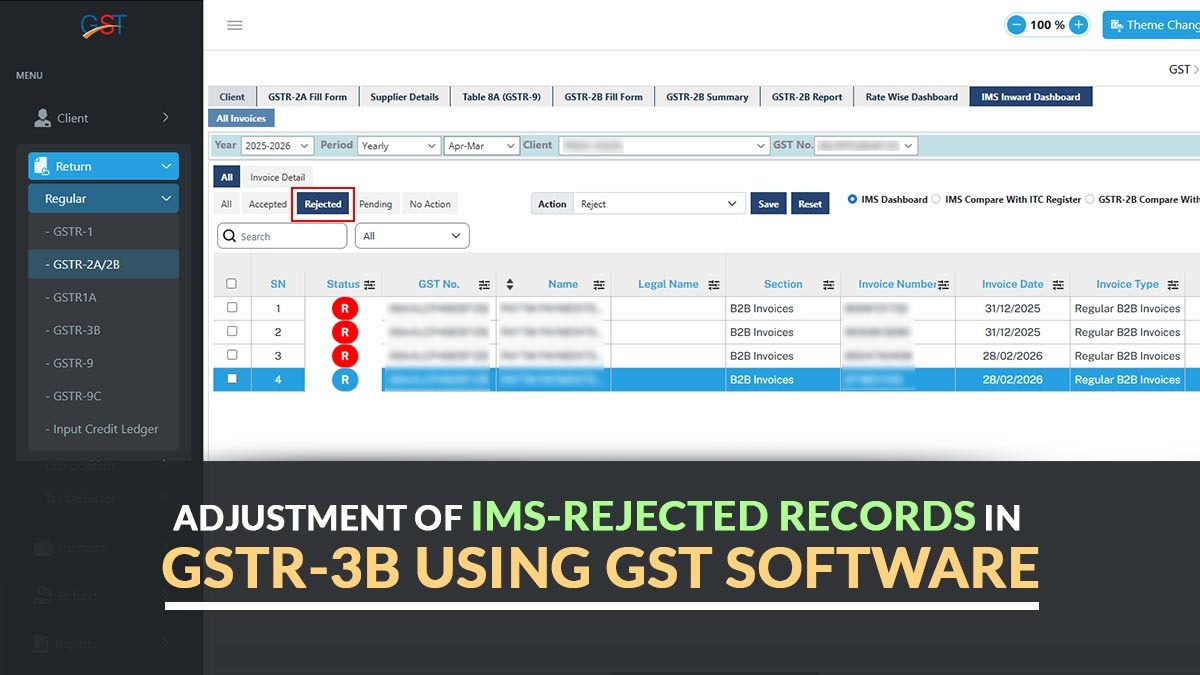
- Segregates accepted, rejected, and pending invoices
- Highlights rejected records in user-friendly dashboards or reconciliation reports
- Connects rejected invoices with their corresponding ITC amounts
This real-time identification ensures that rejected records are not inadvertently counted in eligible ITC calculations.
Automatic ITC Adjustment in R-3B
One significant advantage of GST software is its capability to automatically adjust ITC based on the status of IMS records. This process involves:
- Exclusion from Eligible ITC: Automatically removing rejected invoices from Table 4(A) of GSTR-3B, ensuring that only valid ITC is claimed. Reversal of Previously Claimed ITC: If ITC on a rejected invoice was claimed earlier, the software recognises this and moves the amount to Table 4(B), indicating a reversal or ineligibility.
- Period-Wise Adjustment: GST software accurately maps rejected records to the appropriate tax period, preventing incorrect adjustments in current returns.
This automated mechanism significantly minimises the risk of over-claiming ITC.
Supplier Communication and Correction Tracking
Another essential feature of GST software is its support for communication with suppliers. When an invoice is rejected:
- The software generates supplier-wise rejection reports.
- Taxpayers can convey discrepancies to suppliers for necessary corrections.
- The system automatically tracks corrected invoices uploaded by suppliers in subsequent periods.
Once the corrected invoice is accepted in IMS, the software ensures ITC eligibility in the relevant GSTR-3B period.
Reconciliation with GSTR-2B and Internal Records
IMS data operates cohesively with other records. GST software facilitates multi-level reconciliation by matching:
- IMS status (whether accepted or rejected)
- GSTR-2B auto-generated ITC
- Purchase registers or accounting records
This comprehensive reconciliation guarantees that rejected records are consistently excluded across all GST returns and internal documentation, thereby maintaining accurate audit trails.
Audit Readiness and Compliance Accuracy
Improper handling of IMS rejected records could trigger GST notices linked to excessive ITC claims. GST software mitigates this risk by:
- Keeping detailed logs of rejected and reversed ITC
- Generating audit-ready reports for tax authorities
- Providing justifications for ITC reversals during audits
Read Also: How GST Software Resolves GSTR-3B & 2A/2B ITC Mismatches
By aligning R-3B figures with IMS and GSTR-2B data, the software aids taxpayers in adhering to ever-evolving GST regulations.
The Limitations of Manual Handling
Given the frequent changes in GST compliance rules and the rising volume of invoices, manually adjusting IMS rejected records has become impractical. Common issues with manual processes include:
- Overlooking reversals of rejected ITC
- Incorrect reporting in R-3B tables
- Insufficient documentation for audits
GST software effectively addresses these challenges through rule-based automation and robust validation checks.
Conclusion: The introduction of IMS has enhanced GST compliance by empowering recipients to maintain invoice-level accuracy. However, it has simultaneously complicated the management of ITC in GSTR-3B. GST software serves as a crucial tool, automatically identifying, adjusting, and reporting IMS-rejected records, thereby ensuring that only eligible ITC is claimed.
By facilitating reversals, enabling precise reconciliations, and assisting with supplier corrections, GST software simplifies the R-3B filing process while protecting businesses from compliance risks. In the current GST landscape, utilising reliable GST software is essential for achieving accurate, hassle-free tax compliance.