

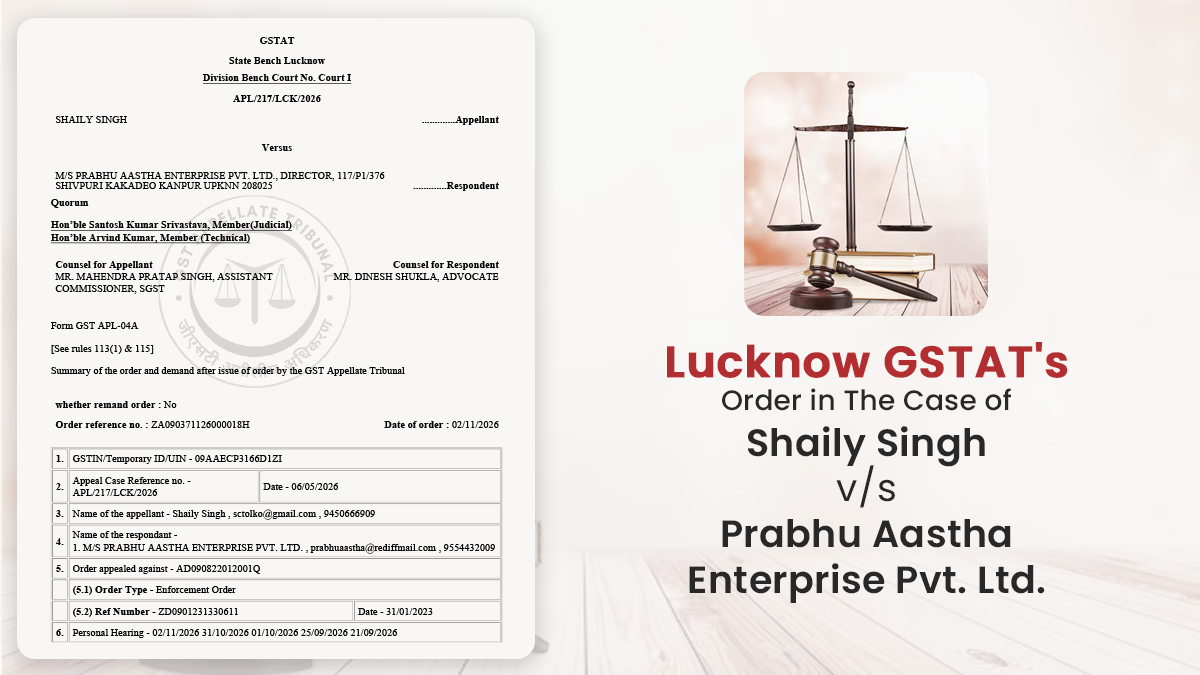
The Lucknow Bench of the Goods and Services Tax Appellate Tribunal (GSTAT) stated on November 2 that the exemption provided under Rule 138(3) of the Central Goods and Services Tax (CGST) Rules, 2017, which allows for the transportation of goods over short distances without requiring ‘Part-B’ (vehicle details) in an GST e-way bill, cannot be nullified by a warning generated by an automated portal.
A Bench comprising Judicial Member Santosh Kumar Srivastava and Technical Member Arvind Kumar dismissed the appeal of the revenue and upheld the order setting aside a penalty of Rs. 2,55,792 levied on Prabhu Aastha Enterprise Pvt. Ltd. The Tribunal held:
“An automated system stamp on a portal cannot override explicit, codified rules enacted by the legislature. Under Explanation 2 to Rule 138(3), the E-Way bill remains valid without Part-B details if the trip fits within the scope of the Third Proviso.”
The dispute arose on May 7, 2022, when a mobile squad intercepted a vehicle transporting pan masala and zarda tobacco from ‘Prabhu Astha Enterprise’ in Kanpur to ‘Mohit Agency’ in Gorakhpur.
The department imposed a penalty u/s 129(3) of the CGST Act, 2017, alleging that the vehicle details had not been provided in ‘Part-B’ of the e-way bill.
The taxpayer stated that the vehicle had transported the goods from their premises to the depot of a local transporter in Kanpur, located approximately five kilometres away from where the goods were to be forwarded to Gorakhpur.
It was argued that the initial movement of goods falls within the scope of the third proviso to Rule 138(3). This proviso provides an exemption under specific circumstances from the requirement to furnish ‘Part-B’ details when transporting goods within a radius of 50 kilometres within the same state.
The Tribunal observed that the goods matched the tax invoices and no discrepancy was revealed under physical verification in their description, quantity, or value.
It was also noted that the transaction was based on a previously generated e-invoice, and no discrepancies were found in the physical verification report.
Rejecting the Revenue Department’s argument that a vehicle deviating from its designated route indicates an intent to evade tax, the bench found no concrete evidence of tax evasion.
Neither the physical verification nor the documentary records substantiated any intent to commit fraud. It further stated:
“A mere deviation in the physical transit path cannot be mechanically equated with a fraudulent intention to evade tax or divert cargo under Section 129(3). The burden of proof rests strictly upon the Revenue to produce concrete, corroborative evidence showing that the alternative route was part of a clandestine, off-the-books operation.”
Read Also: GSTAT: GST Portal Technical Errors Cannot Prejudice Taxpayer’s Statutory Right of Appeal
Therefore, the GSTAT dismissed the appeal of the revenue and upheld the order setting aside the penalty u/s 129(3) of the CGST Act, 2017.
| Applicant Name | Shaily Singh vs. Prabhu Aastha Enterprise Pvt. Ltd. |
| GSTIN | 09AAECP3166D1ZI |
| Counsel for Appellant | MR. Mahendra Pratap Sing |
| Counsel for Respondent | MR. Dinesh Shukla |
| Lucknow GSTAT | Read Order |