

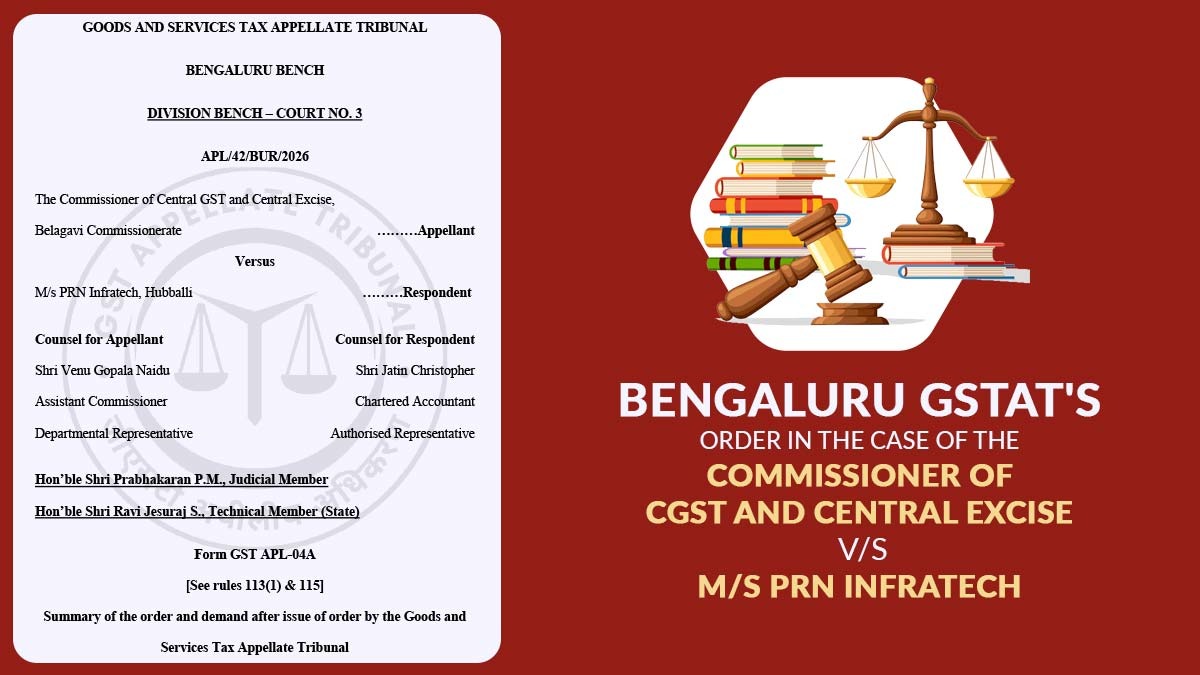
The Bengaluru-based Goods and Services Tax Appellate Tribunal (GSTAT) has stated that a works contractor deliberately excluded royalty deductions from their GST returns in order to evade tax payable under the ‘reverse charge mechanism’.
Observing that the contractor was aware of the tax liability but failed to disclose the transaction, the Tribunal held that the extended limitation period u/s 74 of the CGST Act applies.
A bench comprising Judicial Member Prabhakaran P.M. and Technical Member (State) Ravi Jesuraj S. allowed the Revenue Department’s appeal, upholding a tax demand of ₹1,00,20,488, along with applicable interest and a penalty of an equivalent amount.
This case pertains to ‘PRN Infratech’, a firm based in Hubli that executes works contracts for government departments. Between July 2017 and October 2019, these departments deducted a total of ₹8.86 crore from the firm’s bills as royalty on minor minerals.
While the firm recorded these deductions in its books of account, it failed to disclose these amounts in its GSTR-3B returns for the period from July 2017 to September 2019.
Following the initiation of an investigation by the department in September 2019, the firm paid ₹46.37 lakh as GST on royalties for the period from April to October 2019. It did not pay any interest, nor did it pay the tax due for the preceding period.
The firm’s General Manager (Accounts), who was responsible for GST returns and payments, admitted in a statement that the licensing services provided for the right to use minerals fall under the ambit of the ‘reverse charge’ mechanism.
He objected to the firm being classified as the ‘recipient,’ arguing that it did not hold any mining license. The Tribunal noted that this statement was neither retracted nor contested.
The firm claimed that these deductions were shown in government invoices and the company’s books of accounts, and maintained that the responsibility for this lay with the mining leaseholders. It further argued that the case was ‘revenue-neutral,’ as it could have otherwise claimed an input tax credit.
The tribunal did not accept these claims and stated that disclosure to the works departments did not lead to disclosure to the proper GST officer. It was also noted that Section 17(5)(i), which was in force at the time, prohibited claiming an input tax credit on taxes paid u/s 74.
The tribunal said that, “Each circumstance, taken alone, may not be enough. Taken together, they lead to one reasonable conclusion: the Respondent kept the royalty out of its returns so that the tax on it would not be paid. That is suppression of facts to evade tax. The Revenue has discharged the burden that lay on it.”
The Tribunal quashed the decision of the Appellate Authority, which had applied Section 73 instead of Section 74. The Tribunal upheld a tax demand of ₹1,00,20,488 under Section 74, directed the payment of interest under Section 50, and imposed a penalty of an equivalent amount under Section 74(9) read with Section 74(1). An amount of ₹46.37 lakh, already paid, was adjusted against this tax demand.
| Case Title | The Commissioner of CGST and Central Excise vs. M/s PRN Infratech |
| Case No. | APL/42/BUR/2026 |
| For Appellant | Shri Venu Gopala Naidu |
| For Respondent | Shri Jatin Christopher |
| GSTAT Bengaluru | Read Order |