

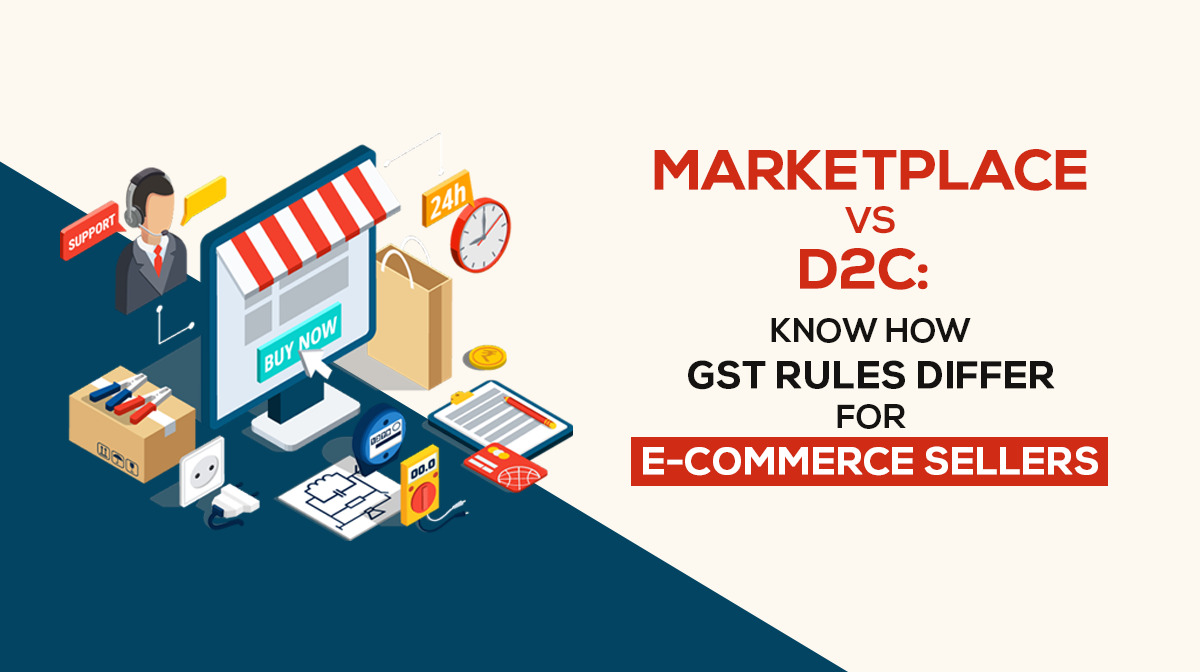
Online selling is not simple, but GST for e-commerce sellers can be confusing when choosing between an online marketplace and your own website. The rules vary for each business model.
Marketplace sellers should follow registration requirements and Tax Collected at Source (TCS). Direct-to-Consumer (D2C) sellers follow the standard GST registration thresholds unless they are otherwise required to register.
Difference Between Marketplace Selling and D2C Selling
Operations of two dominant selling structures in Indian e-commerce:
- Marketplace selling signifies that you list your products on a third-party platform, such as Amazon, Flipkart, Meesho, Myntra, and Snapdeal, and the platform eases the transaction between you and the buyer. You remain the seller of record, and the platform handles payments, logistics support, and tax deductions on your end.
- D2C means that you sell to customers via your own website, app, or social commerce channels like Instagram, WhatsApp, or Facebook. There is no involvement of an intermediary e-commerce operator. You regulate the customer experience and payment flow.
Do Marketplace and D2C Sellers Follow Similar GST Registration Rules?
GST registration under section 24 of the CGST Act is mandatory for most sellers on an e-commerce platform irrespective of turnover.
As of October 1, 2023, small goods sellers engaged in intra-state sales through an e-commerce operator and whose total annual turnover is below the threshold limit (₹40 lakhs for goods and ₹20 lakhs for special category states) are exempt from mandatory registration under Notification No. 34/2023-Central Tax. These sellers can operate using an enrolment number on the GST portal instead of needing full registration.
For D2C sellers, standard threshold rules apply. If your annual turnover from your own website is less than Rs 40 lakhs for goods or Rs 20 lakhs for services, you are not legally required to enrol for GST. However, once you exceed that threshold or engage in interstate sales, registration becomes mandatory.
If under the same GST Identification Number (GSTIN), you operate a marketplace storefront and a D2C website, your combined turnover will determine your compliance obligations. Many sellers who begin D2C also choose to register voluntarily to claim Input Tax Credit (ITC) on their business purchases, which can often outweigh the effort involved in compliance.
How TCS Rules Apply to E-Commerce Businesses
TCS distinguishes marketplace and D2C compliance fundamentally.
For Marketplace Sellers
Every e-commerce operator u/s 52 of the CGST Act is mandated to collect TCS at 0.5% of the net taxable value of sales made through their platform.
This is split as 0.25% CGST + 0.25% SGST for intra-state sales, or 0.5% IGST for inter-state transactions.
In practice, this means that if you sell goods worth ₹1,00,000 in a month through Amazon, the company will deduct ₹500 as TCS before sending you the payment. Amazon will then deposit this amount with the government under your GSTIN via GSTR-8. You can claim this amount as credit in your GSTR-3B, which will reduce your overall GST liability.
It affects your working capital temporarily. Your funds are deducted in advance and can only be reclaimed by offsetting them against your future tax liabilities when filing returns.
For D2C Sellers
No TCS is applicable. Because there is no e-commerce intermediary involved in the transaction chain, you must collect total payments from customers and personally remit the GST to the government.
GST E-invoicing Requirements for E-commerce Businesses
- E-invoicing (electronic invoice generation through the Invoice Registration Portal or IRP) is mandatory for GST-registered businesses whose aggregate annual turnover is more than Rs 5 crore in any financial year from 2017-18 onwards, unless particularly exempted.
- Businesses with an aggregate annual turnover surpassing Rs 500 crore are required to issue B2C invoices with a Dynamic QR Code in accordance with GST rules. This requirement is dissimilar from the e-invoicing framework.
- In this system, every applicable B2B, export, and deemed export invoice should be declared to the IRP and receive a unique Invoice Reference Number (IRN). The authenticated invoice data is automatically populated into GSTR-1, which reduces manual data entry and reconciliation errors.
Specifically-
- Concerning D2C sellers, e-invoicing applies only to their applicable B2B, export, and deemed export transactions. At present, regular B2C invoices are outside the ambit of the e-invoicing mandate.
- Sellers from the marketplace having more than Rs 5 crore threshold should generate e-invoices for their own applicable B2B, export, and deemed export supplies, including direct business sales made outside the marketplace. The customer invoice from the marketplace does not eliminate the seller’s obligation to issue an e-invoice when required.
GST Input Tax Credit (ITC) Rules for E-Commerce Sellers
An e-commerce seller must know about the following conditions-
- Input Tax Credit (ITC) is available only when you possess a valid tax invoice or debit note, have received the corresponding goods or services, and the invoice details have been reported in the GST returns by the supplier, in accordance with the conditions set out u/s 16 of the CGST Act.
- The ITC should be reflected in your GSTR-2B. Sellers are advised to regularly reconcile their GSTR-2B with their purchase records to identify any discrepancies and prevent disputes.
- If the goods or services are utilised in the course or furtherance of business, you can claim ITC. Purchases made for personal use are ineligible.
- The payment to the supplier should be made within 180 days from the invoice date; if not followed, then the claimed ITC should be reversed along with applicable interest. The credit can be reclaimed after making the payment.
- ITC for an invoice or debit note should be asserted by 30 November after the end of the corresponding fiscal year or before filing the annual return for that year, whichever is earlier.
- E-commerce sellers can seek ITC on eligible business expenses such as inventory purchases, packaging materials, office supplies, warehousing charges, courier and logistics services, software subscriptions, advertising and professional services, given that GST has been charged and the expenses are utilised for business.
- ITC cannot be asserted on blocked credit mentioned u/s 17(5), including goods or services utilised for personal consumption and some other restricted items like club memberships, employee recreational expenses and specified motor vehicles, except where statutory exceptions apply.
- You should initially pay the tax in cash if you want to pay GST under the Reverse Charge Mechanism (RCM). After fulfilling the applicable conditions, you can claim ITC on that tax.
How Does GST Place of Supply Apply to E-Commerce Businesses?
Regardless of your selling model, it is essential to accurately determine the ‘place of supply’ in order to apply the correct tax.
- Intra-state sales (seller and buyer in the same state): CGST + SGST applies
- Inter-state sales (seller and buyer in different states): IGST applies
For marketplace sellers, the platform usually records buyer delivery addresses and takes care of this determination in its settlement reports. However, you remain responsible for reporting it accurately in GSTR-1.
For D2C sellers, this determination is done manually. Your payment gateway or order management system should fetch the delivery state for each order so you can accurately categorise and report intra-state versus inter-state sales. Social commerce sellers on platforms like Instagram, WhatsApp, or Facebook must adhere to the same D2C rules.
Applicable GST Rules for Quick Commerce & Dark Store Operators?
The growth of delivery platforms offering 10-30 minute service has resulted in specific Goods and Services Tax (GST) obligations. If you operate or provide services through quick commerce channels, keep the following points in mind:
- Cloud kitchens and dark stores are required to obtain separate GST registrations in each state where they operate.
- In certain cases, commissions and platform fees paid to quick commerce operators may fall under the Reverse Charge Mechanism (RCM).
- Delivery charges are subject to GST, regardless of whether the customer or the platform pays for them.
GST 2.0: Key Changes in GST for E-Commerce Sellers
The most significant reform since the launch of the Goods and Services Tax (GST) in 2017 took effect on September 22, 2025, with the implementation of GST 2.0, which was approved at the 56th GST Council meeting.
The previous four-tier tax rate system of 5%, 12%, 18%, and 28% has been replaced by a simplified structure consisting of two main tax slabs and a special demerit rate.
- 18%: Standard goods and services (most items that were earlier taxed at 12% or 18% now fall under this slab)
- 5%: Essentials, food items, medicines, and mass-consumption goods
- 40%: Luxury and sin goods (a special demerit rate for select items including tobacco, pan masala, aerated drinks, high-end automobiles and yachts)
For the sellers of e-commerce, the below-mentioned are the key revisions-
- FMCG products now attract 5%
- Bakery items reduced from 18% to 5%
- White goods such as air conditioners, televisions and dishwashers reduced from 28% to 18%
- Handicrafts, sculptures and toys reduced from 12% to 5%
- All medicines and drugs now attract a concessional GST rate of 5%
- Manmade fibre reduced from 18% to 5%, while manmade yarn reduced from 12% to 5%
Also Read: GST Impact on E-commerce Sector in India
For e-commerce sellers, these changes require updating the HSN code-to-rate mappings in their ERP systems, invoicing software, and marketplace product listings.
Closure: With the expansion of your e-commerce business, staying compliant becomes easier with the integration of accounting, inventory, and GST procedures.
Manual effort can be reduced via regular review of product classifications, automating routine compliance tasks where possible, and maintaining proper financial records.