

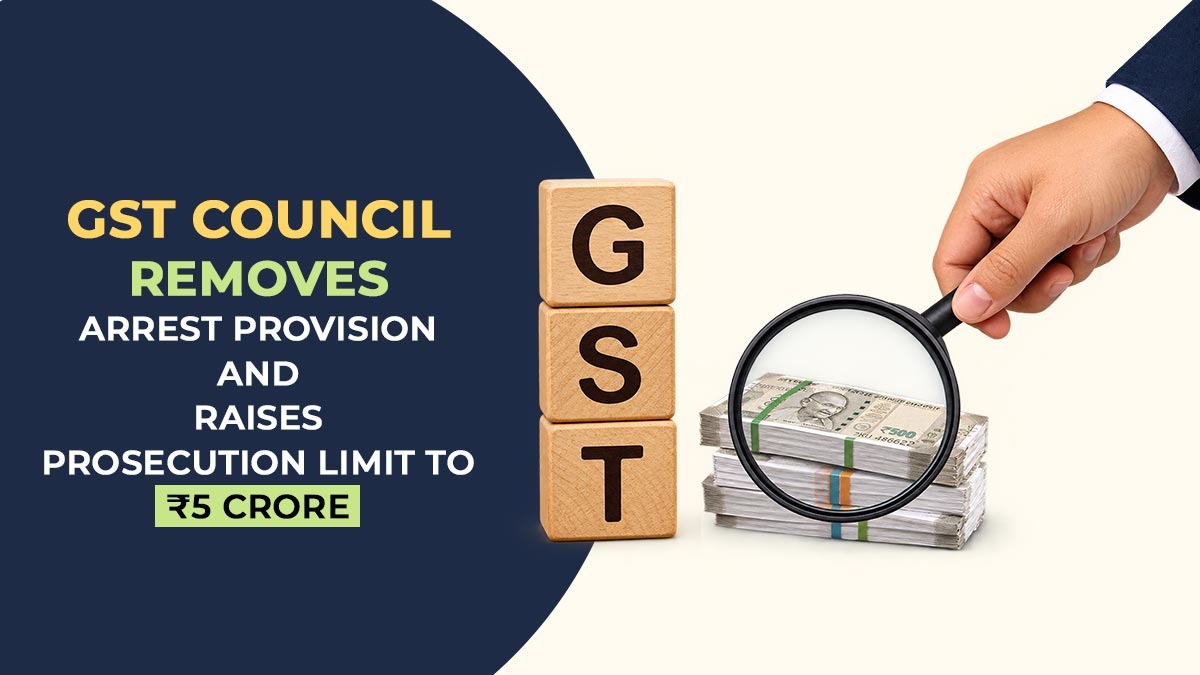
The GST Council has taken measures to eliminate the arrest authority under the Goods and Services Tax regime and decided to raise the limit for prosecution fivefold to Rs 5 crore in a major overhaul of GST enforcement and compliance rules.
In the 57th GST Council meeting, the amendment was approved; the threshold for prosecution will surge to Rs 5 crore from Rs 1 crore. The minimum punishment will also be eliminated, with the decision on whether to charge a fine, imprisonment, or both left to judicial discretion.
The Council has also reduced the general penalty from ₹25,000 to ₹10,000; this penalty applies when no specific penalty has been prescribed for a violation.
This move marks a substantial shift in the implementation of GST. The government states that with improved data matching and analytics at the invoice level, enforcement agencies can now focus more on detecting irregularities rather than instilling fear.
Read Also: GST Council Constitution, Functions and Decision-making
The issue of double taxation on services bought and resold in the identical business line has been addressed by the council separately.
Under this reform, such services will be taxed once instead of twice. This covers common services such as hotel stays booked through agents (up to ₹7,500 per night), restaurant and catering services, and passenger transportation.
The Council stated that credit was not previously granted because these services were taxed at 5% without input tax credit (ITC). In this new structure, the tax chain will now stay intact throughout the transaction.
Read the Press Release of the 57th GST Council Meeting