

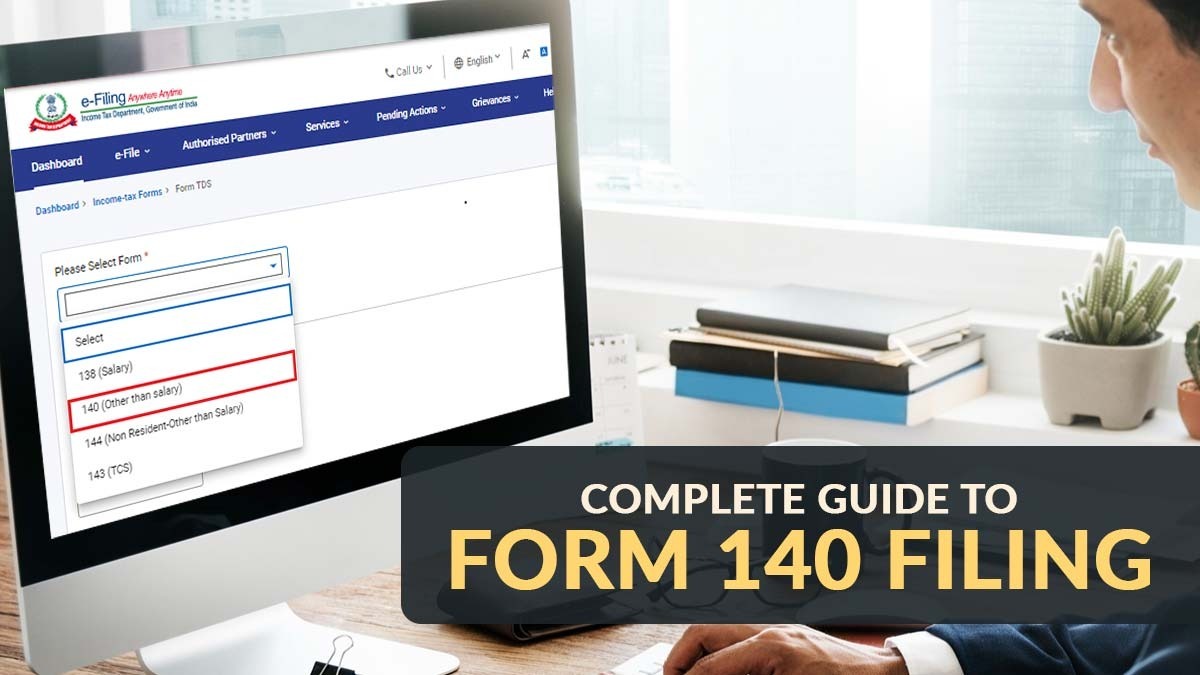
Form 140 filing is specified as a quarterly TDS compliance provision for those who deduct tax from certain non-salary payments made to resident deductees. Form No. 140 substitutes Form No. 26Q under the Income Tax Rules, 2026 and applies to quarterly TDS statements under the Income Tax Act, 2025 framework for Tax Year 2026-27 onwards.
It contains information regarding TDS deducted from payments such as interest, commissions, brokerage, rent, professional fees, contractual payments, and other specified categories. Filing accurately and on time helps those who deduct TDS submit correct reports, while ensuring that the individuals from whose payments the TDS was deducted receive the corresponding tax credit.
Understanding Form 140
Form No. 140 is a quarterly statement of Tax Deducted at Source (TDS) concerning payments other than salary made to resident recipients (deductees). It is filed u/s 397(3)(b) of the Income Tax Act, 2025, and Rule 219(1) of the Income Tax Rules, 2026 [Table: Serial Number 3].
This form contains information regarding the deductor (the person responsible for deducting tax), the tax deposited with the Central Government, and a breakdown of payments and TDS on a deductee-wise basis (i.e., categorized by the individuals from whose payments the tax was deducted). Consequently, filing Form 140 is a crucial component of quarterly TDS compliance for businesses and other deductors.
Under the previous law, Form 26Q was filed in accordance with Section 200(3) of the Income-tax Act, 1961, and Rule 31A of the Income-tax Rules, 1962. While the purpose of reporting remains largely the same, the form number, legal references, and terminology have changed.
| Particulars | Corresponding Earlier Provision | Under New Provision |
| TDS return form | Form 26Q | Form 140 |
| Applicable Payments | Resident non-salary payments | Resident non-salary payments |
| Governing Act | Income Tax Act, 1961 | Income Tax Act, 2025 |
| Governing Section | Section 200(3) | Section 397(3)(b) |
| Governing Rule | Rule 31A | Rule 219(1), Table Sl. No. 3 |
| Filing Period Terminology | Financial Year/Assessment Year | Tax Year |
| Correction Reference | Token/acknowledgement number | Return Receipt Number |
Who is Required to File Form 140?
A person responsible for deducting TDS on non-salary payments made to a resident may be required to file Form No. 140. It includes-
- Companies and limited liability partnerships
- Partnership firms
- Government departments
- Trusts and institutions
- Individuals and Hindu Undivided Families where TDS provisions apply
- Other persons making specified payments to residents
Form No. 140 is not used for TDS on salary. It may cover payments such as interest, commission, brokerage, rent, payments to contractors, professional or technical fees, directors’ remuneration, dividends, and other payments that fall within the scope of applicable TDS provisions.
The liability relies on the payment, threshold, and status of the parties. Transactions particularly reportable via Form 141 are not included in Form 140.
Due Dates for Filing Form 140
Form 140 should be submitted for every applicable quarter. (Form 140 due date for Tax Year 2026–27)
| Quarter | Period | Due Date |
| 1st Quarter | April to June 2026 | 31st July 2026 |
| 2nd Quarter | July to September 2026 | 31st October 2026 |
| 3rd Quarter | October to December 2026 | 31st January 2027 |
| 4th Quarter | January to March 2027 | 31st May 2027 |
Deductors are required to check whether the income tax department has given an extension for a specific quarter. A late fee of ₹200 per day may be imposed under Section 427 for delays in filing returns, subject to a cap equal to the amount of tax to be deducted or collected.
Additionally, a separate penalty may be levied under the applicable provisions of the Income Tax Act, 2025, subject to the conditions and exemptions specified under that section. Furthermore, any delay in the deduction or deposit of TDS will attract separate interest charges.
Form 140 Structure and Format
Form No. 140 contains Part A, Part B, and a deductee-wise annexure.
Part A: Deductor information
Part A records basic details about the deductor, which are:
- Type of deductor
- Name and address
- PAN and TAN
- Email address and contact number
- Applicable Tax Year
It also includes details of the person accountable for deducting tax. In the case of a correction statement, the Return Receipt Number (RRR) of the original statement may be needed.
Part B: Details of Tax Deducted and Deposited
Part B includes the information on the tax deducted and paid to the Central Government. Such information may include:
- Total tax deposited
- Interest and fee paid
- Mode of payment
- BSR code
- Date of deposit
- Challan serial number
- Minor head
- Book adjustment details, where applicable
It is crucial that the challan details match the amounts declared in the deductee records. A mismatch can cause processing default or rejection.
Annexure: Deductee-Wise All Details
The annexure has transaction-level details for each deductee, including:
- PAN and name of the deductee
- Applicable section code
- Amount paid or credited
- Date of payment or credit
- Date of TDS deduction
- Applicable TDS rate
- Tax deducted and deposited
- Reason for nil, lower or higher deduction
Where applicable, the deductor may also be required to furnish a certificate number or a UIN (Unique Identification Number) from Form 121, as per Section 395. In this form, a single annexure is used for reporting at the deductee level under the relevant sections.
Also Read: All About TDS Return Forms 138, 140, 143, and 144 with Due Dates
Documents Needed to File Form 140
The deductor must maintain the following documents and details-
- Valid TAN and PAN of the deductor
- PAN and name of every deductee
- Copies of TDS payment challans
- BSR code and challan serial number
- Date of payment or credit
- Date of TDS deduction and deposit
- Nature and amount of each payment
- Applicable TDS section code and rate
- Lower or nil deduction certificate details
- Interest, fee, or default payment details
- Return Receipt Number (RRR) for a correction statement
The TAN of the deductor should be registered on the income tax e-filing portal. A registered Digital Signature Certificate is needed when DSC is chosen as the validation method. The latest RPU and a valid FVU file are mandatory for online submission.
Form 140 Filing Procedure
1. Deduct and Deposit TDS: Deduct tax on time in accordance with the applicable TDS provisions. Deposit the deducted amount with the Central Government within the time limit stipulated under Rule 218 of the Income Tax Rules, 2026.
2. Download the Latest RPU Utility: Proceed to the Protean portal and download the latest return preparation utility for the quarterly TDS statements. An outdated utility can cause validation or upload errors.
3. TDS Statement Preparation Process: Enter the deductor, challan, and deductee information in the RPU. Check the PAN, section code, payment amount, deduction date, TDS rate, and tax deposited for every transaction.
4. Check the Statement: Verify the prepared statement via the File Validation Utility. After successful validation, generate the FVU file and place it in the specified ZIP format for uploading.
5. Upload Form No. 140: Log in to the income tax e-Filing portal via the deductor’s TAN.
e-File – Income Tax Forms – File Income Tax Forms – Forms as per Income Tax Act, 2025 – Deduction and Collection at Source (Form TDS/TCS) – File Now
Choose the category for deduction and collection at source. Opt for Form No. 140, the applicable Tax Year, quarter, and upload type, such as regular or correction.
Upload the ZIP file that includes the validated FVU file. The FVU version should match the version shown on the e-Filing portal.
6. Verify Details and Submit: Choose the applicable verification method and complete e-verification. The submitted statement can be accessed under the section “View Filed Forms”.
On successful validation, the statement is accepted and sent to TRACES for further processing. If it is not accepted, then the portal shows the reason for rejection. The deductor is required to correct the error, generate a fresh FVU file, and complete Form 140 filing again.
Common Reasons for Form No. 140 Rejection
A statement can be rejected due to-
- Wrong tax year selection
- Filing more than one regular statement for the same quarter
- Mismatch in the FVU version
- Uploading a correction file as a regular statement
- Uploading a regular file as a correction statement
- TAN in the FVU file not matching the logged-in TAN
- Wrong Return Receipt Number (RRR)
- Invalid deductee or transaction details
The deductor must rectify the reported error prior to generating and uploading a fresh validated file.
Choose Professional Assistance for Filing Form 140
Gen TDS can help deductors in preparing and filing quarterly TDS statements accurately and on time. Before submission, our team verifies the deductee details, PAN information, section codes, and challan records.
We can support with-
- TDS calculation and reconciliation
- RPU preparation and FVU validation
- Online Form 140 filing
- Correction statement filing
If you want assistance with new Form 140 filing for TDS reconciliation, FVU validation, online submission, and correction filing, you can check our Gen TDS return filing software and file your return accurately and on time.
Closure
Form 141 filing is the quarterly reporting requirement for TDS deducted from non-salary payments made to the resident deductees. It supersedes Form 26Q under the Income Tax Act 2025 framework. Deductors are required to reconcile challans, validate PAN and TAN details, select the correct section codes, and use the latest RPU and FVU versions.
They should understand the distinction between a delay in depositing TDS and a delay in filing quarterly statements, as both can lead to different consequences. Filing accurately and on time reduces the risk of rejections, the need for correction statements, processing discrepancies, and delays for the deductees in receiving their TDS credit.
Check the User Manual of Form 140: https://www.incometax.gov.in/iec/foportal/newformpage/forms/form140-um
Download Form No. 140