

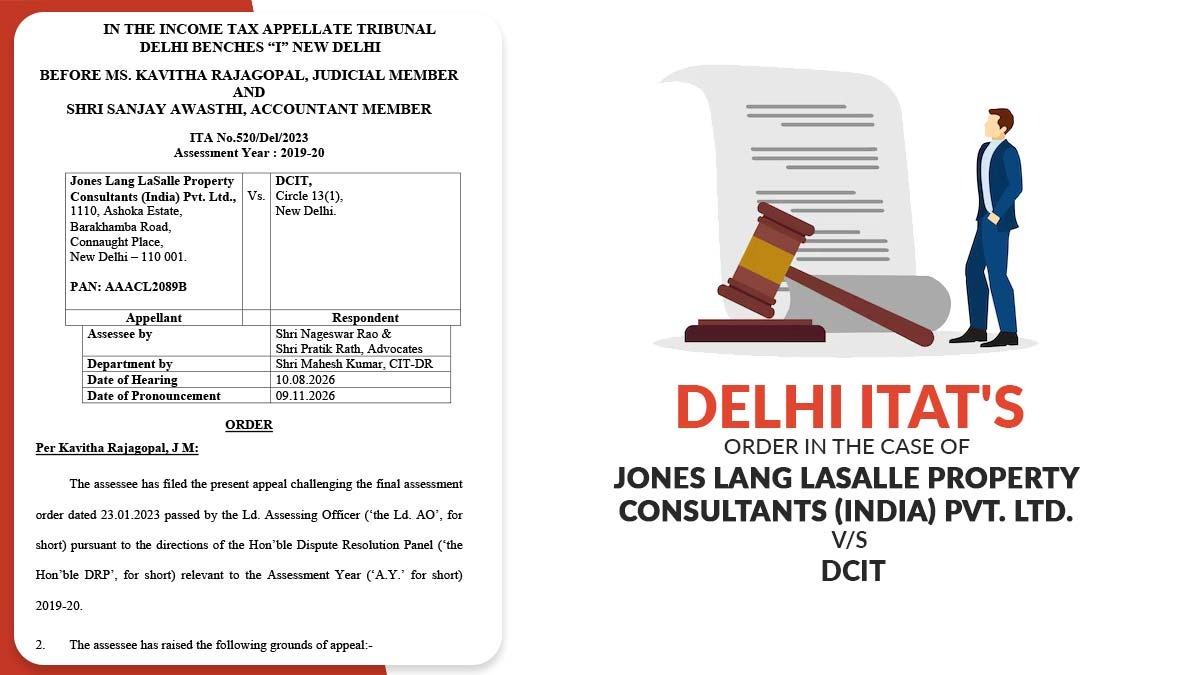
The Income Tax Appellate Tribunal (ITAT), Delhi Bench, has stated that the selection or rejection of comparable companies in transfer pricing proceedings must be based on relevant financial information and a functional analysis.
“The inclusion or exclusion of comparable companies must be supported by cogent reasons based on relevant financial information and functional analysis,” the tribunal stated.
A bench comprising Judicial Member Kavita Rajagopal and Accountant Member Sanjay Awasthi made this observation while remanding a transfer pricing dispute involving Jones Lang LaSalle Property Consultants (India) Private Limited for fresh examination.
The company furnishes real estate consultancy, property management, advisory and brokerage services. For AY 2019-20, it had chosen the Transactional Net Margin Method (TNMM) and selected 19 comparable companies. The Transfer Pricing Officer (TPO) rejected these companies and selected four others: Lancor Maintenance and Services Ltd., BVG India Ltd., Interactive Manpower Solutions Pvt. Ltd. and Info Edge (India) Ltd.
The TPO initially proposed an adjustment of ₹138.65 crore for these services, which was subsequently reduced to ₹138.08 crore following directions from the DRP. Additionally, another adjustment of ₹57.79 crore was made regarding business service charges paid to associated enterprises, bringing the total adjustment to ₹195.88 crore.
The company contested the rejection of its ‘comparable’ cases, the inclusion of companies with allegedly different business operations, and the inconsistent application of various filters, including a 70% export-revenue filter.
It was also argued that the Dispute Resolution Panel (DRP) directions, which mandated a reconsideration of the objections, were not properly implemented. The DRP justified the inclusion of Lancor specifically and barred any fresh investigation, while also limiting the verification process strictly to existing records. The company prompted the tribunal to remove the adjustment instead of providing the revenue another chance to fill gaps in its case.
The tribunal has said that TNMM needs a review of the operations conducted, assets employed, and risks assumed by the company and the comparable companies. It was also noted that the company had not submitted the annual reports, financial statements, or segment-wise information for the comparable companies before it.
“Merely relying upon the observations of the Ld. TPO, without furnishing the underlying financial and functional details of the comparable companies, would not be sufficient to adjudicate the issue conclusively on merits,” the tribunal stated.
It was stated that the shortcomings identified in the TPO’s analysis cannot, in themselves, form the basis for setting aside the entire adjustment. The purpose of remanding the matter was to examine those objections that had not been adequately addressed previously; it was not intended merely to provide the Revenue Department with an opportunity to strengthen its own case.
The Tribunal, subject to the binding directions of the DRP, has remanded the issues about ‘grounds 13 to 20’ back to the Assessing Officer/TPO for fresh examination. The authorities are required to consider the available material, provide the company with an opportunity for a hearing, and pass a reasoned order without reopening matters that have already attained finality.
The tribunal did not specify any opinion on the ultimate inclusion or exclusion of the disputed companies and permitted the relevant grounds and appeal for statistical objectives.
| Case Title | Jones Lang LaSalle Property Consultants (India) Pvt. Ltd. Vs DCIT |
| Case No. | ITA No.520/Del/2023 |
| Assessee by | Shri Nageswar Rao, Shri Pratik Rath |
| Department by | Shri Mahesh Kumar |
| Delhi ITAT | Read Order |