

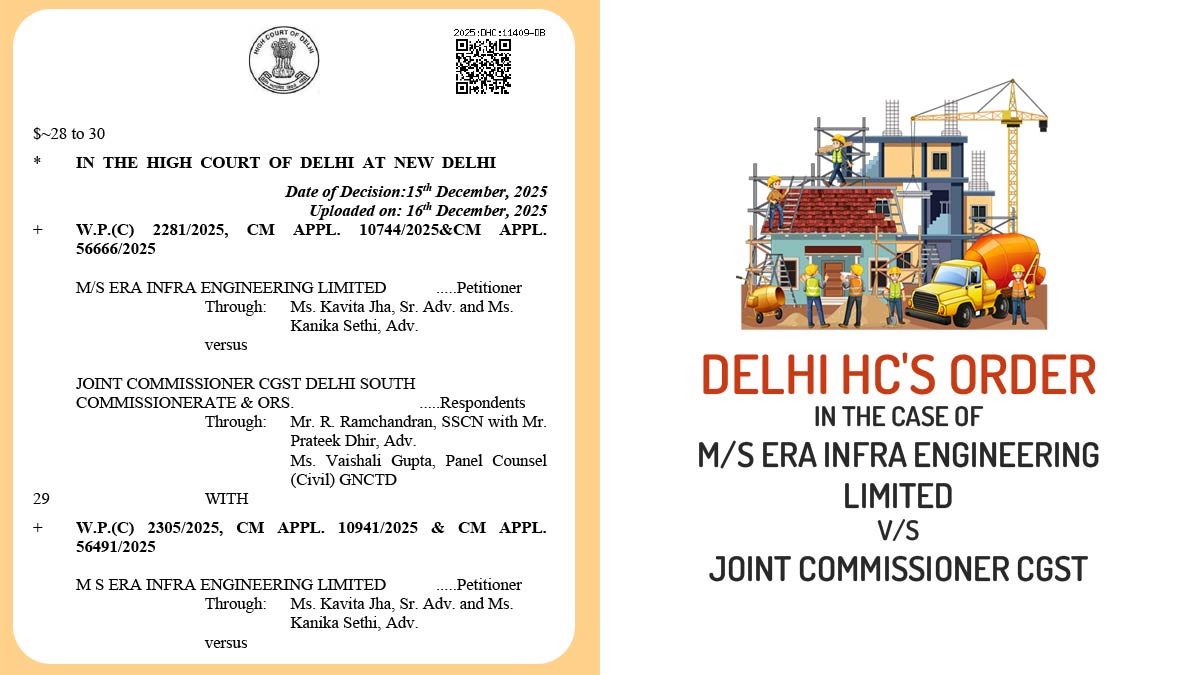
The Delhi High Court has quashed demand‑cum‑show cause notices and consequential orders issued via the Goods and Services Tax (GST) Department against the applicant, keeping that statutory dues for periods before the approval of a resolution plan under the Insolvency and Bankruptcy Code (IBC) stand extinguished.
The court stated that after a resolution plan is approved via the National Company Law Tribunal (NCLT), no new demands could be raised for pre‑resolution periods, as creditors, along with government authorities, are bound by the plan.
ERA Infra Engineering Limited, a construction company, had encountered financial distress and entered insolvency proceedings before the NCLT in 2017 on an application submitted via Union Bank of India.
An Interim Resolution Professional was appointed, who was thereafter confirmed as Resolution Professional, and claims were invited from creditors. The GST department submitted claims of Rs 4.02 crore, which were reduced to Rs 1.94 crore at the time of the Corporate Insolvency Resolution Process (CIRP).
The NCLT, on June 11, 2024, has approved the resolution plan provided by S.A. Infrastructure Consultants Pvt. Ltd., which took over management of ERA Infra. All stakeholders, including government authorities, are bound by the plan.
The GST department, even after it has issued the orders in November 2024 asking for the sums surpassing Rs 8 to 9 crore for FY 2017‑18, 2018‑19, and 2019‑20.
Such demands have been contested by ERA Infra before the HC, claiming that they were untenable as the GST department had earlier taken part in the process of insolvency, and its claims were accounted for in the resolution plan.
Important: GST Demand Recovery from Debtors: Section 79(1)(c) Guide
GST department claimed that the impugned orders only reduced the amounts and no recovery measures had been opted for. It cited that authorities retain limited jurisdiction to assess dues even after insolvency proceedings.
The same claim has been rejected by the Division Bench of Justice Prathiba M. Singh and Justice Shail Jain. The court, referring to Sundaresh Bhatt v. CBIC (2023), ruled that statutory dues not forming part of the resolution plan could not be pursued post approval of the plan. The GST Department, having submitted claims during the CIRP, was obligated by the plan and could not issue new demands for prior periods.
The court in the Supreme Court ruling in Ghanashyam Mishra & Sons v. Edelweiss Asset Reconstruction Co. (2021), which held that after the approval of a resolution plan, all prior claims not included in the plan are extinguished.
The court said that insolvency proceedings need to reach finality, and new management could not be loaded with obligations extinguished under the IBC. While authorities might determine the quantum of operational debt for staking claims in insolvency, they cannot start recovery after the scope of Section 53 of the IBC.
As per that, the impugned orders have been set aside by the court on November 14 and 25, 2024, and the demands raised therein. It outlined that the merits of the demands were not analysed however the legal norms was clear that after the approval of a resolution plan, all prior claims stand frozen, and government departments are bound by its terms.
| Case Title | M/s Era Infra Engineering Limited vs. Joint Commissioner CGST |
| Case No. | W.P.(C) 16944/2025 |
| For Petitioner | Ms Kavita Jha, Ms Kanika Sethi |
| For Respondent | Mr R. Ramchandran, Mr Prateek Dhir, Ms Vaishali Gupta |
| Delhi High Court | Read Order |