

In a crucial ruling for the legal and financial sector, the Delhi High Court has declared that advocates who also provide services as Insolvency Professionals must obtain a separate GST registration.
A Division Bench comprising Justices Pratibha M. Singh and Shail Jain ruled that the services provided by an advocate in the capacity of an insolvency professional are subject to the forward charge mechanism, completely separate from the reverse charge mechanism that typically applies to legal services provided by advocates.
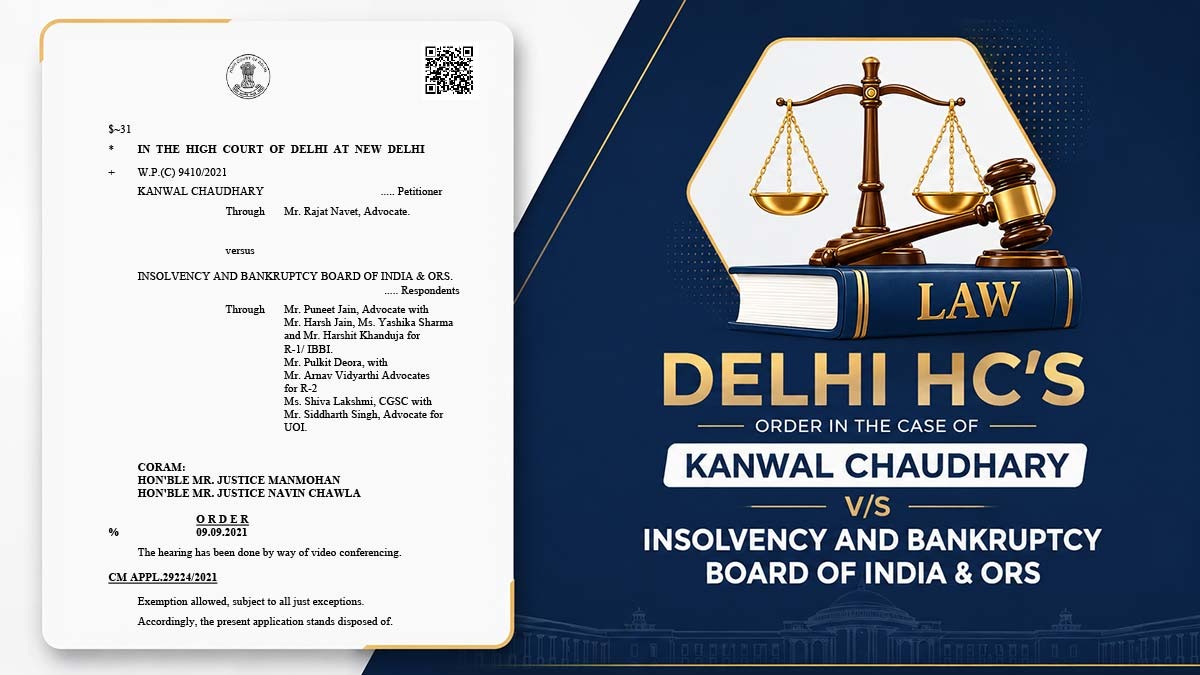
The issue stems from a petition filed by Advocate Kanwal Chaudhary, who challenged an order issued by the Insolvency and Bankruptcy Board of India (IBBI) on March 9, 2021.
The IBBI had directed Chaudhary, who was acting as an Insolvency Resolution Professional (IRP), to issue GST-compliant invoices for his professional fees. The IBBI order clarified that “Insolvency and Receivership” services do not fall under the reverse charge mechanism (where the recipient of the service pays the tax) that is standard for advocates.
Chaudhary challenged this before the High Court, arguing that an advocate acting as an IRP is essentially providing a legal service, and therefore, under Section 9 of the Central Goods and Services Tax (CGST) Act, 2017, the reverse charge mechanism should apply. He also questioned IBBI’s jurisdiction to rule on GST matters and claimed the order was passed without proper reasoning or a hearing.
Court’s Observations and Clarifications
The Delhi High Court examined the case and firmly rejected the petitioner’s argument. The Court noted that when an advocate acts as an insolvency professional, they are governed by a separate, specific regulatory framework (the Insolvency and Bankruptcy Code (IBC) and IBBI regulations), distinct from the Advocates Act.
The judges highlighted that while insolvency services might involve elements of law, they constitute a specialised class of service. Therefore, the High Court held: “The reverse charge mechanism applicable to advocates could not be applicable to services rendered by them as insolvency professionals.”
To avoid any confusion for legal practitioners, the Court made a very clear distinction:
As an Insolvency Professional: The advocate must obtain GST registration and follow all standard GST requirements, paying tax under the forward charge mechanism.
As an Advocate: Any pure legal services provided by the same individual in their traditional role as an advocate will continue to be governed by the reverse charge mechanism.
Key Takeaways/Decision
The High Court directed that advocates acting as insolvency professionals must secure GST registration and fulfil all consequential requirements under the GST Act and rules, treating them identically to any other insolvency professional.
The Court concluded by noting that statutes like the IBC merely offer advocates a new avenue to render specialised services, and the Advocates Act and the IBC must be read harmoniously to allow the growth of legal professionals into new, legally recognised fields.
| Case Title | Kanwal Chaudhary vs. Insolvency and Bankruptcy Board of India & Ors |
| Case No. | W.P.(C) 9410/2021 |
| For Petitioner | Mr. Rajat Navet, Advocate |
| For Respondent | Mr. Puneet Jain, Advocate with Mr. Harsh Jain, Ms. Yashika Sharma and Mr. Harshit Khanduja for R-1/ IBBI |
| Delhi High Court | Read Order |