

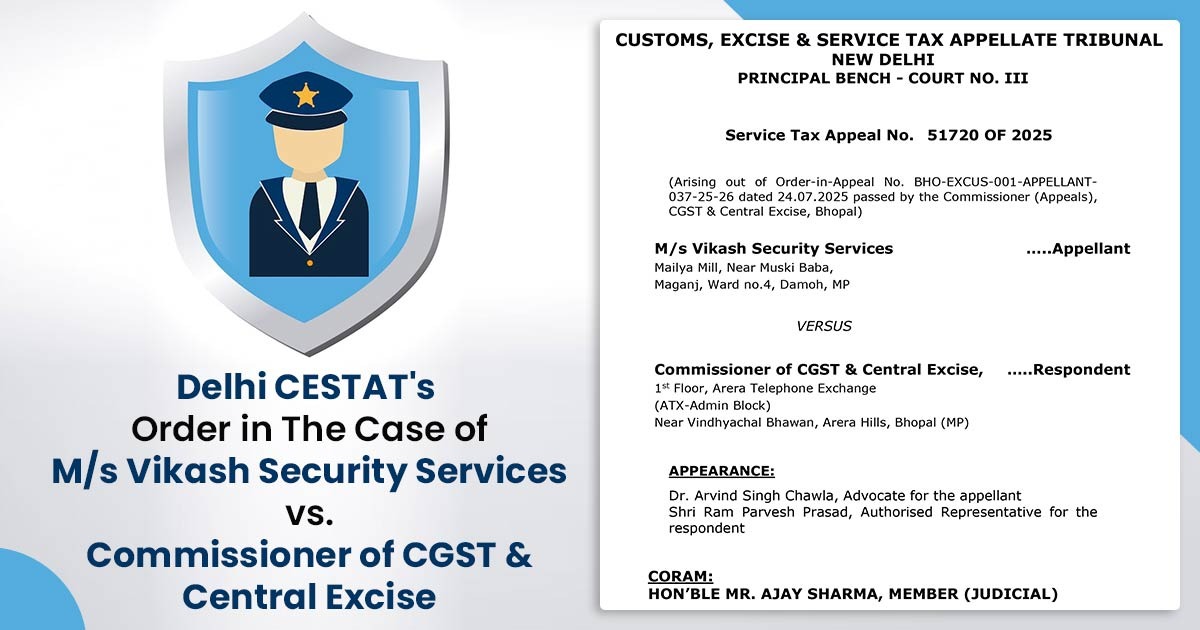
The Customs, Excise, and Service Tax Appellate Tribunal (CESTAT) in New Delhi ruled that the tax department cannot enforce a service tax demand by invoking the extended limitation period solely based on discrepancies between service tax returns and third-party TDS/ITR data.
The tribunal affirmed that the department should itself validate whether taxable services were actually rendered before raising this type of demand. It therefore set aside a ₹7.67 lakh demand against Vikash Security Services.
A bench of Judicial Member Ajay Sharma affirmed that third-party tax data could only initiate an inquiry and could not conclusively establish tax liability.
“It is, at best, a starting point for inquiry. It is not, by itself, conclusive proof of taxable service rendered or of service tax liability incurred. Once the department had access to such TDS data, including the PAN and TAN of the paying parties, it was well within its power and, indeed, its duty, to conduct independent verification from those very parties to ascertain whether taxable services had in fact been provided. That exercise was conspicuously absent here.”
Read Also: New PAN Card and Correction Process Via Genius Tax Software
The issue has emerged when the department compared the appellant’s ST-3 returns (semi-annual service tax returns) with ITR/TDS data for FY 2016-17 and alleged that taxable receipts of Rs 98.97 lakh had not been revealed in the service tax returns. According to this, an SCN was issued asking for the service tax, interest, and penalties.
The appellant before the tribunal claimed that the department had invoked the extended limitation period only based on third-party TDS and ITR data without doing any inquiry or establishing fraud, wilful suppression, or concealment.
The appellant argued that certain services provided to animal husbandry, veterinary centres, educational institutions, and the district election office were either exempt or constituted sovereign functions. It also contended that the relevant receipts were already documented in its financial records and tax filings.
The tribunal put reliance on its ruling in Homoeopathic Medical Publishers v. Commissioner CGST & Central Excise, Mumbai, where it held that income revealed under the Income Tax Act cannot be deemed as consideration for taxable services. In that case, the Tribunal held that authorities must investigate before raising demands based exclusively on return mismatches.
It referred to the ruling of the Gujarat High Court in Nimeshbhai Gunvantbhai Patel, where the Court held that SCNs founded merely on Form 26AS data without analysing the taxpayer’s explanation were not sustainable.
The Tribunal quoted Commissioner of CGST & Central Excise, Mumbai East v. Modern Road Makers Pvt Ltd, which affirmed that differences between income tax and service tax returns cannot automatically be assumed to specify taxable turnover.
On limitation, the tribunal outlined that the responsibility is on the department to justify invoking the extended period.
“Invocation of the extended period of limitation is not a matter of course. It is a penal exception to the normal period, and must be founded upon clear evidence of fraud, collusion, wilful misstatement, or suppression of facts with intent to evade payment of tax.”
The tribunal also ruled that a bona fide conviction about an exemption or non-taxability would not constitute deliberate concealment. It is applicable where the receipts had already been revealed in the appellant’s books and income tax returns.
Therefore, the tribunal set aside the impugned order and permitted the appeal.
| Case Title | M/s Vikash Security Services vs Commissioner of CGST & Central Excise |
| Case No. | Service Tax Appeal No. 51720 OF 2025 |
| For Petitioner | Dr. Arvind Singh Chawla |
| For Respondent | Shri Ram Parvesh Prasad |
| Delhi CESTAT | Read Order |