

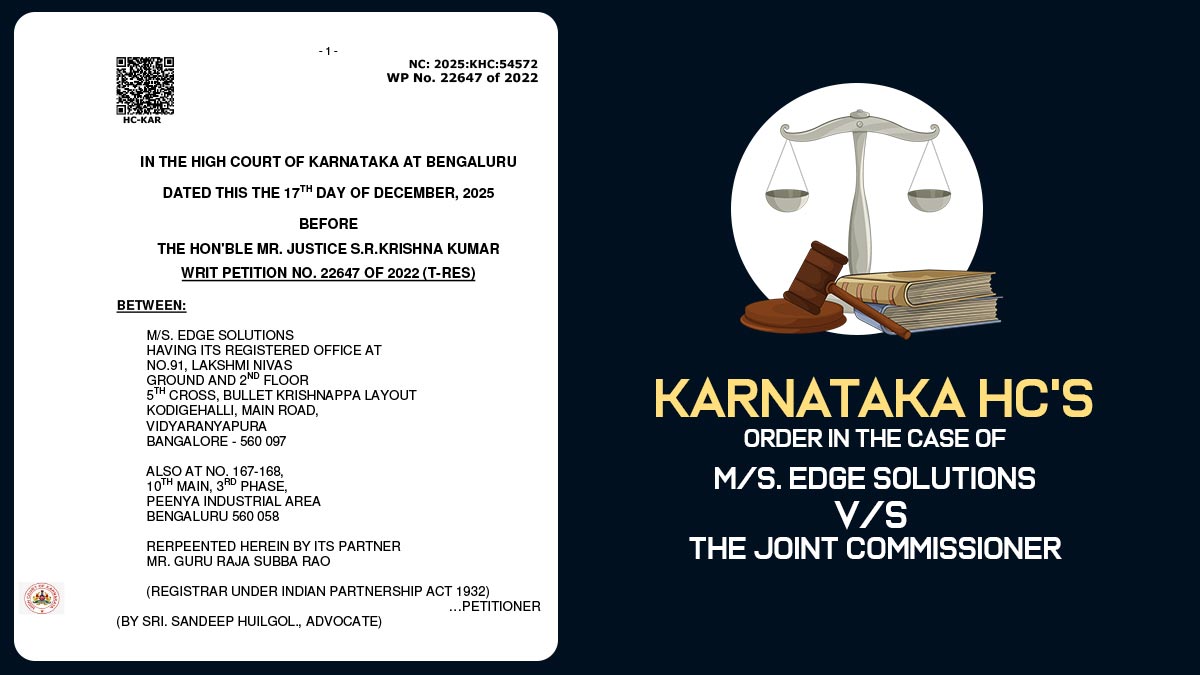
The Karnataka High Court has cancelled a GST (Goods and Services Tax) demand order. This decision came after it was found that tax officials mistakenly combined several different tax periods into one single notice, which is not allowed under the law.
The bench of Justice S.R. Krishna Kumar has stated that any proceedings commenced pursuant to such composite notices are corrupt and must be quashed, though liberty could be reserved for the department to start fresh proceedings within law.
The legal dispute before the Court was whether the GST department could issue a Single Show Cause Notice (SCN) and adjudication order by consolidating multiple tax periods or fiscal years under Sections 73 or 74 of the CGST/KGST Acts.
As per the applicant, this consolidation was opposite to the statutory scheme of the GST law, arbitrary, and without jurisdiction. It was specified that refusal of ITC only on the grounds of a mismatch between GSTR-2A and GSTR-3B was unconstitutional and violative of settled legal principles.
The High Court acknowledged that the issue had already been addressed in previous cases. It emphasised its recent decision in M/s Pramur Homes and Shelters v. Union of India (WP No. 33081 of 2025, decided on December 11, 2025), where a similar question was thoroughly examined.
In Pramur Homes, the Court had categorically held that clubbing, consolidation, bunching, or combining of multiple tax periods or fiscal years into a single or composite SCN under Sections 73 or 74 of the CGST/KGST Acts is illegal, invalid, impermissible, and without authority of law. The notices similar to that are contrary to the provisions and scheme of the GST legislation.
The Karnataka High Court, applying the ratio of Pramur Homes to the facts before it, said that the SCN dated 1 February 2021 and the subsequent adjudication order dated 20 June 2022 suffered from the same fatal defect, namely, the impermissible consolidation of multiple tax periods into a single proceeding.
The court held that once the foundational SCN itself was without jurisdiction, then the resulting adjudication order cannot be kept in law.
Read Also: Best Strategies to Handle GST SCN with Basic Reply Format
HC quashed the SCN on 1 February 2021 and the Order-in-Original on 20 June 2022, and set aside all consequential proceedings, orders, and notices emerging from it.
The court granted permission for GST authorities to initiate new proceedings, as advised, in strict accordance with the law and the framework established under the CGST and KGST Acts.
| Case Title | M/s. Edge Solutions vs. The Joint Commissioner |
| Case No. | WRIT PETITION NO. 22647 OF 2022 (T-RES) |
| For Petitioner | Sri. Sandeep Huilgol, Advocate |
| For Respondent | Sri. Akash B Shetty, Advocate for R1 to R5 Sri. K. Hema Kumar, Aga for R6 |
| Karnataka High Court | Read Order |