


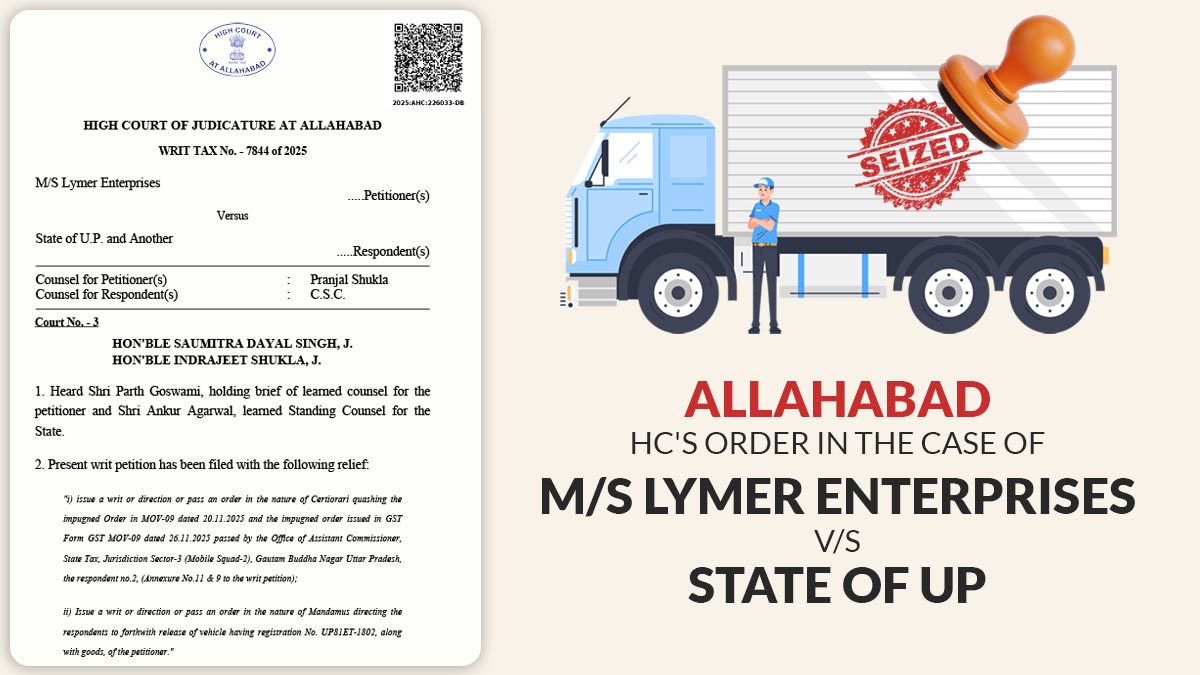
The Allahabad High Court has refused to exercise its writ jurisdiction under Article 226 of the Constitution in a Goods and Services Tax (GST) dispute, which includes the seizure of goods and a vehicle, holding that the applicant should take the statutory appellate remedy as disputed questions of fact were concerned.
The bench of Justice Saumitra Dayal Singh and Justice Indrajeet Shukla has said that the issues of service of notice, genuineness of invoices, and existence of the supplier concern with questions of fact. Such issues are adjudicated in statutory appeal proceedings, where proof can be led and examined. Extraordinary jurisdiction under Article 226 cannot be invoked as a replacement for appellate remedies in such circumstances.
In M/s Lymer Enterprises v. State of Uttar Pradesh, the petitioner approached the High Court seeking the quashing of seizure and penalty orders passed under GST MOV-09 (dated November 20 and 26, 2025). Issued by the Assistant Commissioner, State Tax (Mobile Squad-2), Gautam Buddha Nagar, the impugned orders resulted in the detention of goods and a vehicle (Registration No. UP81 ET 1802). The petitioner prayed for the immediate release of both the conveyance and the cargo.
At the time of transit, the seizure has emerged where tax authorities alleged irregularities, desiring action u/s 129 of the U.P. GST Act, 2017. The applicant does not submit any response to the SCN issued before the passing of the seizure order.
Concerning maintainability, the State has raised a preliminary objection claiming that a perfect statutory appeal was available under the GST law. The applicant is not able to answer the show cause notice (SCN). This permits factual disputes to crystallise against it. There was material before the department raised doubts about the genuineness of the supplier.
Reliance was placed on a recent Division Bench decision in M/s Caviar Trading Company v. State of U.P., where the Court refused to interfere on similar grounds. Reliance was placed on a recent Division Bench decision in M/s Caviar Trading Company v. State of U.P., where the Court declined to interfere on similar grounds.
The petitioner placed strong reliance on a previous ruling of a Division Bench of the same High Court in M/s Mz Momin Products v. State of Uttar Pradesh. In that case, under comparable facts, the Court had intervened and ordered the release of goods upon payment of a reduced penalty u/s 129(1)(a) of the GST Act, instead of the higher penalty prescribed under Section 129(1)(b). On this basis, the petitioner contended that the doctrine of judicial consistency warranted the grant of similar relief in the present matter.
The Bench declined to exercise its writ jurisdiction, explicitly distinguishing the petitioner’s cited precedents from the current factual matrix. The Court clarified that the rulings in M/s Momin Products and Caviar Trading Company did not establish binding legal principles (ratio decidendi), but were instead adjudicated on case-specific grounds.
Notably, in the Momin Products matter, the State had admitted to the facts, and the order was passed with the mutual consent of both parties, a scenario that justified extraordinary writ interference, unlike the disputed facts in the present case.
In comparison to the Caviar Trading Company case, the State contested the factual claims, particularly concerning the existence and authenticity of the supplier. The petitioner’s failure to respond to the show-cause notice was an important factor that weighed against them.
Read Also: Allahabad HC Rejects Plea to Quash GST Fraud Notice, Orders Tax Department to Reveal Evidence
The Court highlighted that even a minor factual dispute is enough for a writ court to decline interference, especially in fiscal matters governed by a comprehensive statutory framework. As a result, the High Court dismissed the writ petition and chose not to interfere with the orders for seizure and penalty.
However, the petitioner was granted the liberty to pursue the statutory remedy of appeal, with the clear note that the appellate authority would decide the matter based on its own merits, without being influenced by any observations made by the Court.
| Case Title | M/S Lymer Enterprises Versus State of UP |
| Case No. | Writ Tax No. – 7844 of 2025 |
| For Petitioner | Pranjal Shukla |
| For Respondent | C.S.C. |
| Allahabad High Court | Read Order |





A dealer should not haste to approach the hon’ble Court first exhausting remedy of appeal u/s 107.
Goods judgment