

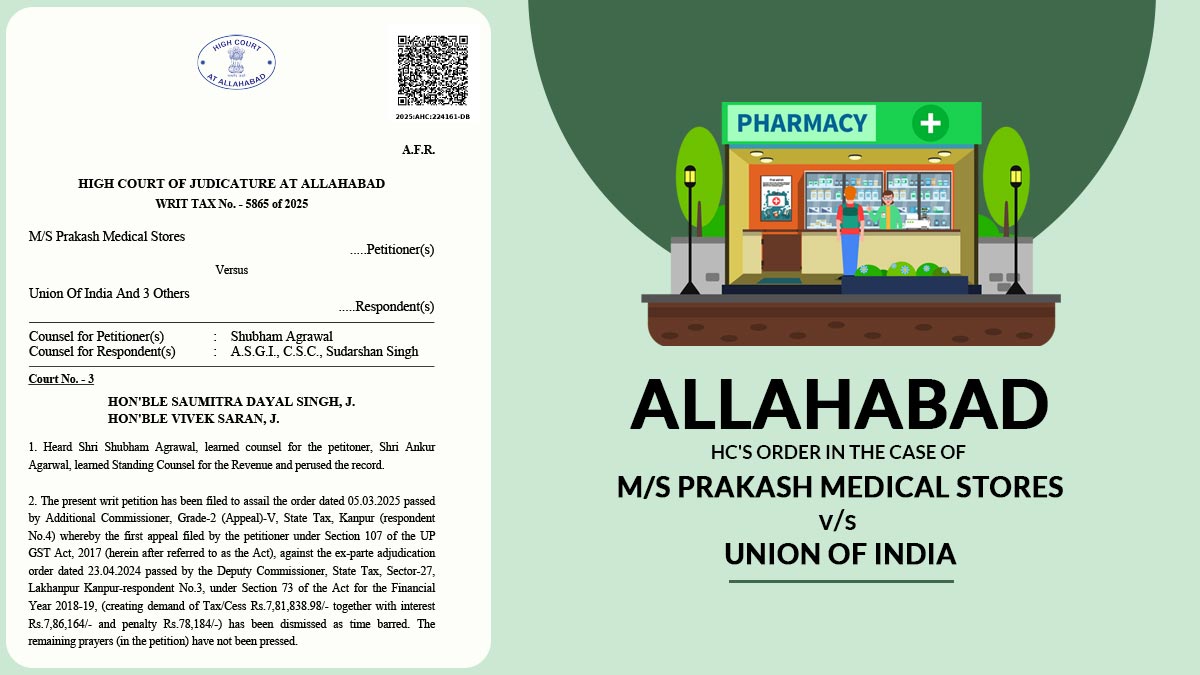
The Allahabad High Court recently rejected a GST order, showing that when a rectification application is presented within the statutory limitation period and is followed in good faith, the period for which it stays pending during adjudication shall be excluded from the computation of the limitation period for filing a following appeal under section 107 of the GST Act.
The decision was rendered in a writ tax filed by M/s Prakash Medical Stores, a registered dealer who was subjected to an ex parte adjudication order dated 23.04.2024 u/s 73 of the Uttar Pradesh GST Act for the FY 2018-19. The order explained tax liability, interest, and penalty demand on the applicant, aggregating to over Rs 15 lakh.
On 23 May 2024, exactly one month after the initial order, the petitioner applied Section 161 of the Act, seeking rectification of apparent errors in the adjudication order. However, this rectification application was rejected as not maintainable on 22 October 2024.
The petitioner then filed a first appeal under Section 107 on 29 November 2024, but it was dismissed by the appellate authority as time-barred. The current writ tax application was initiated due to the non-functionality of the Goods and Services Tax Appellate Tribunal.
On behalf of the applicant, Shubham Agrawal appeared and cited that, though Section 14 of the Limitation Act, 1963 does not apply to proceedings under the GST Act, the underlying principle included in Section 14 of the Limitation Act does apply, and that the appellate authority had made a mistake in declining the benefit of limitation to the applicant. Ankur Agarwal, the Standing Counsel for the State tax department, disputed the applicant’s submissions.
The Division Bench including Justice Saumitra Dayal Singh and Justice Vivek Saran acknowledged the scope of Section 107 (Appeals to Appellate Authority) and Section 161 (Rectification of errors apparent on the face of record) of the UP GST Act, alongside Section 14 of the Limitation Act, 1963, which provides for exclusion of time spent bona fide in proceedings before a court without jurisdiction or under a similar defect.
The court referred to the decision of the Apex court in M.P. Steel Corporation vs. Commissioner of Central Excise (2015), where it was ruled that while the Limitation Act may not apply to the tax proceedings, the underlying principle of Section 14 applies to exclude the time spent in bona fide pursuit of a remedy before a wrong forum.
Subsequently, the court said that the rectification application of the applicant was submitted within the statutory duration of 3 months as mentioned u/s 161 of the GST Act, and that the time during which it stayed due for adjudication is not included for the objective of computing the limitation for the forthcoming appeal.
The Court, concerning the same, mentioned that, “Wherever an application seeking rectification of a mistake apparent on the face of the record may be filed within time, the application of the underlying principle of Section 14 of the Limitation Act may not be examined with a microscope. To the extent that the application is filed bona fide and pursued, that principle would apply, without doubt.”
Therefore, the Allahabad High Court set aside the order of the appellate authority and restored the appeal to its original number and status with the directive that the appeal be determined on merits and in accordance with law, expeditiously.
| Case Title | M/S Prakash Medical Stores vs. Union of India |
| Case No. | Writ Tax No. – 5865 of 2025 |
| For the Petitioner | Shubham Agrawal |
| For the Respondent | Sudarshan Singh |
| Allahabad High Court | Read Order |