

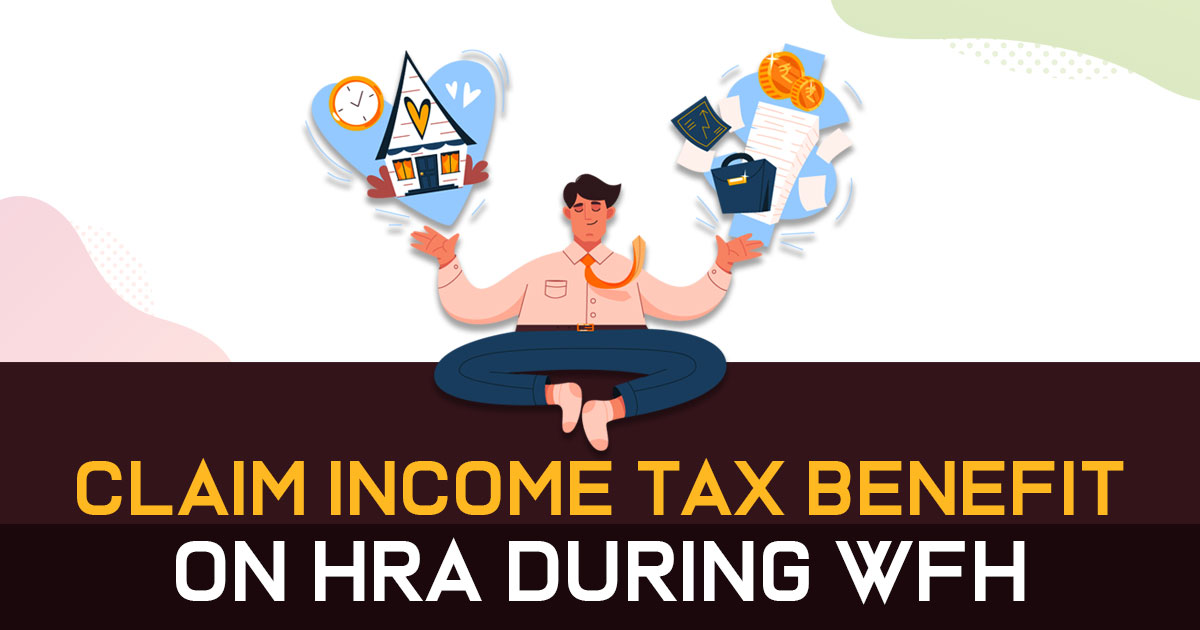
Income Tax Advantage on HRA for WFH
Towards salaried individuals, the tax exemption on the house rent allowance (HRA) is an essential advantage. HRA has arrived through the portion of the salary and can be claimed by employees residing on rent. The primary condition to claim HRA exemption is that the employee must live in a rented house and should not own a house property in the same city where he is employed.
In a situation where an employee works remotely from his self-occupied house, the question of claiming HRA exemption under section 10(13A) does not arise.
There are multiple salaried persons, specifically young ones, who live far from the place taken on rent and work from home along with their parents.
But now the same employees are confused about whether they can avail of house rent allowance (HRA) even when they are residing with their parents while working from home, and if they are permitted to do so, then how is it possible? The article, it elaborates on the issues in brief. But first, let us know who is liable for HRA and what the method of computation is.
Who Can Claim HRA and How Is It Calculated?
House Rent Allowance (HRA) is available to salaried employees who live in rented accommodation and receive HRA as part of their salary. A portion of the HRA received can be claimed as exempt from tax, subject to prescribed conditions under the Income Tax Act. HRA is allowed only under the Old Tax Regime.
Employees who do not live in rented accommodation or do not pay rent cannot claim HRA exemption, and the entire HRA amount becomes taxable. To claim the benefit of HRA exemption, the employee must actually pay rent and maintain valid rent proof or rent receipts. If no rent is paid, the HRA tax benefit cannot be claimed.
Computing the House Rent Allowance (HRA)
Tax exemption from HRA is available on the least of the following amounts:
- Real HRA Obtained by Employee
- 50% of salary (Basic + DA) for employees living in metro cities. And 40% of basic + DA for employees living in non-metro cities.
- Real rent furnished minus 10% of salary (Basic+DA)
When it is the question of salaried employees who are residing with their parents while working from home, the tax advantage on HRA shall not be present if they did not pay any rent. However, the exemption can be claimed if the employee actually pays rent to the parents and maintains proper rent records or proof of payment.
No HRA Advantage When no Rent is Filed
“An employee, in receipt of House Rent Allowance (HRA), is ineligible to claim tax exemption for such HRA if he/she owns the residential accommodation occupied by him/her or has not actually incurred any rental expenditure i.e. HRA received can be claimed as an exemption only if the rental expense has actually been incurred by the employee on the residential accommodation occupied by him/her, said the tax expert.”
If one has filed the rent to their guardians, then it must be displayed as rental income in their income tax return. Their rental agreement must be implemented and furnished as payment proof.
“In practice, there would be fewer instances of a son or daughter getting into such rental arrangements with their parents. Further, the income tax department would be vigilant on these kinds of inter-family transactions, which might result in scrutiny and assessments.”