

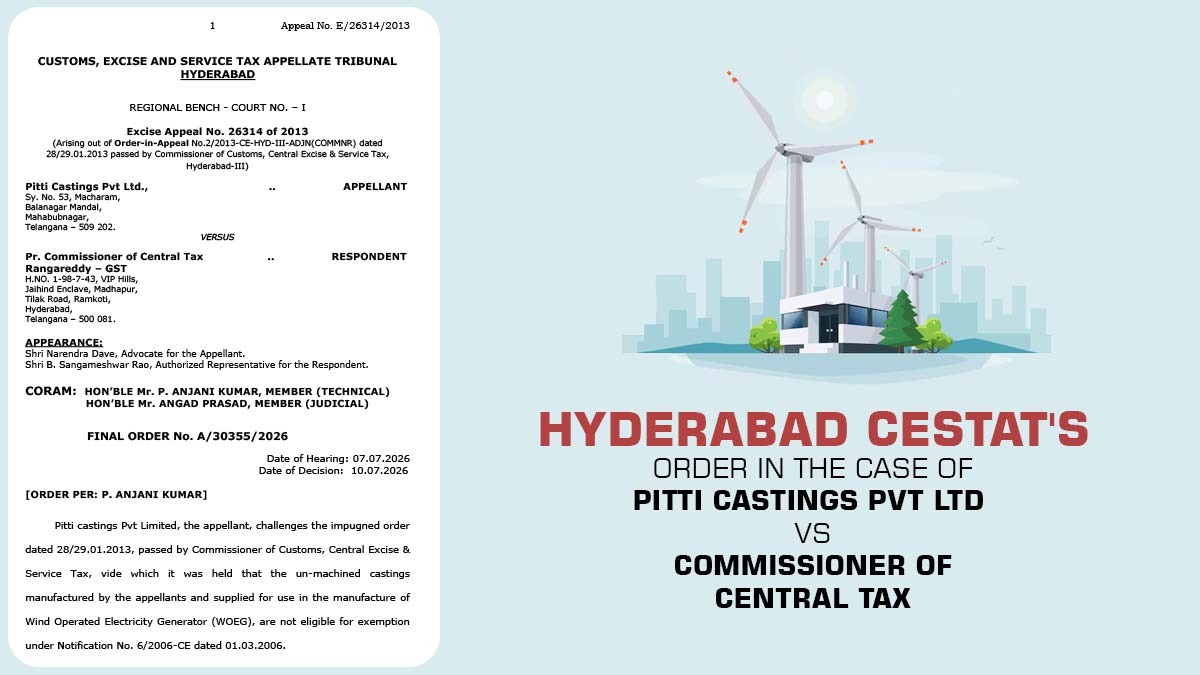
The Hyderabad bench of the Customs, Excise and Service Tax Appellate Tribunal (CESTAT) ruled that unmachined, tailor-made castings used in the manufacture of wind-operated electricity generators qualify for excise duty exemption.
The petitioner, Pitti Castings Pvt Limited, challenged the order issued by the Commissioner of Customs, Central Excise, and Service Tax. In this order, it was stated that the unmachined castings produced by the appellants and supplied for use in the manufacture of Wind Operated Electricity Generators (WOEG) do not qualify for the exemption under Notification No. 6/2006-CE, dated March 1, 2006.
Read Also: Renewable Energy Sector Seeks 5% GST Rate on Battery Energy Storage System Containers
The applicant’s counsel, Narendra Dave, has mentioned that the unmachined castings are categorised under CETH 7325 and were tailor-made as per customer specifications. It is only utilised as parts of the Wind Operated Electricity Generators (WOEG). As the exemption notification includes goods under any chapter, classification was not relevant, and the castings were qualified for exemption under Notification No. 6/2006-CE.
It was argued that the commissioner made an error by concluding that only WOEG parts and components classified under CETH 8503 are eligible for exemption. This interpretation excluded un-machined castings classified under CETH 7325. Furthermore, the Commissioner incorrectly applied the Section Note to Section XVI, which states that the conversion of incomplete blanks into ready-to-use parts constitutes manufacturing.
B. Sangameshwar Rao, the Authorised Representative, repeated the findings of the impugned order and that the Commissioner has taken the right decision for the classification of un-machined castings and refused the benefit.
Similar: A 12% GST Rate Applicable on Renewable Energy Devices, Says MOF Pankaj Chaudhary
The related issue was whether the exemption under Notification No. 6/2006-CE was available to un-machined parts supplied for manufacture of WOEG. The revenue claimed that since purchase orders mentioned quantities in kilograms, the goods could not be considered as castings or WOEG parts.
Notification No. 6/2006-CE exempted goods from various chapters that are used in specific renewable energy devices, including WOEG and their parts. However, the Commissioner refused this exemption, stating that unmachined castings cleared for further manufacturing of WOEG parts were not covered. The exemption applied only to parts consumed within the factory, as indicated in Serial No. 21.
The Tribunal of P. Anjani Kumar, Member (Technical) and Angad Prasad, Member (Judicial) stated that in the present case, it is established that the castings produced by the appellant are specifically designed for use in the manufacture of WOEG and were made according to their requirements. Therefore, we conclude that the un-machined castings are also eligible for exemption.
The Bench observed that the Supreme Court in Dilip Kumar and Company emphasised that exemption notifications must be interpreted based on their plain language, without adding anything to the text. Therefore, since the notification and the relevant list are clear, it is not permissible to interpret Serial No. 21 in a way that restricts it to parts that fall under the same chapter as the items mentioned in Serial Nos. 1 to 20.
| Case Title | Pitti Castings Pvt Ltd vs Commissioner of Central Tax |
| Case No. | Appeal No. E/26314/2013 |
| For Petitioner | Shri Narendra Dave, Advocate |
| For Respondent | Shri B. Sangameshwar Rao, |
| Hyderabad CESTAT | Read Order |