

The Calcutta High Court recently ruled that the illness of a partner within a partnership firm constitutes a ‘sufficient cause’ for the condonation of delay in filing a statutory appeal. Consequently, the Court set aside the order previously issued by the GST Appellate Authority, reaffirming the principle that genuine medical hardships should be taken into account in procedural timelines.
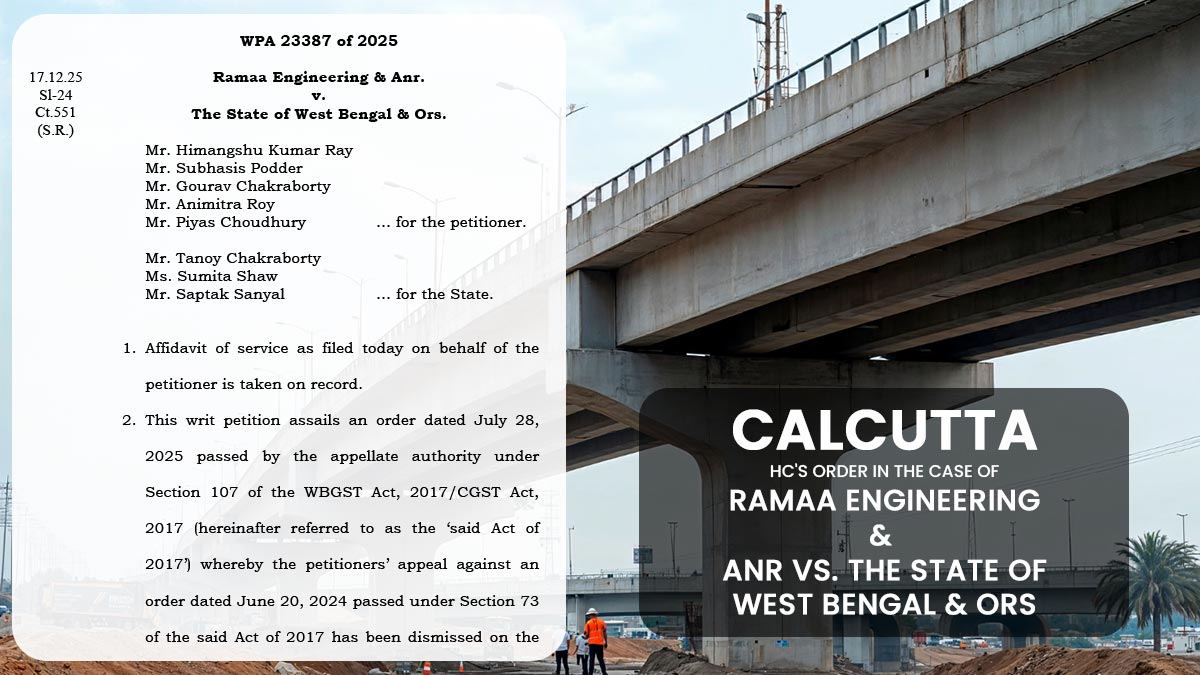
Ramaa Engineering and its partner have approached the Calcutta High Court via a writ petition to challenge an appellate order dated July 28, 2025. The contested order was issued under Section 107 of both the West Bengal GST Act and the Central GST Act, 2017, following a dispute regarding the firm’s tax obligations.
The appeal of the applicant had been dismissed by the appellate authority against an assessment order passed u/s 73 of the GST Act, only on the ground that the appeal was filed beyond the stipulated limitation period.
The statutory appeal had been submitted by the applicants along with an application asking for the condonation of the delay. They elaborated that the delay has taken place due to applicant no.2, who is a partner of applicant no. 1’s partnership firm was suffering from illness in the pertinent period. Before the appellate authority, the medical documents were placed in support of the illness.
The applicant’s counsel, Mr Ray, said that the delay occurred because of genuine and unavoidable circumstances. As per the counsel, the applicant no.1 is a partnership firm that has applicant no.2 and his wife, and due to the illness of applicant no.2, the firm was not able to take the measure in time to submit the appeal. He also mentioned that the delay was marginal and not the consequence of gross negligence or intentional inaction.
The single-judge bench comprising Justice Om Narayan Rai cited that the appellate authority had considered the illness of applicant no. 2 along with the medical documents filed in support of that claim. The court cited that the appellate authority had not doubted the explanation offered by the applicants, yet proceeded to dismiss the appeal only based on delay.
The Court observed that, as the second petitioner held a partner position within the firm, their medical condition was a pivotal factor that directly impeded the timely filing of the appeal. Highlighting the principle of ‘substantial justice,’ the Court noted that in instances of marginal delay backed by bona fide justifications, it is incorrect to characterise the appellants as grossly negligent in exercising their statutory remedies.
The court ruled that the appellate authority must condone the delay rather than dismissing the appeal at the limit. On 28 July 2025 impugned appellate order was set aside, the late filing of the appeal was condoned, and the appeal was restored to the file of the appellate authority for the acknowledgement on merits. The writ petition was disposed of with no order as to costs.
| Case Title | Ramaa Engineering & Anr vs. The State of West Bengal & Ors |
| Case No. | WPA 23387 of 2025 |
| For Petitioner | Mr Himangshu Kumar Ray, Mr Subhasis Podder, Mr Gourav Chakraborty, Mr Animitra Roy, and Mr Piyas Choudhury |
| For Respondent | Mr Tanoy Chakraborty, Ms Sumita Shaw, and Mr Saptak Sanyal |
| Calcutta High Court | Read Order |