

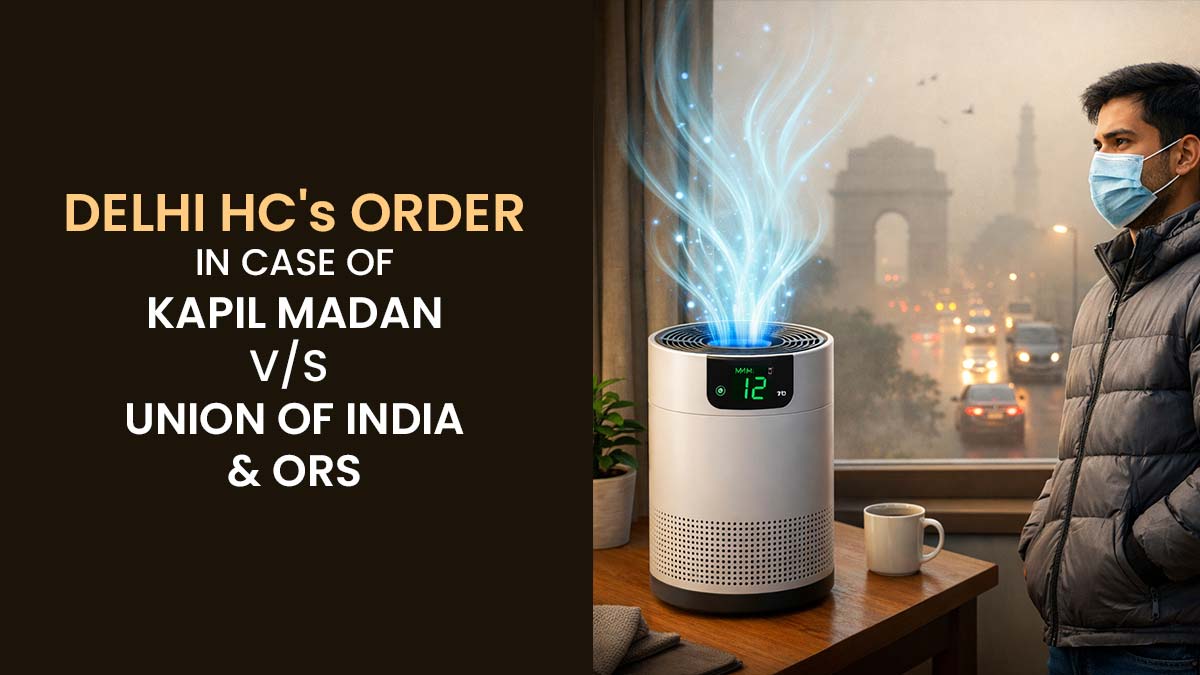
A Public Interest Litigation (PIL) has been filed before the Delhi High Court seeking a declaration that air purifiers should be categorised as medical devices and not treated as luxury items for the purposes of Goods and Services Tax (GST).
The petition contests the charging of 18% GST on air purifiers, calling it arbitrary, unreasonable, and unconstitutional for the severe air pollution crisis in the Delhi-NCR region.
The PIL submitted by advocate Kapil Madan cited that air purifiers are a necessity during periods of “very poor”, “severe”, and “severe+” Air Quality Index (AQI) levels, when breathing itself becomes hazardous. The case can be listed for a hearing today.
The applicant has asked the court to direct the Centre as well as related authorities to reclassify air purifiers as medical devices, which draws a 5% concessional GST rate. The appeal mentioned that “extreme and perilous air-quality crisis”, with toxic particulate matter, has been encountered by Delhi-NCR, which leads to rising cases of respiratory illness, irreversible lung damage, cardiac problems, developmental harm to children, and premature deaths. These conditions are directed to a grave public health emergency and breach the fundamental right to life under Article 21 of the Constitution.
The PIL put reliance on a Central government notification on February 11, 2020, issued under the Drugs and Cosmetics Act, 1940, which expanded the definition of “medical devices” to include any instrument or apparatus intended for prevention, diagnosis, monitoring, or alleviation of disease, even if it functions mechanically or non-pharmacologically.
As per the applicant, air purifiers equipped with HEPA filters remove fine particulate matter, allergens, bioaerosols, and toxic pollutants such as PM2.5 and PM10, thereby lowering the risk of asthma, COPD, and cardiovascular diseases. Various devices include the air quality sensors that support in monitoring hazardous fluctuations, supporting their preventive and health-protective role.
The appeal condemned the differential tax treatment, observing that 5% GST is levied on most of the medical devices, and air purifiers continue to be charged at 18% even after serving an identical preventive function. The applicant stated that the same categorisation does not contain any rational or scientific basis and fails the constitutional test of intelligible differential.
The PIL references advisories from the World Health Organisation and the Ministry of Health and Family Welfare, highlighting that air purifiers are officially recognised as protective devices in poor to severe air quality conditions, particularly for vulnerable groups. The appeal cites that levying the highest Goods and Services Tax (GST) slab on these devices makes them financially inaccessible, thereby infringing on the right to life and clean air.
Courts Citation: On December 24, the Delhi High Court asked the GST Council to convene a meeting and decide, at the earliest, the issue of reducing or removing GST on air purifiers, considering the prevailing air quality situation in Delhi and nearby areas.
While hearing a PIL against the 18% GST levied on air purifiers and to declare the same as a medical device, the court passed the order. Considering the function performed by air purifiers, the court was of the prima facie view that GST of 5 per cent can be provided for air purifiers.
The court earlier in the day had orally specified that GST needs to be exempted by the authorities on air purifiers, considering the air pollution situation in the national capital as an “emergency.
The court orally mentioned, “Then we will have to direct Ministry of Health first and then based on that GST council will have to consider. What we propose to do today is note your concerns, we will ask the nodal officer to place all this before the GST council and within which they will take a decision, and then they will come back on Monday or the day after tomorrow”.
The court observed that the claim of the applicant is that air purifiers qualify as a medical device in terms of the notification of February 2020, which has been issued u/s 3 of the Drugs and Cosmetics Act, 1940.
Read Also: GST on Medicines and Medical Supplies in India
The court scheduled the case for December 26 to allow the counsel for Respondent 2 to obtain instructions on when they can meet and make an appropriate decision.
Case Title: Kapil Madan vs. Union of India & Ors
Case Number: W.P.(C) 19644/2025