

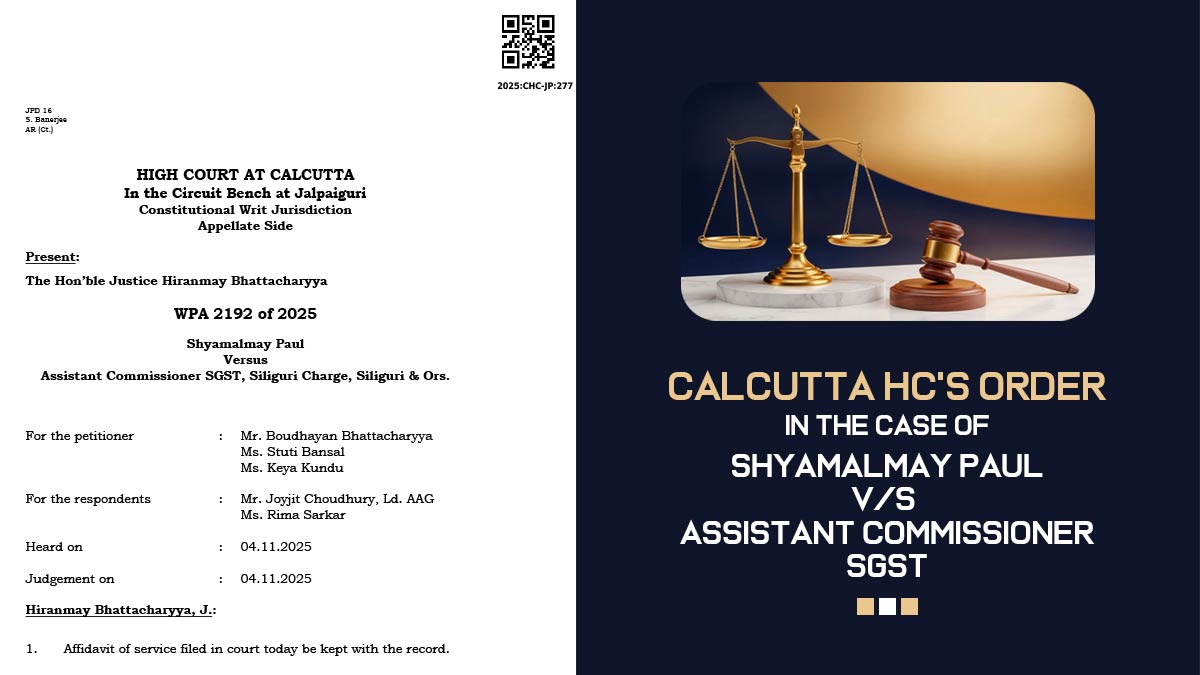
The Calcutta High Court, Circuit Bench at Jalpaiguri, has reiterated that the retrospective cancellation of a supplier’s GST registration, by itself, cannot be the sole basis for denying Input Tax Credit (ITC) to a bona fide purchaser.
An appellate order has been set aside by the bench of Justice Hiranmay Bhattacharyya, passed under the West Bengal Goods and Services Tax Act, 2017, holding that the appellate authority failed to release its statutory duty by not passing a reasoned and speaking order.
A registered taxpayer submitted the writ petition contesting the appellate order on 16 May 2025, by which the Joint Commissioner (Appeals), SGST, Siliguri Circle, had affirmed an adjudication order passed on 29 August 2024 by the Assistant Commissioner, SGST, Siliguri Charge. The dispute emanated from a Show Cause Notice (SCN) issued u/s 73(1) of the WBGST Act for alleged discrepancies in GST returns for the FY 2019-20.
Initially, four discrepancies were alleged; however, the adjudicating authority accepted the taxpayer’s explanation for three of them. The controversy before the High Court was limited to discrepancy number three, which concerned the claiming of Input Tax Credit (ITC) on inward supplies received from a supplier whose GST registration was subsequently cancelled retroactively.
The tax department alleged that ITC was taken incorrectly on the issued invoices by a supplier whose GST registration had been cancelled retrospectively, rendering the credit inadmissible u/s 16 of the CGST/WBGST Acts. Based on such reasoning, tax, interest, and penalty were established u/s 73(9) of the Act, and the appellate authority thereafter upheld the adjudication order.
The applicant claimed that the transactions were genuine and bona fide. Comprehensive documentary proof was placed on record, including tax invoices, e-way bills, transport documents, bank statements, and party ledgers, to support this claim. Taxpayers claimed that payments were made via proper banking channels, goods had physically moved from the supplier to the purchaser, and the GST registration of the supplier was active during the making of the supplies.
Even the appellate authority considered in its order that these documents were filed by the applicant.
Also Read: Allahabad HC: GST ITC Cannot Be Denied to Buyer Due to Supplier’s Default
Justice Hiranmay Bhattacharyya, post analysing the appellate order, said that the appellate authority had mechanically affirmed the adjudication order without independently examining the documentary proof given by the taxpayer. The court discovered that no reasons were recorded as to why the invoices, e-way bills, transport documents, and banking records were inadequate to establish the genuineness of the transactions or actual movement of goods.
The Court observed that the sole reason cited by the appellate authority was that the invoices were issued after the effective date of the cancellation of the supplier’s registration, even though the cancellation was implemented later with retrospective effect. The revenue did not contest that the supplier’s GST registration was valid and active on the date of supply.
The HC, repeating the settled legal norms, ruled that retrospective cancellation of a supplier’s GST registration cannot, on its own, explain the refusal of GST ITC to the purchasing dealer, particularly when no allegation is made that the purchaser was complicit in any fraud or that the transactions were fictitious. The court and authorities should analyse whether the statutory requirements for taking ITC were fulfilled and whether the actual supply of goods had taken place, as per the proof.
As per the State, the applicant did not appear for personal hearings before the appellate authority, the court ruled that only non-appearance could not absolve the appellate authority of its duty to analyse the material already on record. The authority, in the absence of personal appearance, returned findings on the relevance and sufficiency of the documents submitted.
The Calcutta High Court, while concluding that the appellate order was a non-speaking order, set it aside insofar as it related to discrepancy no. 3. The appellate authority has been asked to fix a fresh date of hearing, give advance notice to the taxpayer, and subsequently pass a reasoned and speaking order after considering all materials on record. With such directions, the writ petition was disposed of.
| Case Title | Shyamalmay Paul vs. Assistant Commissioner SGST |
| Case No. | WPA 2192 of 2025 |
| For Petitioner | Mr Boudhayan Bhattacharyya, Ms Stuti Bansal, Ms Keya Kundu |
| For Respondent | Mr Joyjit Choudhury, Ms Rima Sarkar |
| Calcutta High Court | Read Order |