

The Goods and Services Tax Appellate Tribunal (GSTAT), Patna, has said that a mismatch between the turnover revealed in an annual GST reconciliation statement and figures declared in a VAT return cannot establish GST liability.
It has been clarified that if it is established that a discrepancy relates to the pre-GST period, then any tax liability arising from it must be examined under the erstwhile tax laws, rather than under the GST regime.
“The officer has assumed that a mismatch of turnover between GSTR – 9C and RT-1 equals a taxable supply under GST. This is a legal leap without factual foundation. A mere arithmetical difference between two returns under two different laws does not establish liability under GST,” the tribunal stated.
Read Also: GSTAT: GST Portal Technical Errors Cannot Prejudice Taxpayer’s Statutory Right of Appeal
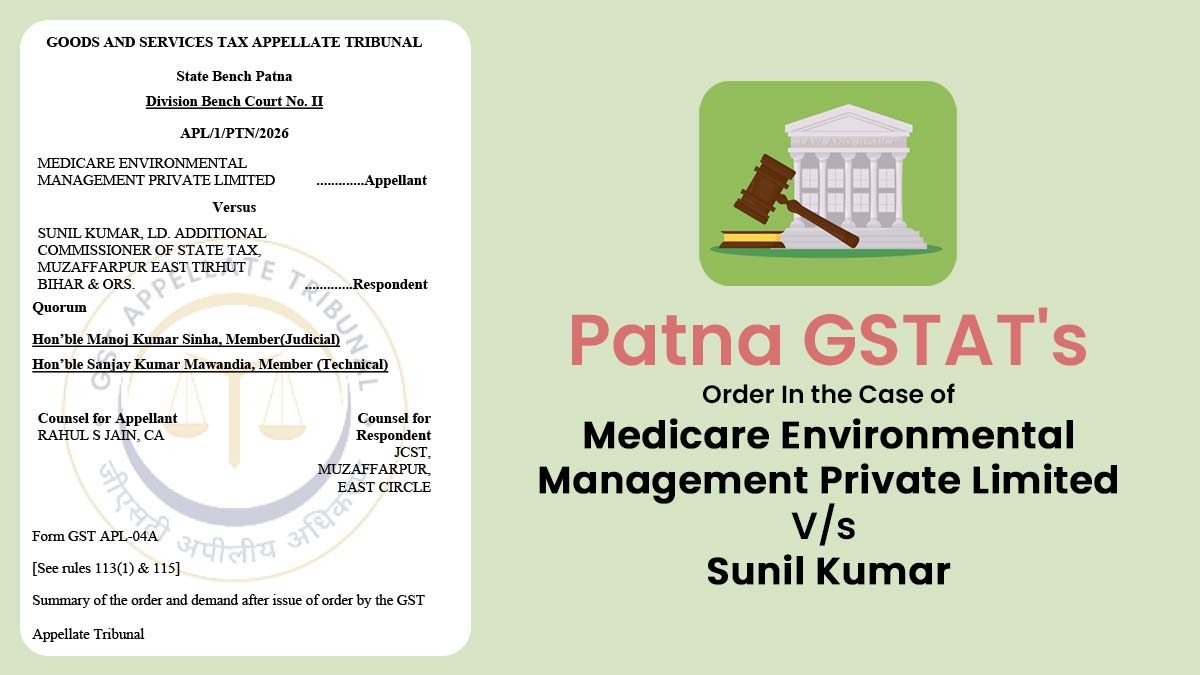
The bench, including Judicial Member Manoj Kumar Sinha and Technical Member Sanjay Kumar Mawandia, was hearing an appeal submitted by Medicare Environmental Management Private Limited, which furnishes biomedical waste management services and sells goods, including plastic waste.
The department treated the difference of ₹1,02,89,923, arising between the ₹1,09,42,270 reported in Table 5G of GSTR-9C (representing turnover for the period April-June 2017, before the implementation of GST on July 1, 2017) and the ₹6,52,347 reported in the Bihar VAT return (Form RT-1) as ‘concealed turnover’.
The company argued that Form RT-1 applies only to goods, whereas the exempted amount of ₹1,02,98,422 derived from biomedical waste management services falls under the purview of service tax (Form ST-3 / Chapter V of the Finance Act, 1994).
Ruling in favour of the company, the Tribunal stated that Section 24(1) of the Bihar VAT Act requires the reporting of transactions involving goods only, not amounts received from services.
“There is nothing on record or nothing has been shown to us that there is legal requirement to declare service receipts in form RT-1, whether as exempt turnover or otherwise,” it stated.
The Tribunal ruled that while an investigation can be initiated under Section 73 of the CGST Act in the event of any discrepancy in GSTR-9C, a tax demand cannot be raised solely on that basis without concrete evidence of a taxable supply on which tax has not been paid.
The Tribunal further stated that transactions proven to have taken place before the implementation of GST cannot be subjected to GST, even if they were not declared under the previous tax regimes.
“Any resulting tax liability or inquiry lies solely with the authorities empowered under those respective acts, not under the GST regime,” the Tribunal expressed.
The Tribunal did not outright accept the appeal, as the company had failed to file a response earlier. It has now presented a detailed breakdown of each transaction along with a CA certificate (dated October 26, 2026).
The Tribunal further noted that the tax calculation of ₹17,59,576 reflects an effective GST rate of 17.1%, which is not a recognised rate.
Recommended: GSTN Opens GSTR-9 and GSTR-9C Annual Return Filing on Portal for FY 2025-26
The Tribunal set aside the previous orders, including the demands for tax, interest, and penalties, and remanded the matter for a fresh decision under Section 113(1) of the CGST Act.
The company is required to submit the necessary documents and returns for verification without any fresh, comprehensive investigation, following which a hearing will be held and a reasoned order will be issued. Any new liability will be determined based on this fresh decision.
| Case Title | Medicare Environmental Management Private Limited vs. Sunil Kumar |
| Case No. | APL/1/PTN/2026 |
| For Appellant | Rahul S Jain |
| For Respondent | JCST |
| Patna GSTAT | Read Order |