

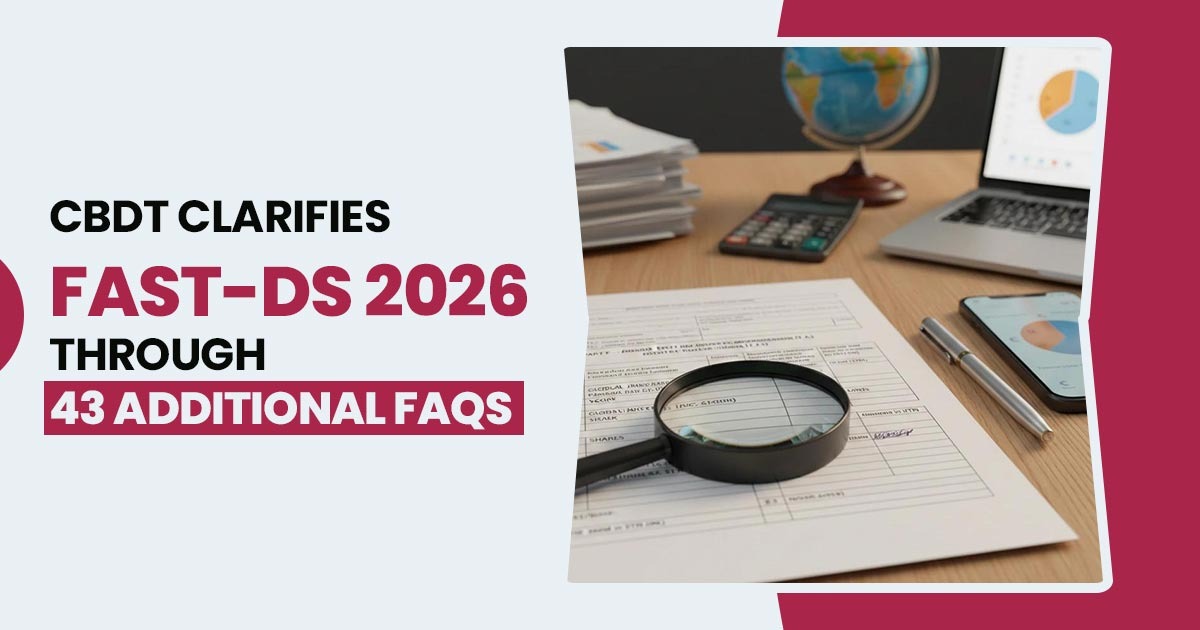
The Income Tax Department has provided supplementary FAQs for the Foreign Assets of Small Taxpayers, Disclosure Scheme (FAST-DS) 2026, stating the method by which taxpayers declare foreign assets and income that were missed in their income tax returns.
These explanations include returning non-residents, jointly held foreign bank accounts, the scheme’s fee structure, and valuation of overseas property. They also specify when the taxpayers can make partial disclosures and whether they can change a declaration after filing the same.
6 things taxpayers must learn before using the scheme.
Returning NRIs Allowed to Retain Overseas Bank Accounts With Post-Tax Funds
Even if you are currently a non-resident, you may still provide information under the FAST-DS scheme regarding a foreign bank account that was opened while you were a resident of India, but which was not reported in ‘Schedule FA’ at that time.
Furthermore, foreign assets acquired during the period when you held the status of an RNOR (Resident but Not Ordinarily Resident) may also be declared under ‘Category B’, provided they were not reported even after you attained the status of an ROR (Resident and Ordinarily Resident).
Joint Holders Must Disclose Foreign Bank Accounts in Their Tax Returns
Major rules for Joint Foreign Bank Accounts are specified below-
Both holders are required to declare undisclosed joint accounts, regardless of who contributed the funds.
Even if one spouse has already disclosed an account, the other spouse may still apply under Category B.
The value of the account is distributed based on defined ownership shares, or, if such shares cannot be determined, it is divided equally.
Under Category B, the eligibility threshold of ₹5 crore is also assessed individually for each declarant, rather than on a joint basis for the account holders.
Read Also: CBDT Rolls Out One-Time Foreign Asset Disclosure Scheme
₹1 lakh fee covers multiple foreign assets across several years
The overview and categories of FAST-DS are mentioned below-
- Category A: A 30% tax plus an additional 30% amount (totalling 60%) must be paid on the value of undisclosed income or assets, subject to a maximum limit of ₹1 crore.
- Category B: Assets acquired out of tax-paid income (which were not included in Schedule FA or for which no return was filed) are covered, up to an aggregate limit of ₹5 crore, upon payment of a flat fee of ₹1 lakh.
- Single Fee Benefit: The Category B fee of ₹1 lakh is applicable once per declaration, covering multiple eligible assets and assessment years.
- Mixed Funding Rule: ‘Category B’ cannot be used for assets financed through both taxed and undisclosed income, although such assets may be eligible for ‘Category A’.
Foreign property valuations get 20% tolerance under FAST-DS
The 20% Valuation Tolerance and Rules:
- Overseas Immovable Property: This applies when the valuation is based on a report from a recognised valuer; it provides a ‘safe-harbour buffer’ of up to 20% on the value determined by the valuation officer (for example, up to ₹72 lakh, with a margin of ₹12 lakh on a valuation of ₹60 lakh).
- Foreign Bank Accounts: This has been excluded from the 20% tolerance, as an account balance is considered something that can be precisely determined.
- Indexed Cost vs. Valuer Report: Using the indexed cost of acquisition effectively establishes a final fair market value, leaving no scope for it to be subsequently adjusted to a higher open-market valuation.
Partial disclosures qualify for immunity under FAST-DS
Taxpayers are not required to declare all of their concealed foreign assets; the exemption applies only to those specific items of income or assets that have been disclosed.
For example, a taxpayer might hold three foreign assets valued at ₹50 lakh, ₹3 crore, and ₹2.5 crore. Even though their combined value is more than the ₹5 crore ‘Category B’ threshold, the taxpayer can still declare the first two assets, which have a total value of ₹3.5 crore under ‘Category B’.
Any foreign asset not included in the declaration receives no protection and remains subject to the risk of taxes, penalties, and legal action.
Declarations for both Category A and Category B can be made together in a single Form 1, provided that each asset meets its respective eligibility criteria.
Important: How Income Tax Filing Will Change After Budget 2026-27?
Taxpayers can revise Form 1 only before Form 2 is issued
The department specified the process for rectifying a declaration. A taxpayer can submit a fresh Form 1 upon determining an omission or error, but only before Form 2 is issued.
After issuance of Form 2 by the department, Form 1 cannot be submitted to add assets or make revisions to the declaration.
Taxpayers must validate the details of their overseas assets, ownership, source of funds, and valuation before filing the form. They must ensure that assets funded via undisclosed income are not accurately positioned under Category B.
These additional FAQs are intended to provide clarity regarding the implementation of FAST-DS; however, taxpayers should verify eligibility conditions and payment-related requirements before making a declaration.
Read the Supplementary FAQs