

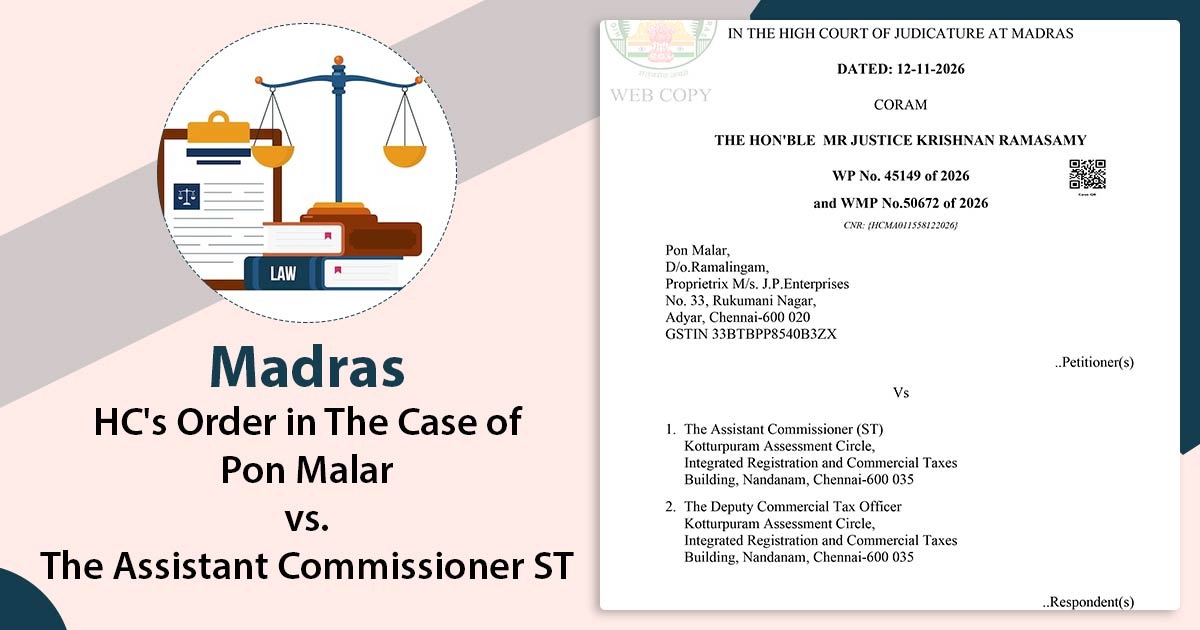
The Madras High Court (Justice Krishnan Ramasamy) has stated that uploading the notices on the GST portal is correct; however, the officers should explore other modes of service under section 169 of the GST Act instead of mechanically passing an ex parte order if the taxpayers did not answer.
The applicant contested an assessment order dated December 26, 2025, which was passed u/s 73 without a personal hearing. She was clueless about the notices uploaded under the portal’s “View Additional Notices and Orders” tab.
The Court remanded the case for fresh consideration, subject to the applicant filing 10% of the disputed tax amount.
In the hearing, the counsel for the applicant agreed to pay 10% of the disputed tax, and the tax department acknowledged that no personal hearing was provided before passing the order. High Court consented to both parties and took up the case for final disposal.
The court observed that the assessment order validated the show cause notice without a personal hearing after the applicant missed the portal upload.
Although uploading documents to the portal is considered legally sufficient service of notice, if a taxpayer repeatedly fails to respond to reminders sent via the portal, authorities should exercise their discretion and consider other modes of service of notice as provided u/s 169.
High Court said that mechanically passing ex parte orders without proper communication only leads to fulfilling empty formalities and triggers avoidable multi-level litigation.
Although service via the portal remains valid, in cases where there is no response to repeated notices sent through the portal, authorities should employ other methods-such as ‘Registered Post with Acknowledgement Due (RPAD)’-as provided for under Section 169(1).
Given the lack of sufficient effort to effectively serve the notice, and taking into account the petitioner’s willingness to pay a portion of the disputed tax, the Court set aside the assessment order dated December 26, 2025, subject to certain conditions, and remanded the matter for fresh consideration.
Also Read: Madras HC Upholds Validity of GST Notice and Order Served via Web Portal U/S 169
The High Court disposed of the writ petition without analysing the merits of the tax demand, specifying a stringent duration for fresh consideration.
The petitioner is liable to pay 10% of the disputed tax within four weeks of receiving the order. The assessment order will only be quashed upon this payment.
The applicant should file her objections along with supporting documents within 3 weeks of payment.
The assessing authority will review the reply, issue a hearing notice permitting 14 clear days, and promptly pass a fresh order based on the merits.
| Case Title | Pon Malar vs The Assistant Commissioner (ST) |
| Case No. | WP No. 45149 of 2026 WMP No.50672 of 2026 |
| For Petitioner | Mr. Vinodh B. |
| For Respondent | Mr. I. Dinesh Additional Government Pleader (Taxes) |
| Madras High Court | Read Order |