

The applicant was registered under the CGST Act in July 2017. On January 11, 2020, the company applied for the cancellation of its GST registration, effective from December 31, 2019, due to the discontinuation and closure of its business.
However, this application remained pending with the GST Department. In the meantime, on September 15, 2022, the Department issued a notice in FORM GST ADT-01 u/s 65 of the CGST Act, proposing an audit of the company’s books of account and records for the period from July 1, 2017, to March 31, 2021. The petitioner was also instructed to provide the documents specified in the notice.
The applicant approached the High Court because of the delay in processing its cancellation application. The approach was through an earlier writ petition, W.P.(C) 5805/2023, seeking cancellation of its registration retrospectively from December 31, 2019.
With the order dated May 4, 2023, the Court asked the department to process the application and make the cancellation effective from the requested date. It directed that returns submitted for the following period be considered void.
Afterward, the applicant contested the audit notice via the existing writ petition, claiming that once its registration had been cancelled from December 31, 2019, it could no longer be considered a registered person u/s 65 of the CGST Act.
It stated that the department does not have jurisdiction to perform an audit, especially for the period that comes beyond the effective date of cancellation.
In this case, the petitioner’s registration was considered suspended effective from January 11, 2020. However, this suspension did not result in the termination of the registration. When the audit notice was issued on September 15, 2022, an application for the cancellation of the registration was still pending.
The Court said that the term registered person u/s 65 should be interpreted for an audit. U/s 2(13) of the CGST Act, an audit analyses records, returns, transactions, ITC claimed, and refunds claimed to validate compliance with the GST law. Thus, the provision cannot be confined merely to the individuals whose registration remains effective on the audit date.
The Court stated that allowing an audit does not signify that the department can consider returns submitted after 31 December 2019 as lawfully valid or disregard the retrospective cancellation order. Accordingly, the Delhi High Court dismissed the writ petition.
The Court held that the cancellation of a GST registration with retrospective effect from December 31, 2019 does not render the audit notice dated September 15, 2022, beyond the scope of jurisdiction, whether in its entirety or in relation to the subsequent period.
The court refused to interfere with the audit notice and lifted the interim stay that had been imposed on December 5, 2023.
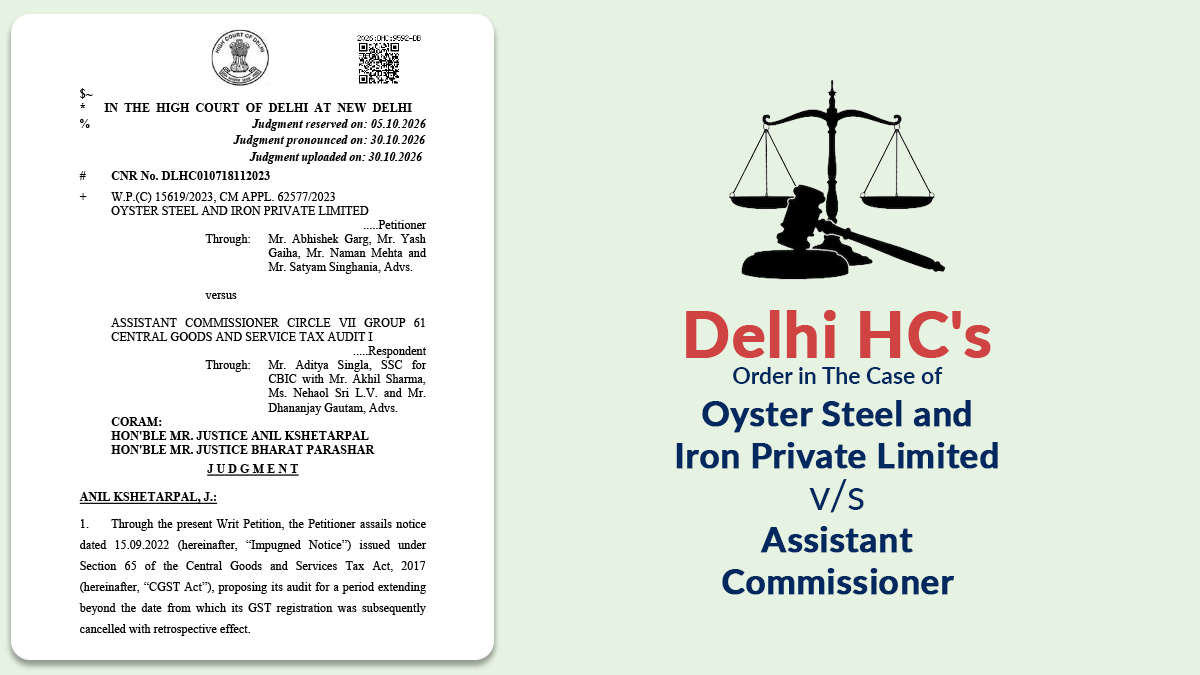
| Case Title | Oyster Steel and Iron Private Limited vs. Assistant Commissioner |
| Case No. | W.P.(C) 15619/2023, CM APPL. 62577/2023 |
| For Petitioner | Mr. Abhishek Garg, Mr. Yash Gaiha, Mr. Naman Mehta and Mr. Satyam Singhania, Advs |
| For Respondent | Mr. Aditya Singla, SSC for CBIC with Mr. Akhil Sharma, Ms. Nehaol Sri L.V. and Mr. Dhananjay Gautam, Advs. |
| Delhi High Court | Read Order |