

The Central Board of Indirect Taxes and Customs (CBIC) has given clarifications regarding the classification and GST treatment of four categories of goods, addressing uncertainties that have caused issues and uneven tax treatment.
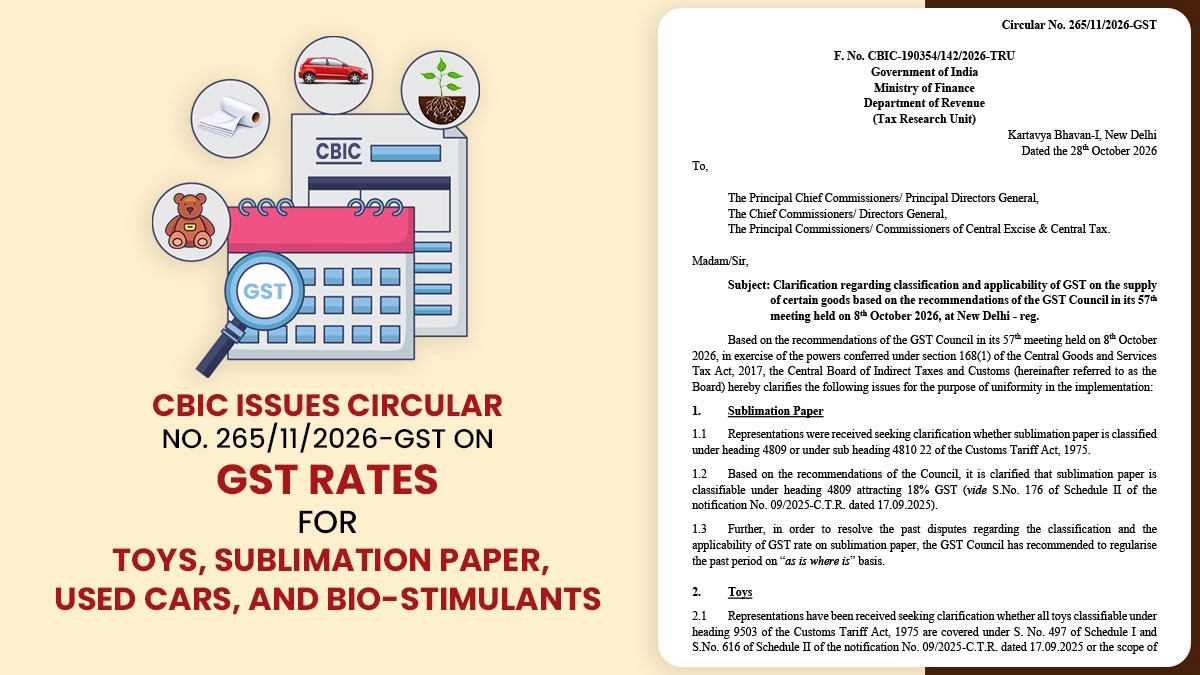
The Ministry of Finance, through Circular No. 265/11/2026-GST dated October 28, 2026, has specified the applicable GST treatment of sublimation paper, toys, old and used motor vehicles supplied under the margin scheme, and seaweed extract-based bio-stimulants.
The clarifications have come after the suggestions made at the 57th GST Council meeting held in New Delhi on October 8, 2026. The motive of the circular is to ensure consistent implementation of GST provisions and resolve the problems of classification faced by businesses and tax authorities.
The important information from the updated CBIC circular.
18% GST on Sublimation Paper
CBIC said that sublimation paper falls under heading 4809 of the Customs Tariff Act, 1975, and attracts 18% GST.
This addresses representations seeking clarification on whether sublimation paper should be classified under heading 4809 or sub-heading 4810 22.
In the circular, the applicable GST rate is 18% under Serial No. 176 of Schedule II of Notification No. 09/2025-Central Tax (Rate), dated September 17, 2025.
Relief from Past Classification Disputes
To resolve disputes regarding the classification and GST rate applicable to sublimation paper during the previous period, the GST Council has advised regularisation on an “as-is, where-is” basis.
This measure aims to clarify the existing disputes concerning the classification and tax treatment of the product.
GST Rate on Toys: Clarification Includes More Than Wheeled Toys
CBIC has mentioned the scope of GST rate entries that are applicable to toys falling under heading 9503 of the Customs Tariff Act, 1975.
Earlier, specific field formations had interpreted the pertinent notification entries selectively, creating uncertainty over whether the entries applied only to toys cited in the notification, such as tricycles, scooters and pedal cars.
The latest clarification validates that the scope of such entries is not confined to the toys mentioned in the notification.
The word “etc.” includes other categories of toys that come under heading 9503, including:
- Dolls
- Other toys
- Dolls’ carriages
- Puzzles of all kinds
- Reduced-size or scale models and similar recreational models, whether working or not
Read Also: Important GST Checklist Guide to CA and Tax Professionals
Applicable GST Rates on Toys
The circular stated the following GST rate entries under Notification No. 09/2025-Central Tax (Rate), dated September 17, 2025:
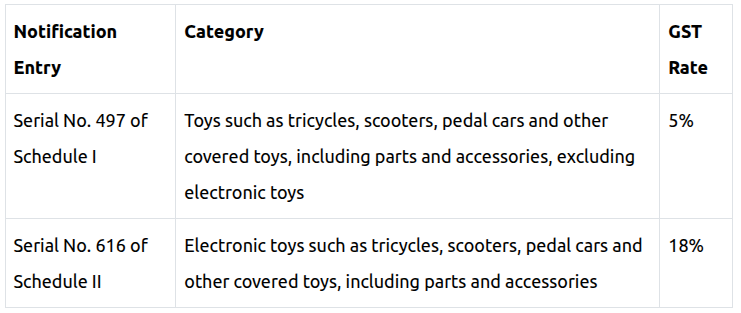
The clarification is crucial for businesses engaged in manufacturing, importing, and supplying toys, as it addresses the interpretation of the pertinent notification entries and has the motive to advance consistent GST treatment.
Used Car Margin Scheme: ITC permitted on Eligible Business Inputs and Services
The clarification of the availability of ITC for suppliers dealing in old and used motor vehicles under the GST margin scheme.
Representations have asked for clarification on whether the ITC restriction for claiming concessional GST and compensation cess rate is applicable merely to the purchase of old and used motor vehicles or extended to other goods and services used in the business.
The CBIC has clarified that this restriction, subject to the provisions of the CGST Act, 2017, does not apply to the Input Tax Credit (ITC) available on eligible inputs or input services, other than those related to old and used motor vehicles.
Therefore, the suppliers functioning under the said margin scheme notifications can claim the ITC on eligible business expenses, including:
- Rent
- Repair and maintenance services
- Advertisement services
- Marketing services
- Spare parts
- Technology services
Understanding ITC Restrictions Under the GST Margin Scheme
The circular clearly states that the restriction on the Input Tax Credit (ITC) under the specified margin scheme notifications applies only to the tax paid on procured second-hand motor vehicles.
This restriction does not apply to eligible ITC on other inputs and input services used in the business.
The clarification specifically pertains to Notification No. 08/2018-Central Tax (Rate), Notification No. 09/2018-Integrated Tax (Rate), and Notification No. 01/2018-Compensation Cess (Rate), all dated January 25, 2018.
However, businesses must continue to meet the applicable conditions and provisions of the CGST Act, 2017, to claim ITC on eligible inputs and input services.
GST Classification of Seaweed Extract-Based Bio-Stimulants Under Heading 3101
The Central Board of Indirect Taxes and Customs (CBIC) has provided clarification regarding the GST classification of seaweed extract-based bio-stimulants.
This clarification specifically addresses whether these products should be categorised as fertilisers under heading 3101 or as plant-growth regulators under heading 3808 of the Customs Tariff Act.
As per the circular, seaweed extract-based bio-stimulants that are registered under Schedule VI of the Fertiliser (Inorganic, Organic or Mixed) (Control) Order of 1985 will be classified under heading 3101.
The relevant entry is Serial No. 237 of Schedule I of Notification No. 09/2025-Central Tax (Rate), dated September 17, 2025.
The GST Council’s recommendations have been implemented with the addition of an explanation in the relevant notification entry.
Past Classification Disputes to Be Settled
The GST Council has suggested regularisation of the past period on an “as is, where is” basis to resolve issues related to the classification of these bio-stimulants.
The clarification furnishes certainty for the classification of the mentioned registered products. Businesses must validate that their products fulfil the registration and classification conditions specified in the circular.
CBIC Instructs Field Formations to Implement the Issued Clarifications
This circular instructs the relevant field units to implement the clarifications, so as to ensure uniformity in the execution of GST provisions.
These instructions have been issued u/s 168(1) of the Central Goods and Services Tax Act, 2017.
Important: GST Filing Errors and How Software Controls Them
The objective of this circular is to resolve differences in interpretation and to provide clarity regarding the classification of the goods in question and the taxes applicable to them.
Read Circular No. 265/11/2026-GST