

Neelima Goenka is a registered taxpayer operating a business as M/s Shri Krishna Enterprises. She claimed ITC of Rs. 1,62,818.76 in her GSTR-3B return for April 2019. However, the credit shown in her GSTR-2A for that month was just Rs. 25,056, which led to an alleged mismatch of nearly Rs. 1,37,762.
The proper officer issued a notice under section 73 of the CGST and SGST Act, 2017, and subsequently passed an order on December 22, 2020, demanding tax amounting to a total of Rs. 1,92,865.92, along with interest and penalties. The demand was due to an alleged excess claim and use of ITC.
However, on July 11, 2022, her appeal was dismissed ex parte because she did not appear for the hearing. Dissatisfied with this decision, she approached the GST Appellate Tribunal. She argued that the credit pertained to actual inward supplies received during the financial year 2018-19 and that it had been claimed within the time limit prescribed by law.
The Tribunal discovered that the ITC claimed by the appellant in April 2019 related to actual purchases and inward supplies made during the financial year 2018-19, which could not be claimed in the relevant returns due to an oversight. As the claim for the credit was within the applicable statutory time limit, the Tribunal stated that the appellant was qualified under the law to claim the credit under Section 16(4) and Section 39(9) of the Act.
The Tribunal said that the notices were uploaded under the “Additional Notices & Orders” tab on the GST portal, rather than under the main “Notices & Orders” tab. The ruling stated that this form of communication denied the appellant an opportunity to engage in the proceedings. Additionally, the adjudicating authority did not offer a personal hearing, even though it anticipated making an unfavourable decision, which violated Section 75(4) of the Act.
The Tribunal determined that the appellate authority dismissed the first appeal without properly examining the grounds raised or the supporting documents. This is contrary to Section 107(12), which mandates that an appellate order must record the points for determination, decisions, and reasons.
Therefore, both the original demand order dated 22 December 2020 and the appellate order dated 11 July 2022 were quashed. As a result, the demand was dismissed, and any amount paid as part of the challenged proceedings was ordered to be refunded according to the law, pending verification of the payment and compliance with statutory requirements.
Therefore, the GSTAT accepted the appeal, set aside the ‘Order-in-Original’ dated December 22, 2020, and the ‘Order-in-Appeal’ dated July 11, 2022, and quashed the demand of Rs 1,92,866.
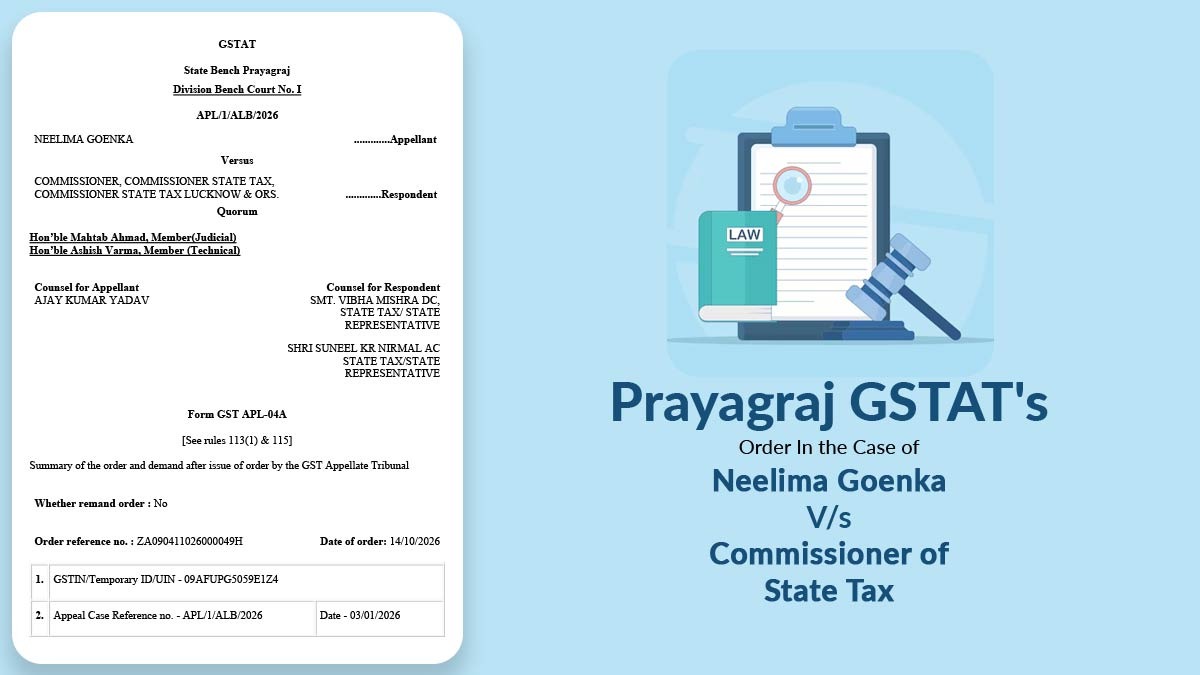
| Case Title | Neelima Goenka Vs Commissioner of State Tax |
| Order No | APL/1/ALB/2026 |
| Counsel for Appellant | Ajay Kumar Yadav |
| Counsel for Respondent | Vibha Mishra DC, Suneel Kr Nirmal AC |
| Prayagraj GSTAT | Read Order |