

The Orissa High Court has issued a notice on an appeal contesting the constitutional validity of Section 147A of the Income Tax Act, 1961, which was introduced by the Finance Act, 2026, with retrospective effect from April 1, 2021.
Section 147A was introduced to clarify that the ‘Assessing Officer’ issuing notices under Sections 148 and 148A refers to an officer distinct from the ‘National Faceless Assessment Centre’ or an ‘Assessment Unit’ as defined u/s 144B. This provision was implemented with retrospective effect from April 1, 2021.
A division bench comprising Dr. Justice Sanjeeb K. Panigrahi and Justice Murahari Sri Raman also noted that the Supreme Court has already stayed further assessment and re-assessment proceedings in the matter concerned; therefore, no separate interim order is required at this phase.
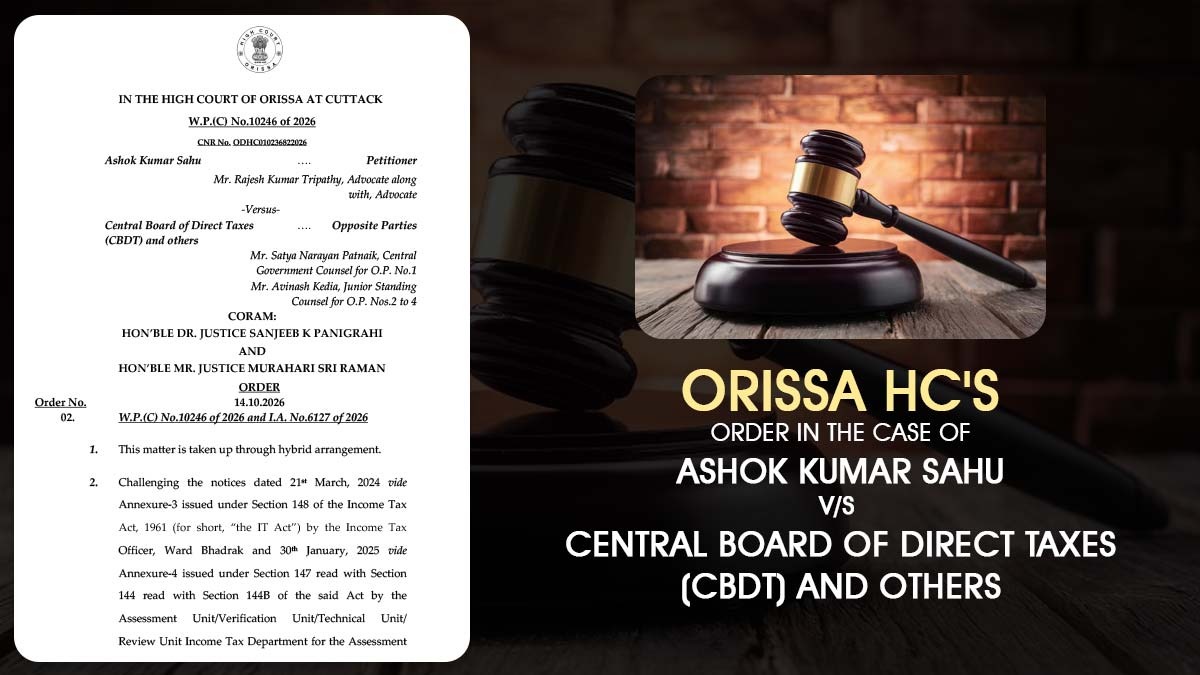
The applicant contested a reassessment notice on March 21, 2024, issued by the Income Tax Officer, Ward Bhadrak, u/s 148 of the Act, along with a subsequent order dated January 30, 2025, concerning AY 2017–18. The petition also sought to have Section 147A declared unconstitutional.
The challenge is related to whether Jurisdictional Assessing Officers can issue reassessment notices when the faceless assessment framework u/s 151A and the scheme reported by the Central Government in 2022 specify a procedure involving automated allocation.
The applicant said that the Jurisdictional Assessing Officer has issued the reassessment notices without complying with the stipulated faceless procedure.
The petitioner argued that the retrospective implementation of Section 147A could not rectify the legal flaw and that the provision itself was unconstitutional.
Other High Courts have also addressed this issue. Recently, on October 12, 2026, the Andhra Pradesh High Court, in the case of Bala Sreenivas Rao Somisetty v. ITO, declared Section 147A unconstitutional. The court ruled that this provision could not validate reassessment notices that were issued without adhering to the relevant faceless assessment framework.
The Punjab and Haryana High Court had also declared Section 147A unconstitutional in Jyoti Sareen v. Union of India on September 10, 2026.
However, the Union Government contested the ruling before the Supreme Court in Union of India v. Bharat Industrial Enterprises Pvt. Ltd. On September 18, 2026, the Supreme Court granted leave to appeal and stayed the judgment of the Punjab and Haryana High Court.
It was directed that the assessment and re-assessment proceedings related to the dispute should not proceed further until the matter is finally settled.
The Orissa High Court referred to the Supreme Court’s order dated April 10, 2026, in Income Tax Officer v. Tej Pratap Singh. In that matter, the Supreme Court had allowed taxpayers to revise their writ petitions to contest the constitutional validity of section 147A.
The Bench observed that the Supreme Court had stayed further assessment and reassessment proceedings following the notices u/s 148.
Also Read: HP High Court Permits Fresh Challenge to Section 147A After SC Remand
The Orissa High Court, concerning existing protection, has said that no interim order was required.
It provided notice to the respondents and directed that the case be listed on December 16, 2026, along with Aditya Park Properties Pvt. Ltd. v. CBDT, which raises a related issue.
| Case Title | Ashok Kumar Sahu vs Central Board of Direct Taxes (CBDT) and others |
| Case No. | W.P.(C) No.10246 of 2026 |
| For Petitioner | Mr. Rajesh Kumar Tripathy |
| For Respondent | Mr. Satya Narayan Patnaik |
| Orissa High Court | Read Order |