

The Bombay High Court has ruled that the Income Tax Department cannot delay calculating the limitation period for completing an assessment while waiting for a certified copy of a court order, provided the relevant tax authorities have already received a digitally signed copy.
“In this era of electronic filing and electronic uploading, and in order to alleviate difficulties of the litigants before us, this is a practice which this Court has adopted. Instead of asking a litigant to apply for a certified copy of the order on payment of fees, a digitally signed copy of the order can be produced before a party, and such order has to be acted upon,” a Division Bench of Justices B.P. Colabawalla and Farhan P. Dubash stated.
The Court made this observation while quashing the Income Tax Department’s order for a second special audit, which had been issued after the statutory deadline for completing the assessment had expired.
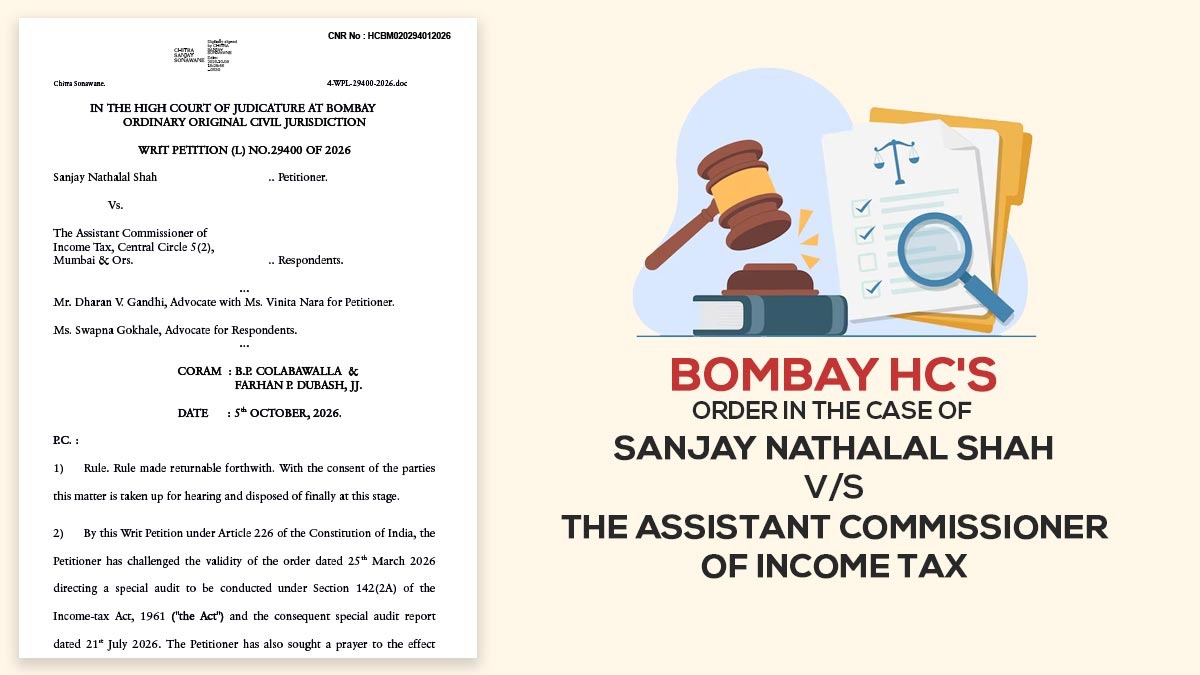
The case is related to Sanjay Nathalal Shah, whose previous special audit was set aside by the HC as it was based on the invalid prior approval. The department then ordered another special audit. Shah contested the fresh order, claiming that the time specified for finishing his assessment had already lapsed.
The dispute centred on the date from which the Department should begin calculating the limitation period following the quashing of the previous special audit order.
Shah argued that the count should commence on January 9, 2026, the date the previous order was uploaded to the High Court’s website, whereas the Department contended that the correct date was February 4, 2026, when the Principal Commissioner received the certified copy.
The court rejected the claim of the department and analysed clause (iv) of Explanation 1 to Section 153 of the Income-tax Act, 1961, which provides for the exclusion of time when a special audit direction is contested before a court.
Read Also: Bombay HC: Delay in Filing ITR Due to CA’s Advice Does Not Constitute Assessee’s Negligence
The provision is related to the date on which the order quashing the audit direction is obtained by the Principal Commissioner or Commissioner. Unlike the provisions regarding the lifting of the stay on assessment proceedings, there is no specific requirement to obtain a certified copy in this instance.
“Thus, there was no need for the Department to wait for a certified copy of the order to be presented to the Principal Commissioner for the computation of the period of limitation to commence,” the court stated.
The court observed that Shah’s counsel had shared the digitally signed order with the Deputy Commissioner of Income Tax through WhatsApp on January 10, 2026. On January 12, 2026, the ITO (Judicial) had emailed the digitally signed order to the Principal Commissioner.
The court placed reliance on CBDT Instruction No. 2/2022, which requires the department to quickly circulate the orders of the High Court and download them as soon as they are uploaded. It also stated that February 4, 2026, could not be deemed as the date of receipt since the digitally signed order had reached the authorities in January.
The deadline for the assessment was March 13 at the latest. The Court set aside the special audit order dated March 25 and the associated report. Citing CIT v. Shelly Products (2003), the Court held that the income declared in the return would be deemed accepted.
| Case Title | Sanjay Nathalal Shah vs. The Assistant Commissioner of Income Tax |
| Case No. | 29400 OF 2026 |
| For the Appellant | Mr Dharan V. Gandhi, Ms Vinita Nara |
| For the Respondent | Ms. Swapna Gokhale |
| Bombay High Court | Read Order |