

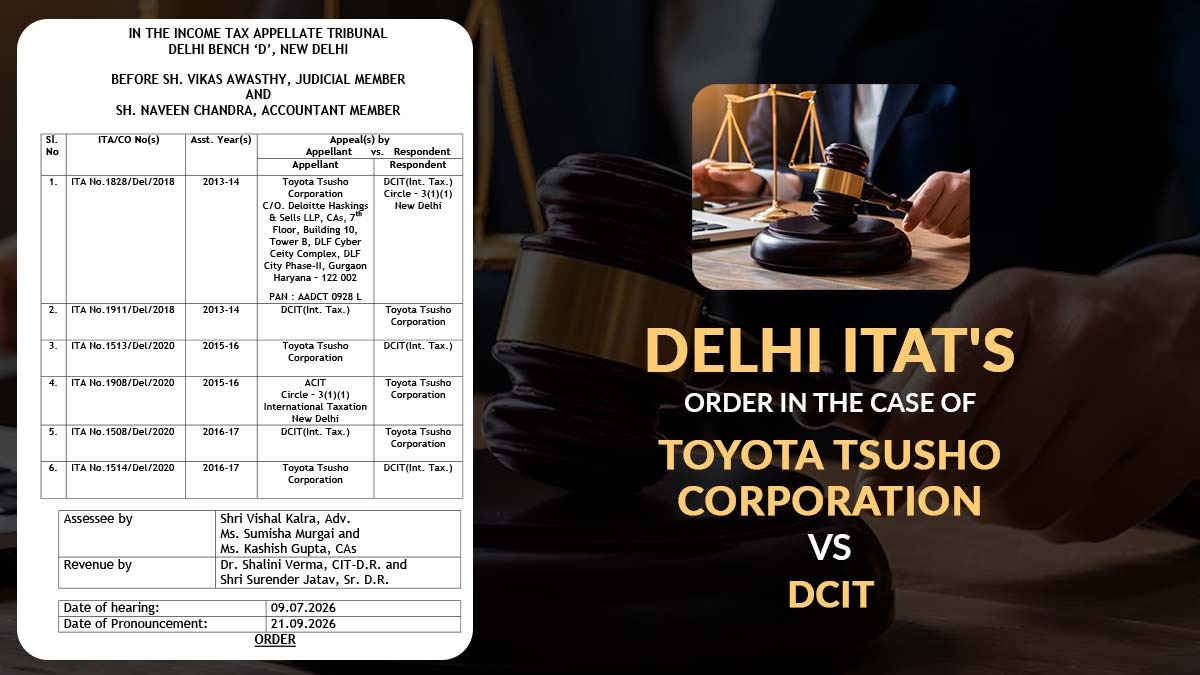
The New Delhi Bench of the Income Tax Appellate Tribunal (ITAT) ruled that the reimbursement of salary costs on a cost-to-cost basis for employees sent on deputation does not fall within the tax ambit as ‘Fees for Technical Services’ (FTS) in India.
The taxpayer, Toyota Tsusho Corporation, received ₹2,08,41,050 from Toyotsu Rare Earths India Private Limited (TREI) as reimbursement for the salary costs of expatriate employees deputed to the Indian entity.
The employees worked for the Indian entity, while their salaries were initially paid by the assessee under an administrative arrangement and subsequently reimbursed on a cost-to-cost basis without any markup. The Transfer Pricing Officer also acknowledged that the reimbursement was made at cost.
The taxpayer argued that the reimbursement was essentially a salary cost and could not be classified as ‘fees for technical services‘ in their case. Furthermore, the reimbursement of salary costs to a foreign affiliate without any markup or additional payment cannot be taxed by treating it as ‘fees for technical services’.
Furthermore, it was stated that tax had already been deducted at source from the salaries of foreign employees in India under Section 192 of the Income Tax Act, and the same amount could not be treated as ‘fees for technical services’ in the case of the assessee.
The taxpayer said that, in refusing the claim, the Commissioner of Income Tax (Appeals) had made a mistake only because the taxpayer had proposed the tax reimbursement in its return. Accordingly, the taxpayer requested the exclusion of the reimbursement of the foreign employee’s salary from their taxable income.
Also Read: FTS (Fee For Technical Services) U/S 9(1)(vii) Covers Specialized Knowledge Transfer: Delhi HC
Vikas Awasthy, Judicial Member, and Naveen Chandra, Accountant Member, observed that in this case, the assessee made a payment of ₹2,08,41,050 towards the salaries of foreign employees working for TREI. The assessee had sent these employees to TREI on deputation.
Subsequently, TREI reimbursed this amount on a cost-to-cost basis, without any markup. We also note that the TPO did not object to the fact that the amount was reimbursed on a cost-to-cost basis.
Reliance was placed on the decision of the Bangalore Bench in the matter of Toyota Boshoku Automotive India (P.) Ltd. vs DCIT, wherein it was determined that employees deputed to the Indian company would be considered employees of that company and the reimbursement made by the Indian company to the non-resident AE would be treated as salary rather than FTC; consequently, the AE would not be liable to pay tax on this reimbursement.
Therefore, the bench said that the reimbursement of salary costs of deputed employees does not constitute taxable income in the hands of Toyota Tsusho Corporation.
The Delhi High Court in Commissioner of Income Tax (Appeals) vs Bharat General Reinsurance Co. Ltd. (supra) and the Bombay High Court in Balmukund Acharya, respectively, held that the doctrine of ‘estoppel’ cannot be invoked against the law.
Furthermore, a receipt that does not fall within the tax net under the law cannot be brought within the scope of taxation merely because the taxpayer had mistakenly admitted it to be so. Thus, the tribunal concluded that the reimbursement of deputed salary must not be included in the taxable income.
| Case Title | Toyota Tsusho Corporation Vs DCIT |
| Case No. | ITA No.1828/Del/2018 |
| For Petitioner | Shri Vishal Kalra, Ms Sumisha Murgai, Ms Kashish Gupta |
| For Respondent | Dr Shalini Verma, Shri Surender Jatav |
| Delhi ITAT | Read Order |