

The Supreme Court has affirmed that departmental circulars, instructions, and administrative clarifications are binding on departmental officials, but they are not binding on the High Court or the Supreme Court when interpreting legal provisions.
Justice S.V.N. Bhatti and Justice N.V. Anjaria referred to Ratan Melting & Wire Industries, where it was held that:
“Administrative Circulars and clarifications issued by the Central or State Governments merely reflect the Executive’s understanding of statutory provisions. Such Circulars are not binding on the courts. Under the constitutional framework, only the Judiciary can interpret statutory provisions. The Executive does not have this power.”
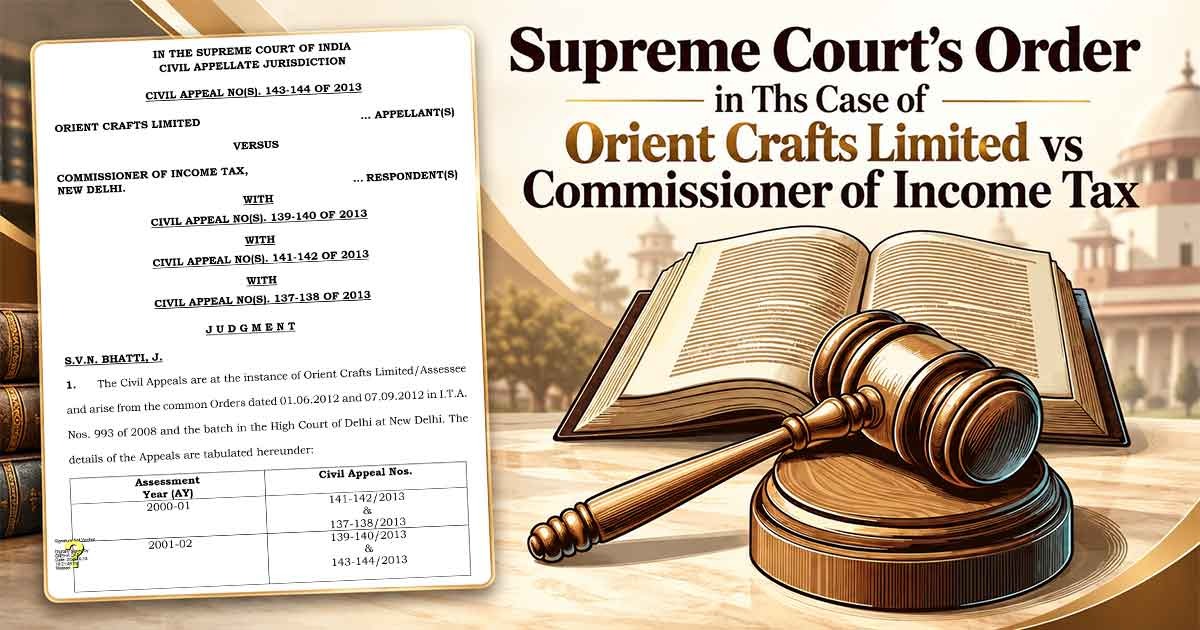
The Court heard the appeal submitted by Orient Crafts Ltd and Samtex Fashions Ltd concerning the claim for deduction u/s 80HHC of the Income Tax Act, 1961 for the proceeds from the sale of export quota.
On the transfer of export quotas, the taxpayer obtained a premium. This was based on a CBDT office memorandum citing that the premium could be treated in the same manner as profits derived from the sale of import licences, cash assistance on exports, and duty drawbacks. Thus, it is eligible for a deduction u/s 80HHC.
Counsel for the appellant submitted that the Department cannot take a stance contrary to its own circular. He claimed that the Department cannot challenge the orders of the CIT(A) and the ITAT because a departmental circular is inconsistent with the statute or deviates from its strict provisions.
Upon the filing of the appeal, the High Court observed that quota permits are not issued under the ‘Imports (Control) Order, 1955’; therefore, Section 28(iiia) is not applicable. Furthermore, since earnings derived from quotas do not constitute cash assistance or duty drawback, Sections 28(iiib) and 28(iiic) are also inapplicable.
The HC stated that even if the CBDT issues a circular beneficial to the taxpayer, the Income Tax Department retains the right to challenge a court or tribunal order if it believes the law has been misinterpreted.
Read Also: Step-by-Step Guide To File Income Tax Return FY 2025-26
Subsequently, following an adverse High Court ruling, the taxpayers filed an appeal with the Supreme Court.
In its verdict, the Supreme Court clarified that any circular or clarification that contradicts the law or a judicial decision holds no legal validity.
The Bench observed that the department’s circular attempted to impose a ‘legal fiction’ by treating income derived from the sale of export quotas as specific business profits under Sections 28(iiia) to 28(iiic). It was clarified that the sale of export quotas does not possess the specific characteristics inherent in those particular provisions.
The Court stated that even if government circulars run counter to laws enacted by Parliament, compelling the Court to adhere to them would violate the fundamental constitutional principles governing the interpretation of tax laws.
It also upheld the High Court’s ruling that the department can contest any incorrect interpretation of the circular.
“….if the Revenue were permanently barred by its own Circular from questioning a legal interpretation in Court, the Department could never appeal an erroneous Tribunal decision. Since an assessee benefiting from a circular would never appeal, the true statutory meaning could never be adjudicated by the High Courts or the Supreme Court,” the division bench stated.
Accordingly, the Supreme Court refused to enforce the department’s circular, which sought to treat the premium earned from the sale of export quotas as business profits under Sections 28(iiia) to 28(iiic). Upholding the High Court’s decision, the Supreme Court granted no relief to the appellants.
| Case Title | Orient Crafts Limited vs Commissioner of Income Tax |
| Case No. | Civil Appeal No. 143-144 OF 2013 |
| Supreme Court | Read Order |