

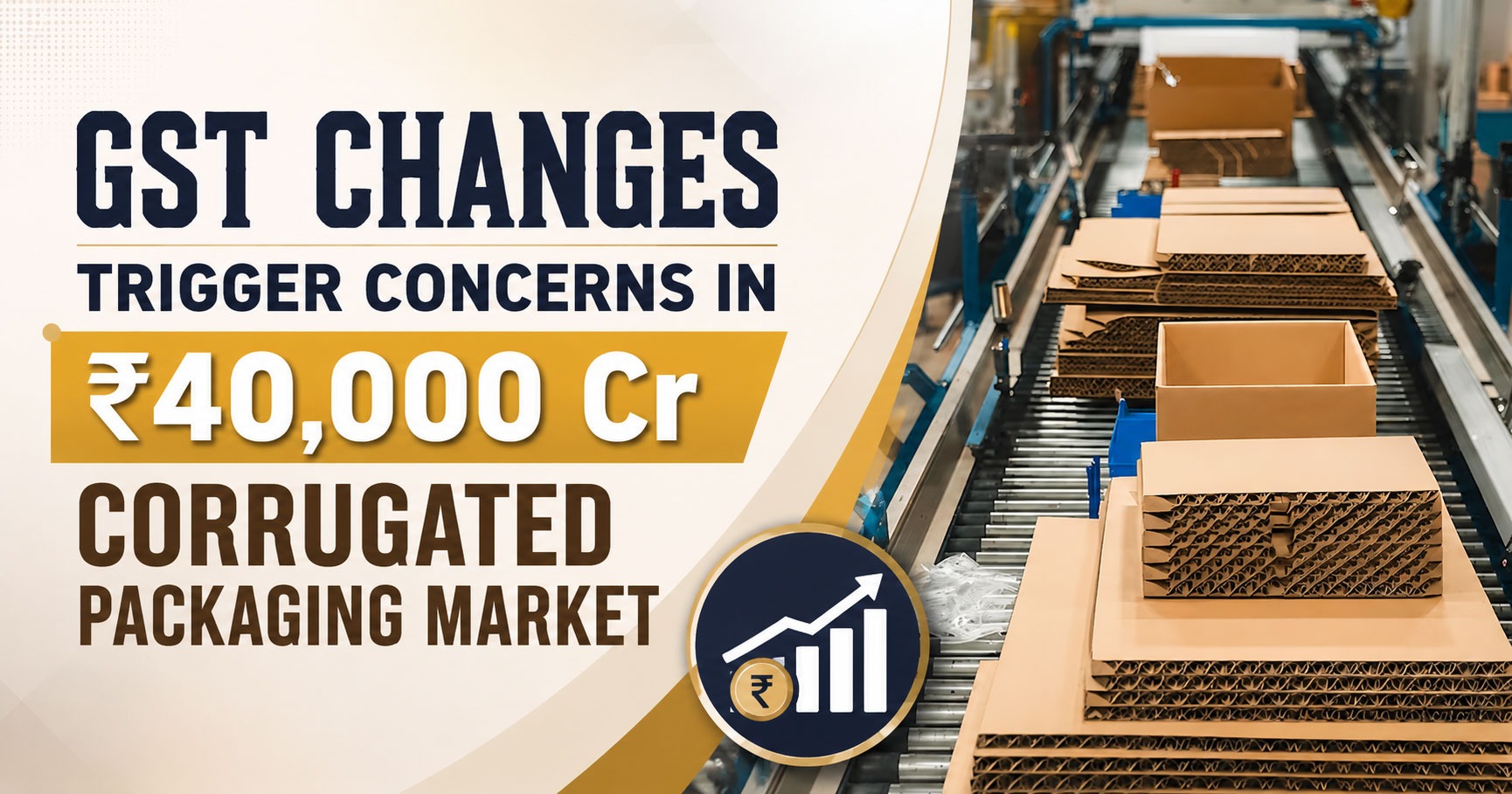
The ₹40,000 crore corrugated packaging industry has described the modifications to the GST from September 2025. Especially, the tax on raw materials has been raised to 18%, while the tax levied on finished goods has been reduced to 5%.
The corrugated packaging industry includes micro, small and medium enterprises (MSMEs) and manufactures the brown boxes that are used in food, agricultural produce, medicines, electronics, textiles, engineering goods and e-commerce shipments.
As of September 2025, the GST on finished corrugated boxes has been reduced to 5%, while the tax on its primary raw material, kraft paper, remains at 18%. Consequently, manufacturers collect a massive GST ITC that can not be entirely used against their output tax liability.
All Micro, Small and Medium Enterprises (MSMEs)
Efficient packaging is the major component on which manufacturing policies of the Government depend. India can become a global manufacturing and export hub if the manufacturing industries also remain financially competitive. It is concerned with strengthening India’s manufacturing value chain.
More than 15,000 manufacturing units produce corrugated boxes, and all come under the ambit of the MSME sector.
The corrugated packaging industry just seeks restoration of GST neutrality and is not asking for concessions in tax or financial incentives. A tax framework must promote value addition.
Because of the absence of neutrality in the GST, Rs 366 crore of the industry’s working capital is stuck every month. The structure needs immediate correction for corrugated box manufacturers.
Locked Funds
Only some manufacturing sectors can assert such prevalent economic relevance. Every policy whose purpose is to promote domestic manufacturing exports, logistics, or e-commerce relies on reliable and cost-effective packaging.
The funds that shall be used towards technology upgrades, automation, capacity expansion, employee development, or exports are stuck in tax credits.
Instead of improving liquidity, the revised GST structure has inadvertently reduced it.
The requirements for higher borrowing and the rise in finance costs surge from the blocked tax credits for the MSME corrugated box industry.
Time-Consuming Process
While refund mechanisms are available under GST, the process can be lengthy, requires extensive documentation, and places a significant administrative burden on businesses. Delayed refunds can worsen cash flow challenges for companies that are already operating on narrow profit margins.
Important: OPA Strongly Objects to Centre’s 18% GST Rate on Paperboard
The problem goes beyond just raw materials. The input tax paid on many services and capital goods is not fully refundable under the current framework, which raises the cost of new investments.
For an industry that needs continuous modernisation to enhance quality, productivity, and sustainability, this situation discourages technological advancements.
Corrugated packaging is biodegradable, recyclable, renewable, and forms an element of a well-established circular economy based on recovered fibre.
As compared to other alternative packaging materials, corrugated boxes already satisfy several environmental objectives without any additional incentives.
Supporting this industry is not only an industrial policy objective, but it also promotes national environmental objectives.
We are focused on restoring GST neutrality, the fundamental principle that taxes should not add to costs in the production chain.
Read Also: Gujarat AAR: Paper Bags Attract 5% GST, Rejects 18% Tax Classification
He mentioned that the ICCMA, in collaboration with industry stakeholders and professional advisors, has chosen to engage constructively rather than confrontationally.
Detailed proposals have been given, and discussions have taken place with policymakers at various levels. We admire the government’s willingness to listen to industry concerns and remain hopeful that this long-standing issue will be resolved through GST rationalisation.
Representations have been made to Finance Minister Nirmala Sitharaman, senior officials in the Ministry of Finance, GST Council members, the GST Fitment Committee, and various state governments.
The government could reduce the GST on kraft paper to 5% or increase the GST on corrugated boxes to 18%, while ensuring full input credit flow.