

The Supreme Court has said that the omission of Rule 96(10) of the GST (Goods and Services Tax) Rules applies to pending proceedings for IGST refunds.
“The intention to omit the rule without any saving clause was to bring to an end the unnecessary complications once and for all and the intention cannot be to keep alive the unnecessary complications insofar as the pending proceedings are concerned.”
The Union of India and the Department submitted the SLP against the judgment, which stated that the omission of Rule 96(10) of the GST rules applies to every pending proceeding as on the date of its omission, which favoured assessees including Hikal Limited.
The court entertained the issue whether the omission of Rule 96(10) through Notification No.20/2024 would eliminate the benefit of the taxpayer in the proceedings
Claims are specified for the refund of integrated tax paid on goods and services exported out of India. It was unclear whether these pending refunds would be regarded without the restriction under sub-rule 10.
The taxpayer said that the sub-rule was revoked without a saving clause. Thus, it applies to all the pending proceedings. Although the claim was not accepted by the Additional Solicitor General appearing for the Union of India.
On the request of the AGST, the apex bench observed the minutes of the 54th meeting of the GST Council. ASG, at the time of the proceedings, stated that the suggestions are merely advisory and that it is not obligatory to consider them. It was asserted that the same is prospective.
The words from the minutes of the GST Council meeting read:
“The Law Committee observed that operation of rule 96(10) is leading to unnecessary complications without any intended benefit being served and therefore recommended that rule 96(10), rule 89(4A) & rule 89(4B) of the CGST Rules, 2017 may be omitted with prospective effect and that consequential amendments in clause (b) of sub-rule (4B) of rule 86, clause B, clause C and clause E of sub-rule (4) of rule 89 and Explanation (a) to sub-rule (5) of rule 89 of CGST Rules may be made.”
The ASG attempted to show the court that the omission has prospective effect, as mentioned in the minutes.
The division bench observed that the decision of the Constitution Bench in Kolhapur Canesugar Works Ltd v. Union of India held that if a rule is omitted, proceedings initiated under the same cannot continue unless the law provides for continuance via a saving clause or a lawful fiction.
In this case, the court determined that there was no provision allowing the continuation of proceedings initiated under the omitted rule. As a result, the proceedings will be legally terminated. The court also found no justification for intervening in the High Court’s order.
Also Read: Supreme Court Halts GST SCN Amid Parallel Proceedings During Pending Statutory Appeal
The Court directed the High Courts to dispose of similar cases in accordance with the present judgment. The appeals were quashed, directing the Registry of High Courts to put the cases on the issue of Rule 96(10) after taking orders from the Chief Justice of the respective High Courts.
Decision Impact
The judgment furnishes an explanation on the treatment of the pending IGST refunds from the view of the omission of Rule 96(10) of the GST rules. From this verdict, it is specified that the pending IGST refunds would be regarded without applying the omitted rule.
Although the GST minutes specified ‘prospective’, the court highlighted that Rule 96(10) was leading to unnecessary complications without providing any intended benefits. As a result, since this sub-rule was omitted without a saving clause or legal fiction, any proceedings initiated under it will not continue.
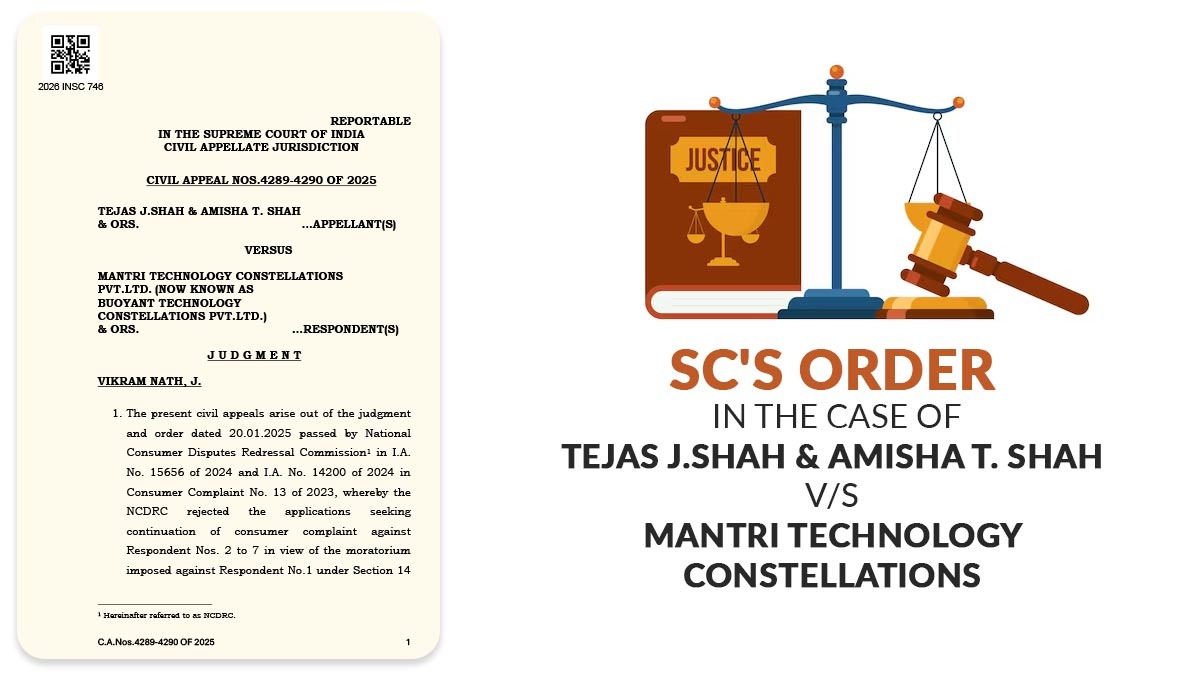
| Case Title | Tejas J.shah & Amisha T. Shah Vs. Mantri Technology Constellations |
| Case No. | CIVIL APPEAL NOS.4289-4290 OF 2025 |
| Supreme Court | Read Order |