

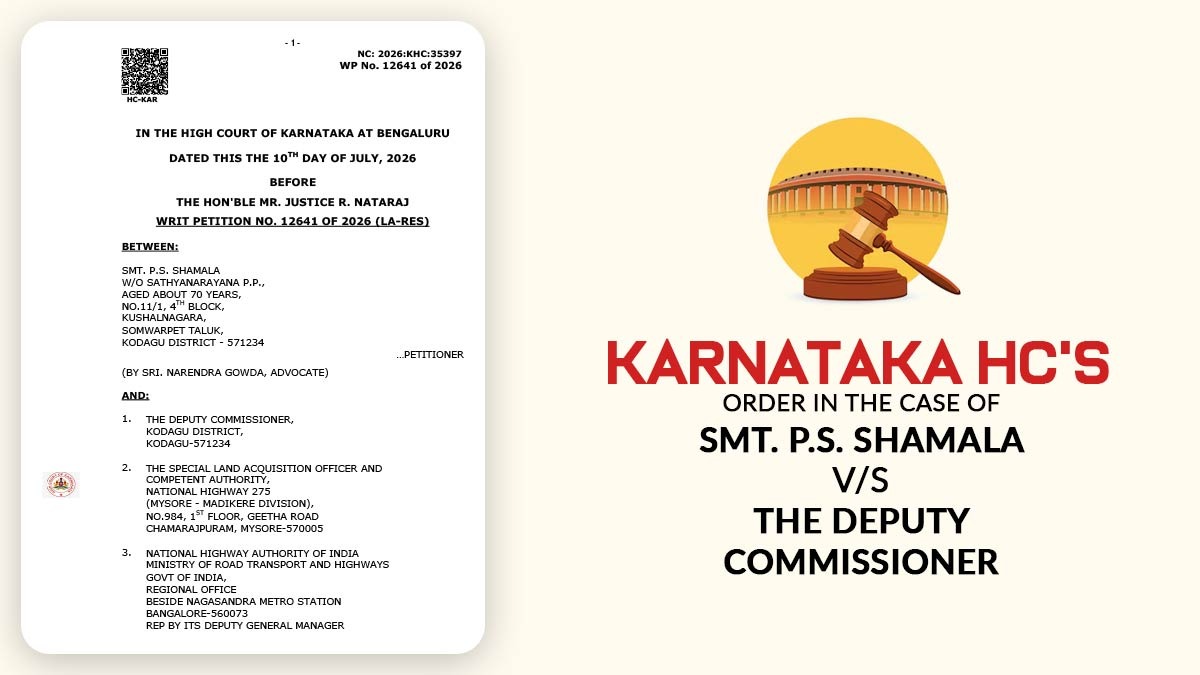
The Karnataka High Court has ruled that no GST can be deducted from compensation paid for the compulsory acquisition of land, holding that such acquisition does not constitute a “supply of goods or services” under the GST law. Accordingly, the Court set aside the GST deduction from the compensation amount.
“An immovable property cannot, at any stretch of imagination, be construed as goods. Therefore, there is neither supply of goods nor services, but an expropriation of the property of a citizen using statutory power. The petitioner has neither sold any goods nor provided any service in giving away his property. Therefore, even if a wide latitude is given to the words “supply of goods or service”, the acquisition of property by the State in exercise of its power of eminent domain cannot fall within the definition of the words “supply of goods or service”. Justice R. Nataraj stated.
The Karnataka High Court directed the authorities to refund ₹18.39 lakh that had been wrongly deducted as GST from the land acquisition compensation payable to P.S. Shamala. The Court also ordered the payment of 15% annual interest from the date of the award until the refund is made and held that the interest amount may be recovered personally from the concerned Special Land Acquisition Officer.
The Court has charged costs of Rs 50,000 on the officer.
Read Also: Karnataka HC Grants Relief on Common GST Notices, GSTR-2A/GSTR-3B ITC
Landowner P.S. Shamala held 8.5 guntas of land in Kodagu district, which was compulsively acquired for the Mysuru-Madikeri Highway widening project. Although compensation was fixed at ₹1.21 crore, the Special Land Acquisition Officer deducted ₹18.39 lakh towards 18% GST from the payout.
Shamala has questioned the deduction and said that the acquisition of land is neither a sale of goods nor a supply of services. As per her counsel, the GST Act does not apply to compulsory acquisition of land as no sale of goods or provision of any service was there that could draw GST.
NHAI and its project director countered the appeal. They said that while compensation for the land itself may not draw GST, the structural part covered under the award was subject to GST under the Act. They claimed that the deduction had been applied to all impacted landowners.
The court had denied that. It said that buildings attached to land are treated as immovable property and cannot be deemed as “goods” under the GST regime. The acquisition of property by the State through the exercise of its power of eminent domain is not considered a transaction that involves the supply of goods or services.
While the authorities argued that GST should be applicable to the structural component, the court observed that they had not determined any provision in the GST Act that would classify the compulsory acquisition of land or structures as a supply of goods or services.
The Court held that the authorities had acted in excess of their power; it set aside the award to the extent it deducted GST from the compensation. It asked the authorities to refund the deducted amount, including interest.
The court ordered that the interest liable to be paid to Shamala be recovered personally from the Special Land Acquisition Officer.
| Case Title | Smt. P.S. Shamala vs. The Deputy Commissioner |
| Case No. | WP No. 12641 of 2026 |
| For Petitioner | Sri. Narendra Gowda |
| For Respondent No. 1 | Aditya Diwakar |
| For Respondent No. 2 to 4 | Shilpa Shah |
| Karnataka High Court | Read Order |