

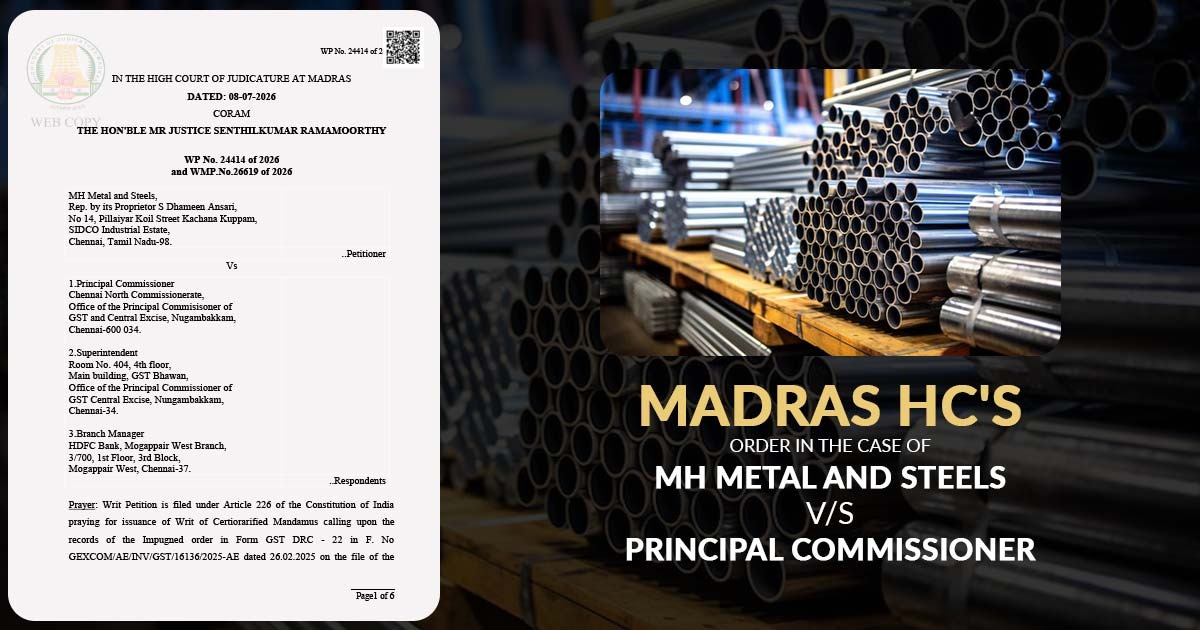
The Madras High Court on 8 July said that a provisional attachment of a taxpayer’s bank accounts under section 83 of the Central Goods and Services Tax (CGST) Act cannot be maintained only by reproducing the statutory language without revealing any tangible material or reasons to justify the action.
Commissioner has the authority under section 83 of the CGST Act to provisionally attach a taxpayer’s property, including bank accounts, to safeguard government revenue during the pendency of the mentioned proceedings under the Act.
Justice Senthilkumar Ramamoorthy permitted the writ petition filed by MH Metal and Steels, contesting the provisional attachment of its bank accounts ordered on 26 February 2025. He held:
“Turning to the second pre-requisite, the order uses the expression “in order to protect the interest of revenue and in exercise of the powers conferred under Section 83 of the Act”. This, however, is merely a mechanical recitation of the language of Section 83 and does not satisfy the requirements for issuing an order of provisional attachment.”
The applicant claimed that the attachment order wrongly recorded that proceedings under Sections 74 and 122 of the CGST Act had already been initiated, despite the state GST authorities issuing the Show Cause Notice (SCN) only on 2 April 2026.
It put reliance on the decision of the Madras High Court in Kesar Jewellers v. Additional Director General, DGGI, which said that an order u/s 83 should reveal tangible material showcasing the importance of provisional attachment.
The GST department, countering the petition, claimed that another remedy was present under Rule 159(5) of the CGST Rules. As per the norms, a person who is not satisfied with a provisional attachment can submit objections in Form GST DRC-22A seeking release of the attached property.
While reviewing the validity of the attachment order, the Court noted that Section 83 requires two conditions to be met before exercising the power of provisional attachment. First, proceedings under Chapters XII, XIV, or XV of the CGST Act must have been initiated. Second, the Commissioner must determine that the attachment is necessary to protect government revenue.
The Bench concluded that the first condition was met, as a summons had been issued u/s 70 of the CGST Act, which is part of Chapter XIV. However, it pointed out that the attachment order incorrectly referenced proceedings under Sections 74 and 122, even though such proceedings had not been initiated at the time the order was made.
The second requirement showed that the order did not provide any factual basis to justify the Commissioner’s satisfaction. It was noted that simply claiming that the attachment was necessary “to protect the interest of revenue” was merely a mechanical repetition of the statutory language.
While referring to its decision in Kesar Jewellers, the bench said that an order u/s 83 should include the reasons and show the tangible material based on which the commissioner forms the perspective that provisional attachment is important. It said that-
“The impugned order does not indicate any basis for the formation of the opinion that provisional attachment is necessary to protect revenue interest. In the absence of any rational basis for the decision, the order is unsustainable.”
Also Read: Bombay HC Quashes GST Bank Account Attachment Orders Under MGST Act for Lack of Proper Reasons
Therefore, the HC set aside the provisional attachment order and specified that the GST authorities shall have the chance to start fresh action as per the law, if required.
| Case Title | MH Metal and Steels Vs Principal Commissioner |
| Case No. | WP No. 24414 of 2026 |
| For Petitioner | Ms Vipula DS |
| For Respondent | Ms Pooja Jain |
| Madras High Court | Read Order |