

Receiving a GST show cause notice (SCN) can be a significant concern for businesses dealing with India’s Goods and Services Tax (GST) compliance requirements.
In a recent ruling, the Madras High Court clarified that GST authorities are not required to conclusively establish fraud before issuing a show cause notice under Section 74 of the CGST Act.
The Court observed that proceedings may be initiated when the available records prima facie indicate fraud, wilful misstatement, or suppression of facts, with the final determination to be made during the adjudication process.
The court ruled that under Section 74 of the Central GST (CGST) Act, officers only need initial, or prima facie, evidence of tax evasion to issue a show cause notice (SCN). The actual burden of proving fraud, wilful misstatement, or the suppression of facts falls on the subsequent adjudication process, not the initial notification stage.
Decoding the Legal Standard
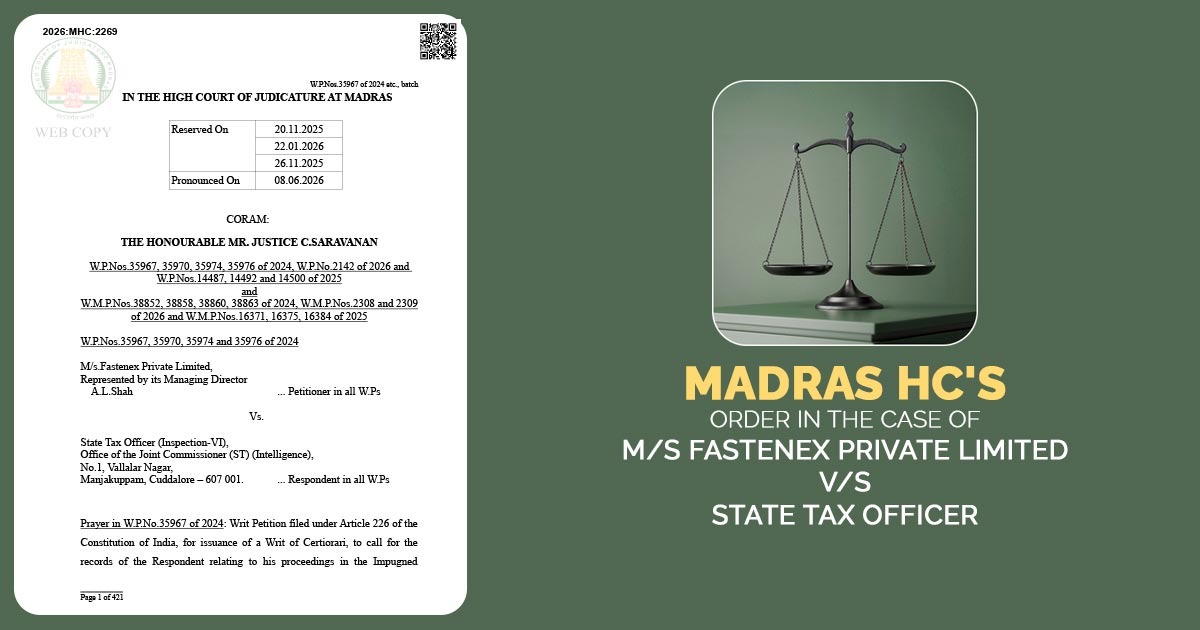
The decision emerged from a batch of petitions, spearheaded by M/s Fastenex Private Limited v. State Tax Officer. At the heart of the dispute was the threshold of evidence required for the tax department to accuse a business of intentional tax evasion.
Justice C. Saravanan, presiding over the case, focused on the specific phrasing of Section 74. The law states that an officer may take action “where it appears” that taxes have been unpaid, underpaid, or wrongly credited due to fraudulent actions.
The court interpreted this language to mean that an officer simply needs to form a reasonable opinion based on the records currently available to them.
Expecting the tax department to thoroughly prove fraud before a notice is even issued misinterprets the procedural timeline. Adjudication, the court explained, is the proper venue for testing those allegations.
Read Also: Madras HC: Tax Officers Must Apply Sense, Not Treat GST Notice Service as a Formality
Streamlining the Notice Process
The ruling also offered practical relief for tax officers regarding paperwork.
Often, a show cause notice is preceded by an audit, scrutiny, or physical inspection, during which the foundational facts of the alleged evasion are already shared with the taxpayer.
The High Court stated that if a business has already received these details through pre-notice communications, the formal SCN need not repeat every single fact.
Not a Blank Check for Tax Authorities
While the ruling certainly strengthens the hand of GST enforcement, the High Court was careful to establish boundaries. Justice Saravanan emphasised that this interpretation does not grant tax officers unrestricted or arbitrary power.
Before invoking Section 74, the department must still hold relevant and justifiable material indicating foul play. Furthermore, the ruling preserves the taxpayer’s fundamental right to dispute the department’s claims and present their defence during the adjudication hearings.
The court also sent a clear message regarding legal strategy, noting that businesses should generally avoid filing writ petitions to challenge show cause notices.
Because these disputes rely heavily on complicated factual questions, they are best handled by the designated adjudicating authority rather than through early high court intervention.
Important: Orissa HC: No GST Demand After Pre-Proceeding Reversal of Wrongly Availed ITC
What This Means for Businesses
This judgment is poised to significantly impact how GST laws are enforced moving forward. Tax departments will likely feel more confident issuing notices based on initial suspicions and documentary discrepancies, knowing the courts support a “prove it later” approach to the formal hearings.
For taxpayers, the takeaway is clear: the initial show cause notice is merely the opening argument. Businesses must maintain meticulous records and be fully prepared to defend their tax positions during the adjudication phase, as shutting down an investigation at the initial notice stage has just become substantially harder.
| Case Title | M/s Fastenex Private Limited vs. State Tax Officer |
| Case No. | W.P.Nos.35967, 35970, 35974, 35976 of 2024, W.P.No.2142 of 2026 |
| For Petitioner | Mr K.Ravi, M/s.Rugan and Arya |
| For Respondent | Mr.C.Harsharaj |
| Madras High Court | Read Order |