

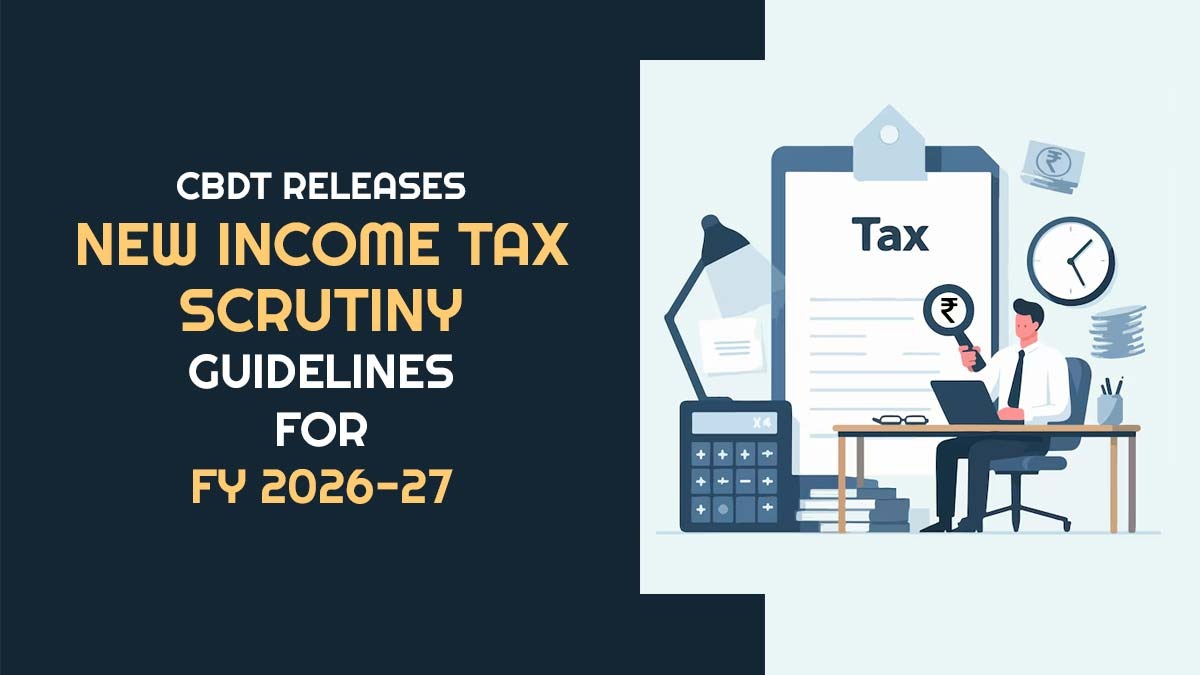
Recently, the Central Board of Direct Taxes (CBDT) has issued guidelines specifying the categories of Income Tax Returns (ITRs) that will be subject to Complete Scrutiny during FY 2026-27. The norms, issued vide F.No.225/56/2026/IТА-II dated 4th June 2026, specify the parameters, approval mechanism, and procedural requirements for the selection of cases for scrutiny.
The objective of these guidelines is to ensure focused scrutiny of high-risk cases involving survey actions, search-and-seizure proceedings, cancelled registrations, recurring tax disputes, and specific tax-evasion information received from enforcement agencies.
Six Categories Identified for Mandatory Income Tax Scrutiny
Survey Cases (CS-01)
Returns of taxpayers covered under a survey conducted under Section 133A of the Income-tax Act on or after 1 April 2024 shall be compulsorily selected for scrutiny. However, surveys conducted under Section 133A(2A) are excluded from this category.
Search and Seizure Cases (CS-02)
Cases involving a search under Section 132 or a requisition under Section 132A conducted between 1 April 2024 and 31 March 2026 shall be designated for compulsory scrutiny. The scrutiny proceedings shall be initiated after obtaining administrative approval from the competent authority.
Cases Related to Registration and Regulatory Approvals (CS-04)
CBDT has asked for scrutiny of cases where registration or approval granted under norms like Sections 12A, 12AB, 35(1)(ii), 35(1)(iia), 35(1)(iii), and Section 10(23C) have not been granted or have been cancelled or withdrawn before 31 March 2025. Still, the taxpayer has continued to claim an exemption or deduction on the return filed in Form ITR-7. Cases in which appellate authorities have restored these registrations shall not be included.
Recurring Addition Cases (CS-05)
Returns may be chosen where additions were incurred in earlier assessment years on recurring issues of law or fact that have reached a conclusion or have been kept by the appellate authorities. Rs 50 lakh threshold has been fixed for eight metro jurisdictions and ₹20 lakh for other jurisdictions.
Tax Evasion Intelligence-Based Cases (CS-06)
The cases grounded on specific data pointing to tax evasion obtained from law enforcement agencies, intelligence units, investigation wings, or regulatory authorities will be scrutinised if the taxpayer has submitted a return for the related assessment year.
AIS, SFT, and NMS Information Explained
CBDT, where returns are submitted in response to notices issued u/s 142(1) only because of information available via the Non-Filer Monitoring System (NMS), Annual Information Statement (AIS), Statement of Financial Transactions (SFT), CPC-TDS data, or information from the Directorate of Income Tax (I&CI), these cases will not automatically come under compulsory scrutiny. Their selection shall be acknowledged via the Computer Assisted Scrutiny Selection (CASS) process.
Cases Requiring Notice u/s 143(2)
Also, the norms include cases where reassessment notices u/s 148 have been issued, and returns have either been filed or not filed. These matters must be managed via the National Faceless Assessment Centre (NaFAC), with underlying documents uploaded through the jurisdictional assessing officers.
Provisions for International Taxation and Central Charges
As per CBDT, International Taxation and Central Circle charges may independently choose cases for scrutiny based on the mentioned parameters after getting administrative approval. The respective authorities will continue to manage these matters and not NaFAC.
Due Date
The Board has prompted field officers that, according to the proviso to Section 143(2) of the Income-tax Act, notices for returns filed during the FY 2025-26 and selected for compulsory scrutiny need to be served on or before June 30, 2026.
Closure
The latest guidelines from the CBDT provide clearer information about the categories of taxpayers who will be subject to mandatory scrutiny, as well as the procedures that assessing officers should follow.
Taxpayers who fall within these specified risk parameters should ensure that their records, claims, and supporting documentation are organised. This will help facilitate a seamless assessment process and prevent disputes.