

All companies registered under the Companies Act, 2013 must submit their financial statements to the Registrar of Companies (ROC) via Form AOC-4. As per the company’s criteria, the filing can be completed either through the standard AOC-4 form or through an AOC-4 XBRL filing
Companies are required to submit their financial statements in XBRL format that fulfil specific turnover limits, paid-up capital thresholds, listing requirements, or Ind AS applicability.
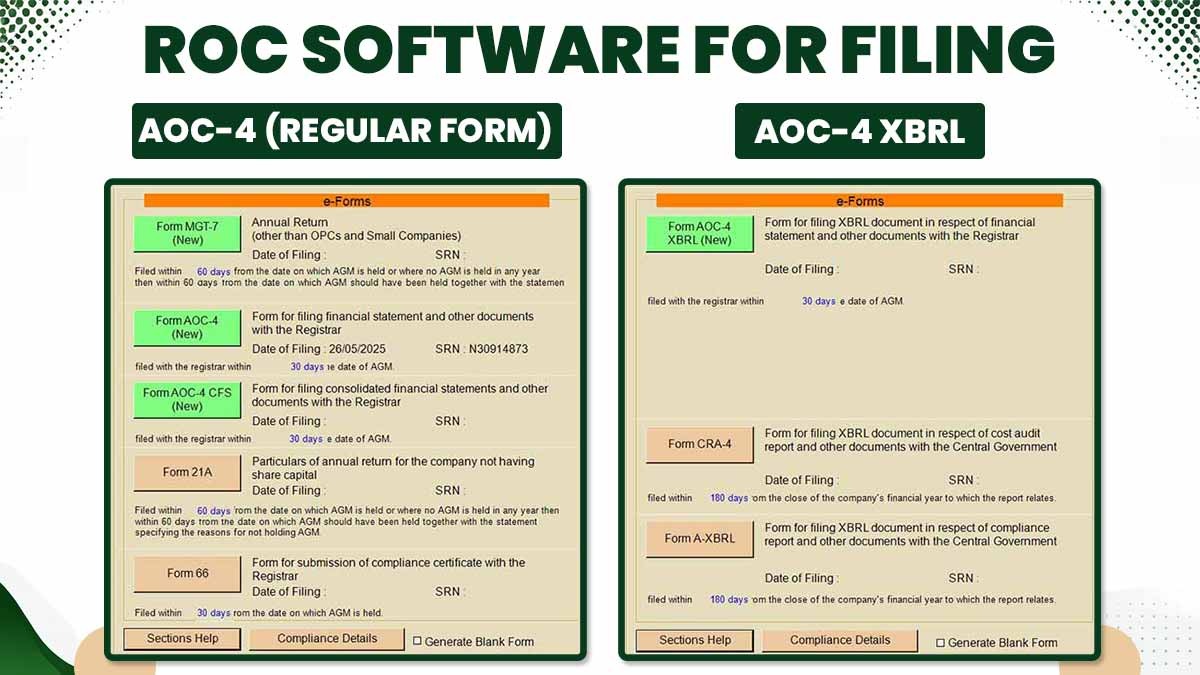
Many companies and professionals with the full migration of all e-forms to the MCA V3 Portal are now utilising automated ROC software to facilitate the intricate web-based data entry process. The present ROC software supports regular AOC-4 filings (using the web-based or Excel utility) and AOC-4 XBRL filings. This helps professionals remove manual data entry on the portal, prevent session timeouts, ensure automated validation, and complete their filings easily.
AOC-4 and AOC-4 XBRL
Below, we have explained the comparison between AOC-4 and AOC-4 XBRL, along with the changes.
Regular AOC-4 Filing (MCA V3 Web-Form / Excel Hybrid)
In the V3 platform, now AOC-4 is not a traditional standalone PDF form. It has been shifted to a web-based or Excel-based application. Mandatory linked web forms supersede traditional PDF attachments. It comprises:
- Balance Sheet and Profit & Loss Account (filled via web form or Excel utility)
- Extract of Auditor’s Report [Standalone] (as a mandatory linked form)
- Extract of Board’s Report (as a mandatory linked form)
- Form CSR-2 & AOC-4 CFS (mandatorily attached as linked forms, if applicable)
- Notes to Accounts (uploaded as a PDF text attachment)
AOC-4 XBRL Filing
AOC-4 XBRL is a digital financial reporting format in which data is filed via XBRL (eXtensible Business Reporting Language). Financial data is now digitally tagged using the MCA-approved taxonomy, making it machine-readable instead of using text numbers.
Latest V3 Change: In addition to the generated XBRL instance XML file, a complete set of duly signed financial statements should now be attached to the e-form AOC-4 XBRL.
Typically, the following companies need to file AOC-4 XBRL:
- Listed companies and their Indian subsidiaries
- Companies with a paid-up capital of ₹5 crore or more
- Companies with a turnover of ₹100 crore or more
- Companies that fall under the IND AS requirements
Note: Generally, banks, insurance companies, non-banking financial companies (NBFCs), and power companies are exempted from XBRL filing pre-requisites.
Significance of ROC Software for AOC-4 and AOC-4 XBRL
Direct V3 form preparation on the portal risks data loss from frequent session timeouts, and manual XBRL tagging is very technical. These compliance operations are automated under the advanced ROC software.
Features of Modern ROC Software
- JSON/Excel Generation: Automatic creation of V3 portal-ready data packages.
- Prefill with Edit Logs: In the V3 system, previous year’s figures auto-populate. If edited, the software assists in drafting the mandatory reason for change.
- XBRL Tagging and Taxonomy Mapping: Automated mapping of financial figures with the updated MCA XBRL taxonomy.
- Error Detection & Pre-Scrutiny: An advanced validation engine that fetches errors before submission to the MCA portal.
- Linked Form Integration: Simultaneous generation of the Extract of Board’s Report, Auditor’s Report, and CSR-2.
Comparison of Regular AOC-4 filing and AOC-4 XBRL filing through ROC software
Step 1: Financial Data Collection
Regular AOC-4 Filing: The audited financial data is extracted manually by the professionals. ROC software eases the auto-import of such schedules from the ERP or trial balance.
AOC-4 XBRL Filing: Financial data can be extracted automatically by the software, and it verifies the same against previous data schemas for consistent element extraction.
Step 2: Preparation of Financial Statements
Regular AOC-4 Filing: The software transforms the accumulated data into the mandatory MCA V3 Excel template or a direct online web form structure.
AOC-4 XBRL Filing: The structure of the financial statements is mapped using the software in accordance with the digitised MCA taxonomy rules.
Step 3: Form Filling Process
Regular AOC-4 Filing: Company information is automatically retrieved using the Company Identification Number (CIN), and financial metrics are incorporated into the web form through software-generated JSON data blocks.
AOC-4 XBRL Filing: Company details and financial nodes are structured within the internal XBRL engine of the software.
Step 4: Document Attachment & Linked Forms
Regular AOC-4 Filing: Traditional PDF attachments for Board and Audit reports are no longer used. Instead, the software automatically generates the required Linked Web Forms for the Extract of the Board Report and the Auditor’s Report.
Must Read: How ROC Software Prepares Many Reports Needed for Filing
AOC-4 XBRL Filing: The software creates the XBRL XML instance document and prompts the user to attach a scanned copy of the signed financial statements, ensuring compliance with the latest V3 mandate.
Step 5: XBRL Applicability Check
Regular AOC-4 Filing: No XBRL tagging is required.
AOC-4 XBRL Filing: The software computes eligibility thresholds (Paid-up capital ≥ ₹5 crore or Turnover ≥ ₹100 crore) and activates the XBRL module.
Step 6: XBRL Tagging and Mapping
Regular AOC-4 Filing: Not applicable.
AOC-4 XBRL Filing: The software applies standardised tags to balance sheet metrics, cash flows, and notes to accounts.
Step 7: Process of Validation
Regular AOC-4 Filing: The software functions field-level checkmarks to match V3 business validation algorithms.
AOC-4 XBRL Filing: An advanced tool functions automated calculations and validations against MCA taxonomy rules to confirm that assets equal liabilities.
Step 8: Final Package Generation
Regular AOC-4 Filing: The software compiles the online data structure or develops a valid Excel utility sheet ready for V3 upload.
AOC-4 XBRL Filing: The software provides an error-free XBRL XML instance file.
Step 9: Error Detection
Regular AOC-4 Filing: Internal software alerts avert submission errors via blocking missing mandatory disclosures or mismatched previous year variances.
AOC-4 XBRL Filing: Errors like missing mandatory tags or broken calculation links are displayed by the software before any submission for MCA pre-scrutiny.
Step 10: Digital Signature (DSC) and Portal Submission
Regular AOC-4 Filing: Post online submission, the V3 platform generates a PDF, which should be downloaded, digitally signed via emSigner, and re-uploaded along with online fee payment.
AOC-4 XBRL Filing: Via active V3 business user login credentials, signed XML instance documents and forms are processed.
Example of AOC-4 XBRL filing via ROC Software
Let’s take an example of ABC Manufacturing Pvt. Ltd., which has a paid-up capital of Rs 8 crore and an annual turnover of Rs 150 crore. As it surpasses the thresholds for filing, AOC-4 XBRL is mandatory.
- Data Import: The trial balance is loaded into the software.
- Automatic Taxonomy Mapping: The software maps items such as Revenue from Operations, Share Capital, Borrowings, and Fixed Assets to the appropriate MCA XBRL tags.
- Validation and Balance Checks: The validation engine examines missing disclosures, mathematical discrepancies, and the definitions of text tags.
- XML and Signed Copy Integration: The software generates the final XML document and attaches the signed copy of the audited financial statements.
- Portal Upload: The professional logs into the MCA V3 portal as a business user, uploads the validated files, applies the Digital Signature Certificate (DSC), and processes the fee payment.
Issues in Manual AOC-4 XBRL Filing
It is not easy to manually file XBRL on the V3 portal because of the below-mentioned reasons:
- Manually understanding complex tag taxonomies causes human error.
- MCA’s real-time validation modifications may cause unforeseen validation errors on the portal.
- Automated text parsing engines are essential for the complex formatting of text footnotes within XML.
ROC Software Benefits for AOC-4 and AOC-4 XBRL
- V3 Portal Alignment: The software automatically aligns with the new web form architectures and linked form dependencies.
- Exempt from Portal Timeouts: Data is saved on local devices, which prevents it from being lost during peak portal traffic hours.
- Error-Free Taxonomies: Regular updates keep the software synchronised with the latest MCA validation rules.
- Facilitated Professional Handling: The software allows Chartered Accountants (CAs), Company Secretaries (CSs), and corporate teams to batch-process filings via effective tools such as Gen GST and related suites.
Closure: AOC-4 filing is a significant compliance activity. In the MCA V3 platform, regular AOC-4 has transformed into an integrated web-form ecosystem with linked components, whereas AOC-4 XBRL needs accurate technical taxonomy tagging and adherence to signed attachment compliance. Efficient ROC software reduces these intricacies, easing the conversion of manual corporate filing data into accurate, portal-ready, and compliant submissions.