

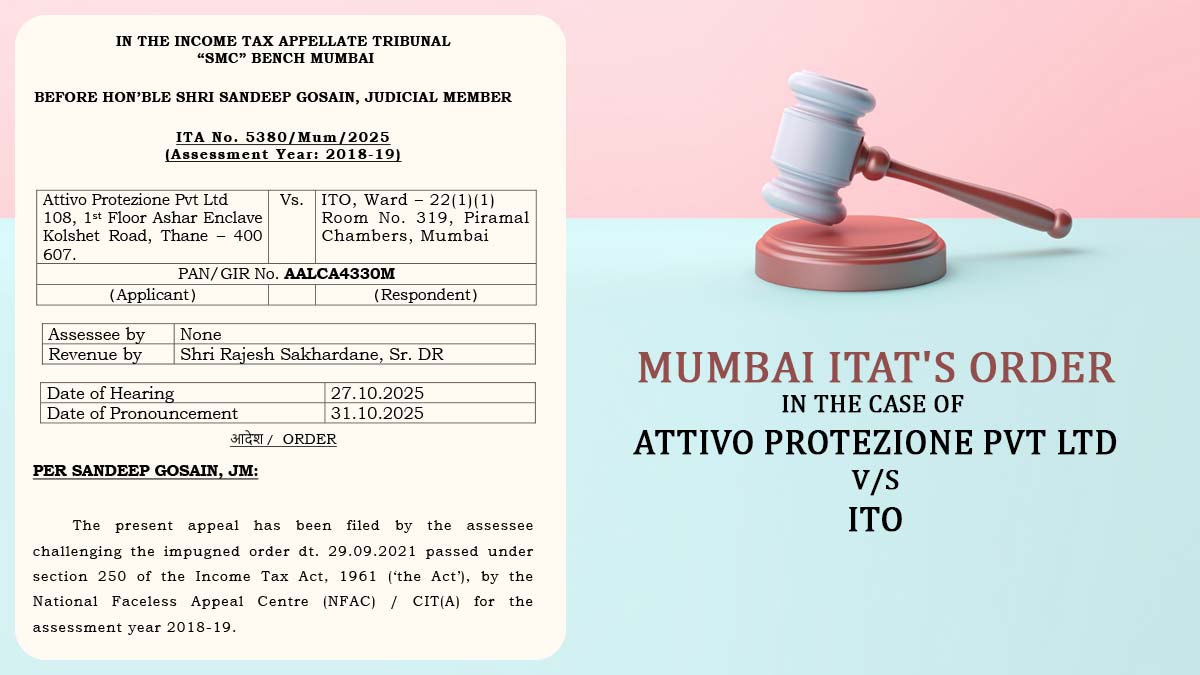
The Mumbai Bench of the Income Tax Appellate Tribunal (ITAT) has dismissed the appeal based on inordinate delay of 1,370 days in filing, holding that the taxpayer’s reliance on its tax consultant’s failure to advise remedial action does not comprise “sufficient cause” for condonation u/s 5 of the Limitation Act, 1963.
An order dated 29 September 2021, passed by the Commissioner of Income Tax (Appeals) CIT(A), for the Assessment Year 2018-19, had been contested by an appeal. No one represents the taxpayer, Attivo Protezione Pvt Ltd, despite repeated calls when the case was taken.
Since the taxpayer had been unable to file the obligatory affidavit supporting its condonation appeal, an adjournment request was found unexplained. Hence, the tribunal proceeded ex parte and rejected the application for adjournment.
The taxpayer in its condonation petition attributed the delay to the alleged inaction of its tax consultant, who did not suggest any appeal after the order of the CIT(A).
The Tribunal found this explanation to be vague and legally unsound. It was noted that blaming the consultant does not forgive the taxpayer, a private limited company, of its statutory duty to seek legal remedies within the said time limits.
The bench of Sandeep Gosain (Judicial Member) drew upon a series of Supreme Court rulings, including Basawaraj & Ors. v. Special Land Acquisition Officer (2014) and Anshul Agarwal v. NOIDA (2011), to specify that “sufficient cause” cannot be interpreted liberally when negligence or lack of bona fides is evident.
The order mentioned the principle that condonation of delay is a discretionary relief, not a case of right, and the Mumbai High Court could not exercise this discretion mechanically or on a sympathetic foundation.
Tribunal stresses that the law of limitation provides a larger public objective, as shown in the maxim “Interest reipublicae ut sit finis litium”-it is in the public interest that litigation must come to an end.
It referred to decisions in Oriental Aroma Chemical Industries Ltd. v. Gujarat Industrial Development Corporation (2010) and State of West Bengal v. Administrator, Howrah Municipality, which held that only bona fide and diligent conduct entitles one to leniency in matters of delay.
The tribunal observed that the taxpayer had attended previous proceedings before the tax authorities and was known of the adverse appellate order, and held that negligence had been proved from the inaction of nearly 4 years.
Read Also: Bombay HC: Delay in Filing ITR Due to CAs Advice Does Not Constitute Assessee’s Negligence
The Bench cited that “putting all the blame on the tax consultant would not absolve the assessee of its own responsibility,” outlining that each day of delay should be explained satisfactorily with major causes.
The Tribunal, on discovering no justification or related proofs, ruled that the delay was neither bona fide nor unavoidable. It consequently refused to accept the delay and dismissed the appeal as time-barred without reviewing its merits.
| Case Title | Attivo Protezione Pvt Ltd vs. ITO |
| Case No. | ITA No. 5380/Mum/2025 |
| Assessee by | None |
| Revenue by | Shri Rajesh Sakhardane |
| Mumbai ITAT | Read Order |