

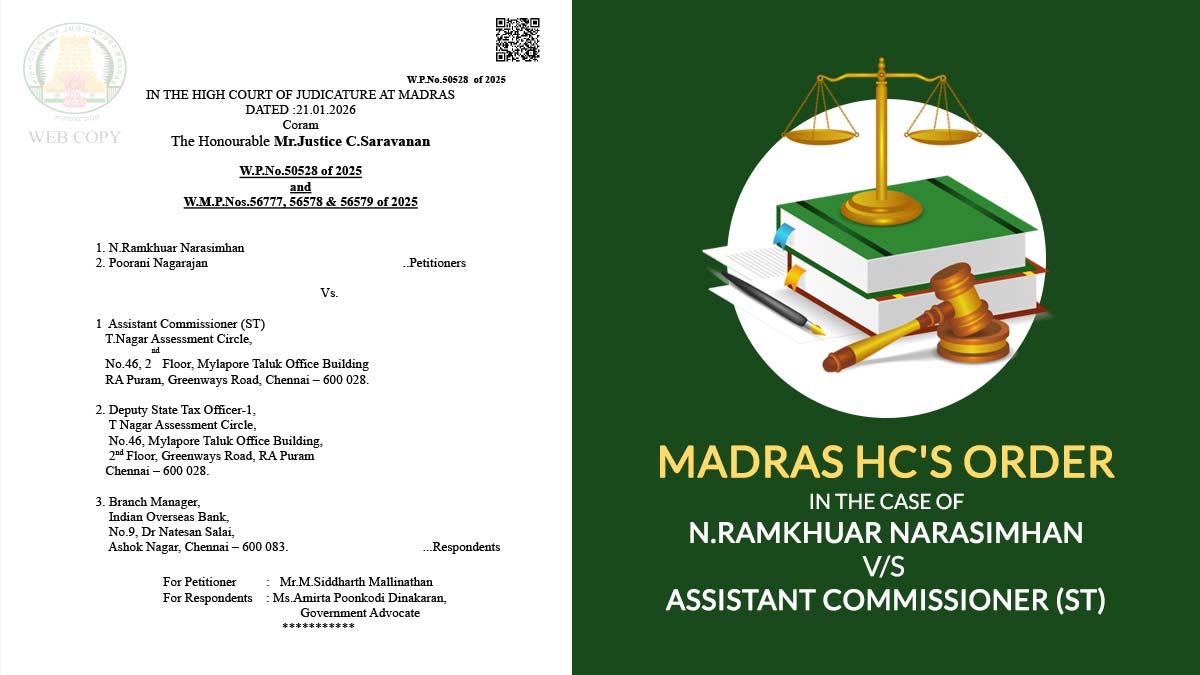
The Madras High Court has decided that company directors who are going through liquidation cannot be held personally responsible for paying off the company’s GST dues. The court has given them an opportunity to free themselves from these financial responsibilities.
N. Ramkhuar Narasimhan and Poorani Nagarajan, who were directors of M/s. Infinitas Energy Solutions Pvt. Ltd., a company that had entered insolvency proceedings under the Insolvency and Bankruptcy Code, 2016 (IBC).
Before the HC, a petition was submitted that contests the State Tax Department’s recovery action, which included the seizure of their personal bank accounts, for GST liabilities that were allegedly made when the business was already in liquidation.
According to the facts noted by the Court, an Interim Resolution Professional (IRP) was appointed for the company on 08.09.2017. Subsequently, by an order dated 06.02.2019, the company was directed to be liquidated, and the same professional was appointed as the Liquidator.
Even after liquidation, it was marked that the business of the company was undertaken from April 2019 to March 2021, and the GST obligation was cited to have emerged during the same period. But rather than pursuing recovery via the liquidation procedure and from the company’s assets, the department started recovery proceedings via attaching the individual bank accounts of the director, ministering them as directors “as per MCA records.”
Read Also: Madras HC Directs Re-Adjudication on Ex-Director for GST Liability, Calls Bank Attachment a SCN
The petitioners contended that they were no longer in control of the company, which was now under the Liquidator’s charge, making direct recovery from them unjustified. Section 88 of the GST Act has been analysed by Justice C. Saravanan, which deals with the obligation in the case of a company in liquidation.
The court mentioned that Section 88(3) makes directors jointly and severally obligated merely in a particular situation where tax, interest, or penalty determined on the company could not be recovered, and the director obtains a chance to prevent the obligation by establishing that non-recovery was not due to any gross neglect, misfeasance, or violation of duty on their part.
The Court also noted that part of the tax had already been recovered from the company’s GST credit ledger, while interest and penalty remained outstanding. Therefore, the Court found no justification for attaching the personal bank accounts of the directors without following the procedure prescribed under Section 88(3). Accordingly, the High Court permitted the applicants to approach the State Tax authorities within 15 days to seek disengagement from such liability.
The authorities were directed to issue relevant orders on merits within 15 days, after allowing the petitioners to be heard. The attachment will be lifted, subject to the department’s final order.
| Case Title | N.Ramkhuar Narasimhan vs. Assistant Commissioner (ST) |
| Case No. | W.P.No.50528 of 2025 |
| For Petitioner | Mr.M.Siddharth Mallinathan |
| For Respondents | Ms.Amirta Poonkodi Dinakaran |
| Madras High Court | Read Order |