

The Kerala High Court has refused a GST assessment order given against a registered assessee. The court defined that the problem of incorrectly claiming GST ITC under an inappropriate tax category had earlier been resolved in favour of the taxpayer by a Division Bench of the same court.
The Court mentioned that the taxpayer could not be penalised for a procedural lapse. Still, the State government can ask the GST Council to solve the administrative settlement of payments between the Centre and state tax authorities.
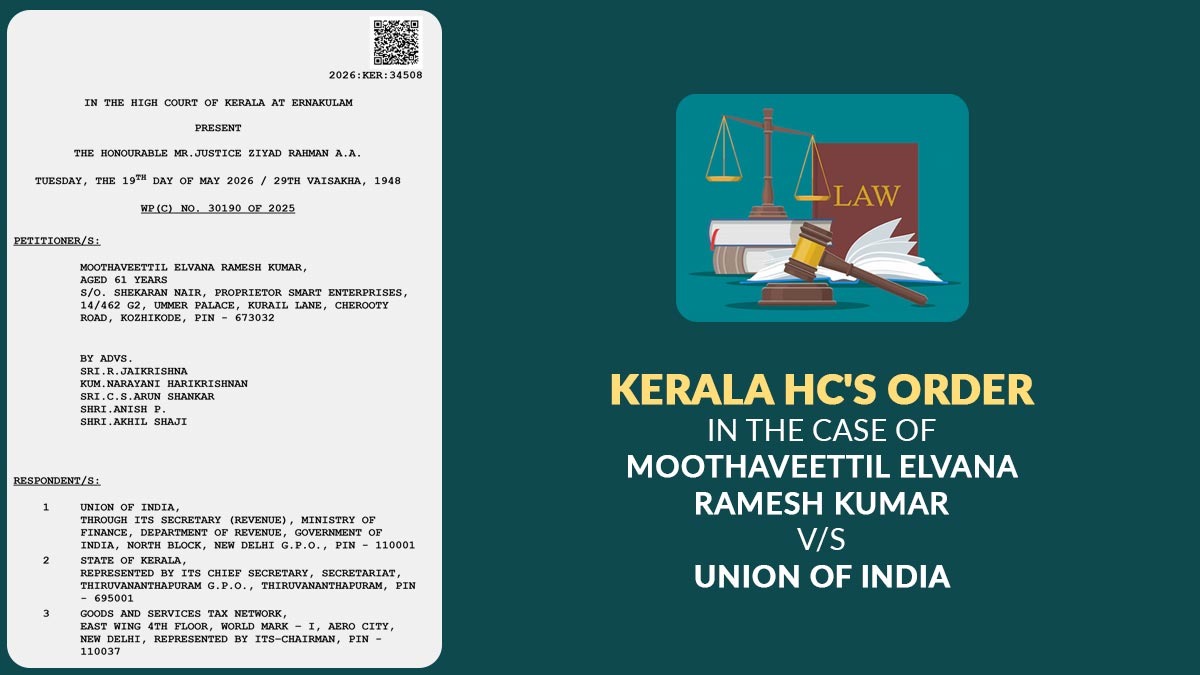
Moothaveettil Elvana Ramesh Kumar, proprietor of Smart Enterprises, Kozhikode, challenged an assessment order granted by the State Tax Officer under section 73 of the Kerala State GST (KSGST) Act, 2017, for the AY 2018-19.
The department had begun the proceedings after discovering that the applicant had incorrectly claimed his eligible ITC under the Integrated Goods and Services Tax (IGST) head but wrongly utilised it to adjust his output tax liability under the Central GST (CGST) and State GST (SGST) heads for the period April 2018 to March 2019.
The applicant’s representative said that the tax authorities’ demand was unsustainable in law. It was mentioned that the particular legal question on cross-usage of GST ITC had earlier been settled in favour of the taxpayer by the Division Bench of the Kerala High Court in the landmark case of Rejimon Padikapparambil Alex v. Union of India and Others.
The Court, after hearing from the petitioner’s lawyer, the Central Government Counsel (CGC) representing the Union of India, and the Government Pleader for the State authorities, concurred with the arguments presented by the applicant.
Justice Ziyad Rahman A.A. cited that the legal issue raised in the existing petition was clearly addressed in favour of the taxpayer by the Division Bench judgment cited by the petitioner’s counsel.
Hence, the Court approved the writ petition and set aside the impugned assessment ruling in its entirety. Although the Court furnished a clarification on the broader administrative outcomes of these ITC set-offs, the credit, in effect, impacts the income share of the Centre and the State.
The Court stated that the respondent State government can approach the GST Council as per the norms specified in the Division Bench judgement to build a systemic solution for the settlement of these monies between the relevant ministries.
Subsequently, the writ petition was disposed of, furnishing relief to the taxpayer and allowing a policy-level determination at the GST Council.
| Case Title | Moothaveettil Elvana Ramesh Kumar Vs Union of India |
| Case No. | Wp(c) No. 30190 of 2025 |
| For Petitioner | R.Jaikrishna, Kum.Narayani Harikrishnan, C.S.Arun Shankar, Anish P., Akhil Shaji |
| For Respondent | Anju Divakar, P.R.Sreejith |
| Kerala High Court | Read Order |