

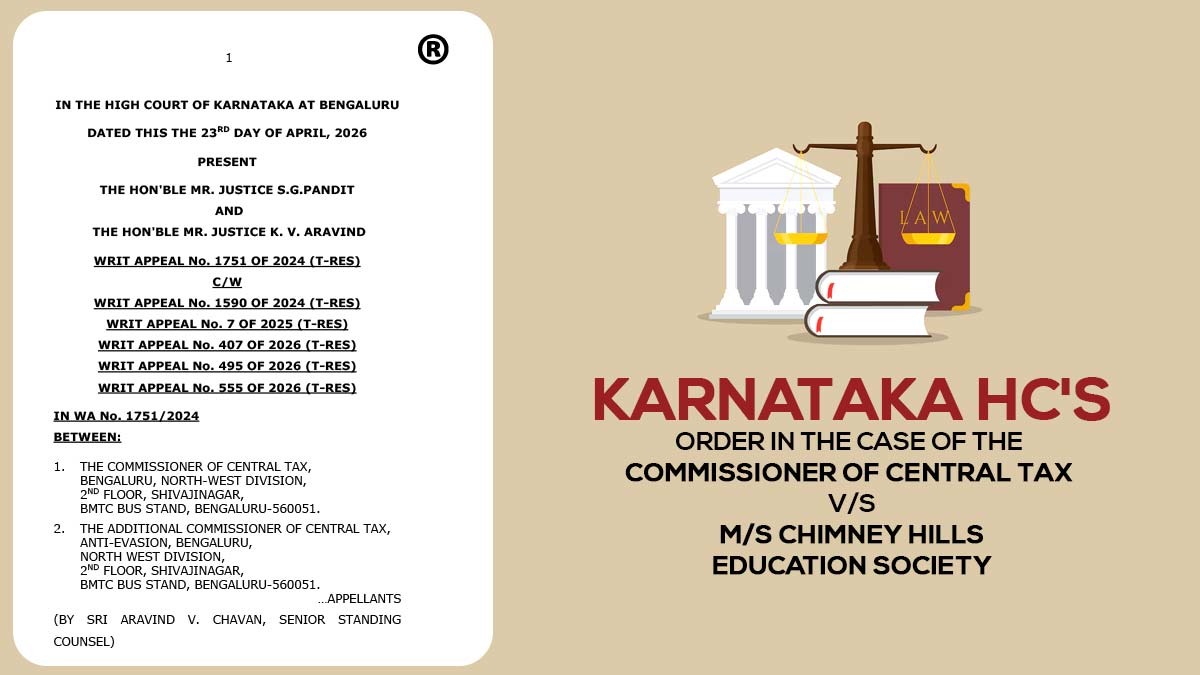
The Karnataka High Court has upheld the procedural validity of issuing consolidated show cause notices u/s 73 and 74 of the CGST Act, 2017. The Court clarified that a common notice covering multiple financial years is legally permissible, provided all statutory requirements are satisfied.
This ruling confirms that merely aggregating tax periods does not invalidate the demand, offering important clarity on the department’s powers in handling cumulative assessments.
The bench of Justice S.G. Pandit and Justice K.V. Aravind furnished the judgment while permitting a batch of writ appeals submitted via the department against orders of the Single Judge.
The appeals have emerged from a series of cases where the Revenue had issued SCN alleging tax short payment, fraud, suppression of facts, or misstatement for extended periods spanning several financial years.
Previously, the single judge had quashed such notices, holding that proceedings under sections 73 and 74 should be limited to a single financial year, and that consolidated notices were not allowable. But the Division Bench did not agree with this interpretation and overturned the previous law.
As per the Court, the problem at hand is whether the GST law allows the issuance of a common SCN that includes multiple financial years or tax periods. The Bench, while answering this in the affirmative, held that nothing in Sections 73 or 74 of the CGST Act limits the issuance of notices to a single financial year.
It noted that the statutory language utilises the expression any period, which shows legislative intent to permit flexibility instead of levying a stringent financial year-wise limitation.
The Court rejected the claim that GST proceedings are limited to a specific financial year. It clarified that although returns, assessments, and reconciliations are typically organised on an annual basis, this does not prevent authorities from initiating demand and recovery proceedings for multiple periods with a single notice. It outlined that reading such a restriction into the law shall lead to adding words not contemplated by the legislature.
The Bench raised concerns about limitation, noting that safeguards were earlier incorporated into Sections 73(10) and 74(10), which specify timelines for adjudication.
Hence, even if a consolidated notice is issued, the demand remains subject to the applicable limitation period. The Court did not find any legal issues with combining multiple tax periods into a single notice, provided that statutory timelines are followed.
The Court, on concerns of procedural fairness, specified that the issuance of an SCN only initiates proceedings and allows the taxpayer to answer. It repeated that these notices must not ordinarily be interfered with at the writ phase, especially when an effective statutory remedy is available under the GST structure.
Important: Bombay HC to Decide the Validity of a Single GST Notice for Multiple Financial Years
The Court acknowledged the claim that consolidated notices may form intricacies of jurisdiction, pecuniary limits, or mixing of cases involving fraud and non-fraud.
The ruling stated that concerns regarding the issuance of a common notice can be addressed during the adjudication stage and do not invalidate the notice itself. Additionally, it confirmed that adjudication can be conducted on a year-by-year basis, even if the notice pertains to multiple financial years.
Notably, this ruling is consistent with similar decisions made by other High Courts, including those in Delhi and Allahabad, which have upheld the validity of a combined show cause notice (SCN) under the GST law. Therefore, the Karnataka High Court supported a pro-Revenue interpretation, favouring administrative efficiency and flexibility in enforcement.
Read Also: How GST Software Handles Notices & Hearings Easily U/S 73
The appeals of the revenue have been permitted by the court, and it upheld the legality of consolidated SCNs under Sections 73 and 74 of the CGST Act.
| Case Title | The Commissioner Of Central Tax vs. M/S Chimney Hills Education Society |
| Case No. | No. 1751 OF 2024 (T-RES) |
| For the Petitioner | Sri Aravind V. Chavan |
| For the Respondent | Sri. A. Shankar, and Sri Pranay Sharma |
| Karnataka High Court | Read Order |