

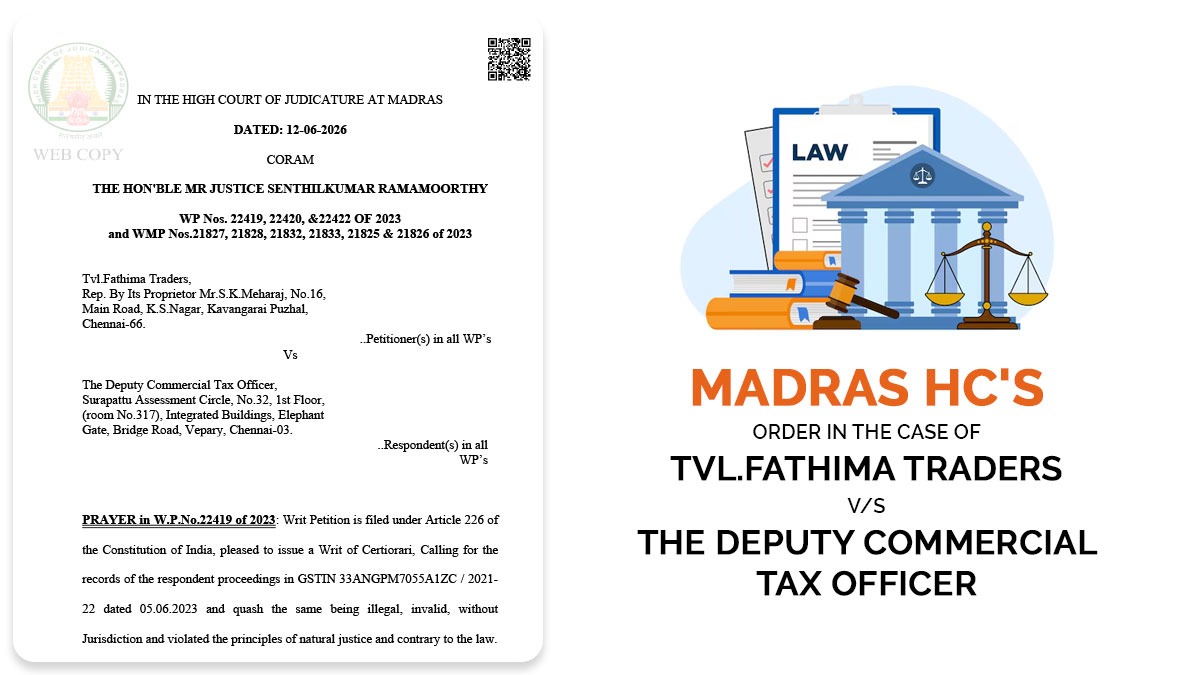
The Madras High Court has held that Input Tax Credit (ITC) cannot be denied solely because the supplier’s Goods and Services Tax (GST) registration was cancelled with retrospective effect.
The Court observed that a retrospective cancellation of a supplier’s GST registration, by itself, is not sufficient grounds to disallow a genuine purchaser’s ITC claim.
Justice Senthlikumar Ramamoorthy said that “without examining as to whether the petitioner had established supply of goods by submitting invoices, e-way bills, lorry receipts and the like, the petitioner’s claim should not have been rejected solely on the ground of the retrospective cancellation of the supplier’s registration.”
A petition was submitted by Tvl. Fathima Traders that contests a separate assessment order for the fiscal years 2019-20, 2020-21, and 2021-22.
The applicant claimed that the assessing authority had not authorised the ITC claimed on purchases made from one of its suppliers only because the GST registration of the supplier had been cancelled with retrospective effect from July 1, 2017.
It claimed that the supplier was a registered person when the transactions were entered into and that the retrospective cancellation could not automatically invalidate genuine purchases.
The representative of the applicant, quoting the decision of the Madras High Court in M/s Engineering Tools Corporation v. Assistant Commissioner (ST), stated that retrospective cancellation of a supplier’s registration cannot be the only ground for refusing ITC.
The judgment of the case specified had stated that the tax authorities must check the genuineness of the transactions by analysing the related documentary proof, rather than cancelling the claim only because the supplier’s registration stood cancelled retrospectively.
The State protected the assessment orders by claiming that specific invoices had been issued after the effective date of cancellation of the supplier’s registration.
Read Also: Karnataka HC Quashes ₹1.13 Crore GST Demand Over Improper Service of SCN
The applicant did not provide sufficient documents to prove that the goods had actually been supplied and received. The Revenue mentioned that the ITC refusal was justified.
The High Court noted that the assessing authority must verify whether the petitioner provided invoices, e-way bills, lorry receipts, and other documents that demonstrate genuine supply of goods before disallowing Input Tax Credit (ITC).
Additionally, the retrospective cancellation of the supplier’s registration cannot be considered definitive proof that the transactions were not genuine or that the purchaser was ineligible to claim Input Tax Credit (ITC).
The bench overturned all the assessment orders and remanded the case to the assessing authority for fresh consideration. The officer was asked to provide the applicant a reasonable chance of hearing, analyse the documentary proof pertinent to the genuineness of the transactions, and pass fresh orders within three months.
Therefore, the writ petition was disposed of.
| Case Title | Tvl.Fathima Traders vs. The Deputy Commercial Tax Officer |
| Case No. | WP Nos. 22419, 22420, &22422 OF 2023 and WMP Nos.21827, 21828, 21832, 21833, 21825 & 21826 of 2023 |
| For Petitioner | Mr.D.Vijayakumar |
| For Respondent | Mr.L.Gokulraj |
| Madras High Court | Read Order |