

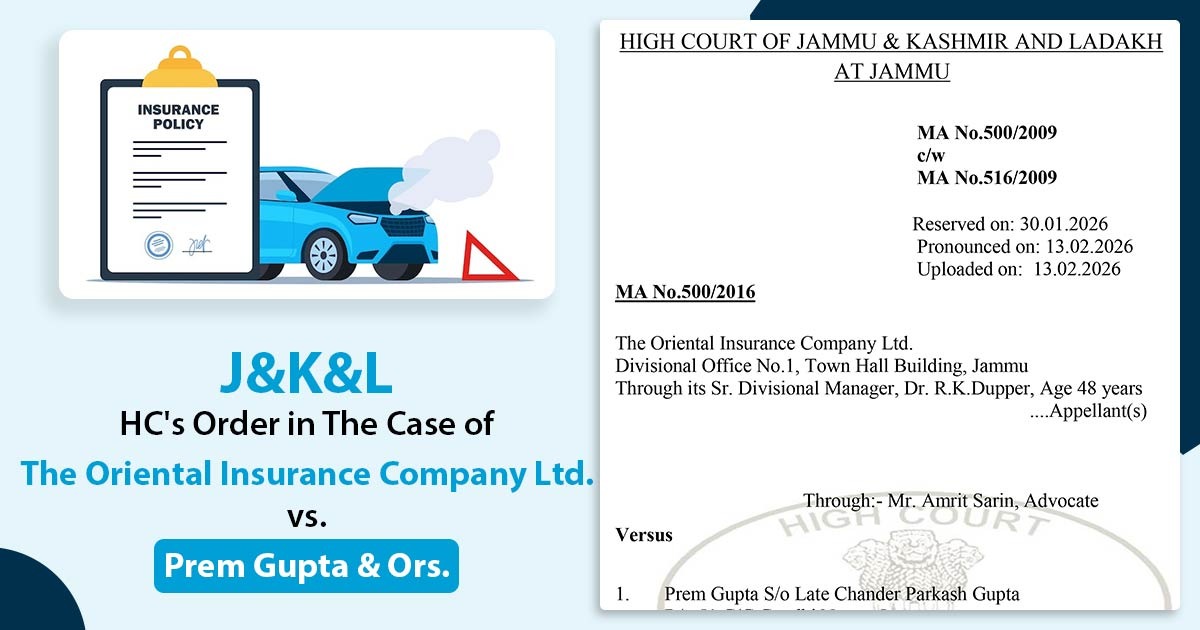
The Jammu & Kashmir High Court has ruled that in cases involving compensation for victims of traffic accidents, if a deceased person’s income is clearly shown through their Income Tax Returns (ITR), then the insurance company cannot demand additional proof of how that income was earned.
This means that once the income is established through tax records, the insurance company must accept it without needing further details about its source.
A bench consisting of Justice Sanjeev Kumar Shukla and Justice Sanjay Parihar stated that neither the Motor Accident Claims Tribunal (MACT) nor the appellate court is needed to investigate the sources of income shown in the Income Tax Return, especially when there is no evidence provided to dispute its accuracy.
The insurance company argued that even though the claimant provided the deceased person’s income tax return for the relevant year, she did not successfully show where that income had come from.
Read Also: Simple to Understand How You Can Save Tax U/S 80D Easily
The Court, denying the appeal as “without substance”, stated that once the income is revealed in a return submitted before the income tax authorities and established on record, the Tribunal could not undertake an enquiry into the source of the income in claim proceedings under the Motor Vehicles Act.
Thereafter, the Court said that enough material was there to show that the deceased was a partner in a business firm, M/s Chander Parkash Prem Kumar, and was earning income from the said business. No proof in rebuttal was led by the insurance company to doubt the authenticity of the ITR given by the claimant.
The Court, at the time of dismissing the insurer’s appeal, determined merit in the submission of the claimant that the Tribunal had unable to award just compensation by not considering the actual income of the deceased and by not applying the accurate multiplier.
The Court reassessing the compensation took the annual income of the deceased as Rs 2,71,747; Added 10% towards future prospects within the Constitution Bench judgment in Pranay Sethi; Deducted 50% towards personal expenses, noting that the deceased had left behind only one dependent; and applied the multiplier of 9 in accordance with Sarla Verma.
Recommended: Which Income Tax Software Should You Choose – Find Out Here
According to this, the loss of dependency was computed at Rs 13,45,149. The Court, under conventional tools, awarded Rs 15,000 for funeral expenses and Rs 40,000 for the loss of consortium.
Therefore, the total compensation determined was Rs 14,00,149. The revised amount, post deducting the sum obtained, was to be paid before the claimant, including an interest at 7.5% per annum from the filing date of the claim petition till realisation.
Subsequently, while the appeal submitted via the Insurance Company was dismissed, the award passed through the Tribunal stood modified to the above extent.
| Case Title | The Oriental Insurance Company Ltd. vs. Prem Gupta & Ors. |
| Case No. | MA No.500/2016 |
| For Petitioner | Mr. Amrit Sarin, Advocate |
| J&K & Ladakh High Court | Read Order |