

The Bombay High Court, in its ruling, allowed videography of GST summons proceedings in the case of a cancer patient and permitted the presence of an advocate at a visible but not audible distance, subject to certain conditions.
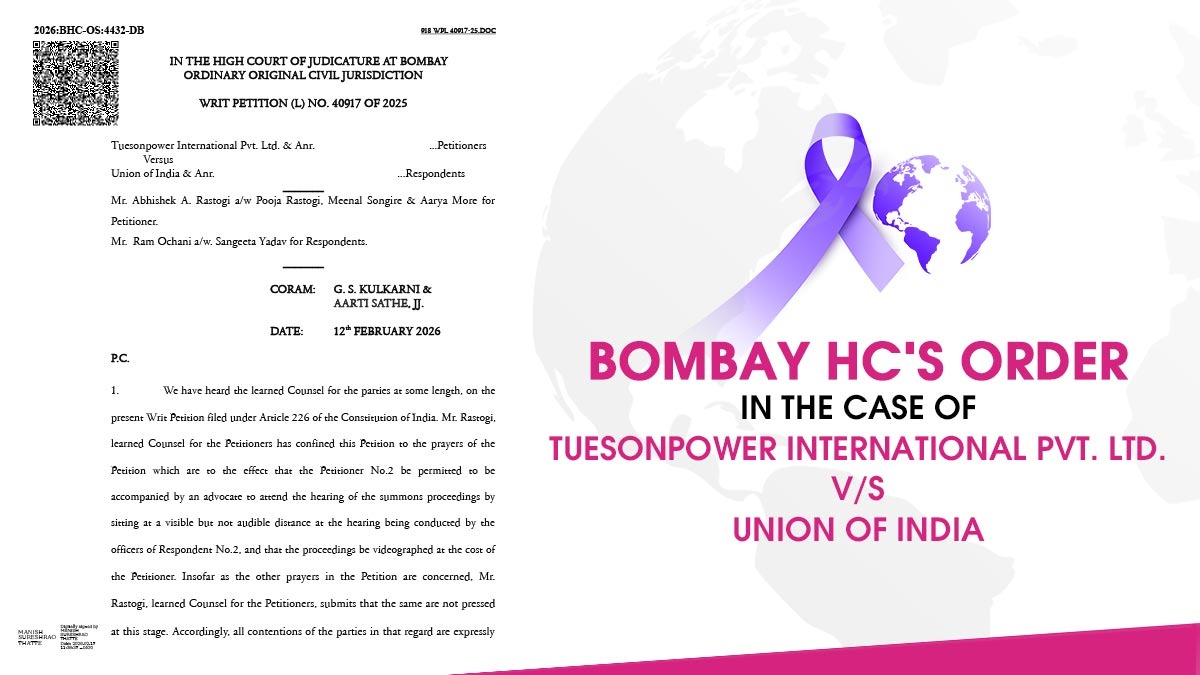
Tuesonpower International Pvt. Ltd. and another applicant filed a petition in the High Court under Article 226 of the Constitution, contesting a summons issued u/s 70 of the CGST Act, 2017.
This summons was specifically directed at Petitioner No. 2 in relation to an inquiry concerning the input tax credit claimed by Petitioner No. 1 on purchases made from Zes Stock Enterprises and New Era Enterprises.
As per the applicants, the transactions were genuine and supported via valid tax invoices, which were shown in GSTR-2B returns. They cited that the payments were incurred via appropriate banking channels. Also, applicants mentioned that the GST registrations of the specific suppliers were cancelled and that the suppliers must submit statutory appeals, which are due before the authorities.
The counsel of the applicant filed that they want to cooperate with the inquiry. It was brought to the notice of the Court that the Petitioner No. 2 is suffering from cancer and is undergoing treatment. The petitioners restricted their relief to two limited prayers.
They requested permission for Petitioner No. 2 to be accompanied by an advocate during the summons proceedings, with the advocate seated at a visible but inaudible distance. They also asked for the proceedings to be videographed at their own expense.
The respondents’ counsel claimed that Petitioner No. 2 should cooperate in the inquiry and furnish all the crucial documents as well as information. They stated that the proceedings are performed in premises equipped with CCTV cameras, and no separate direction for videography or other safeguards was needed.
The Division Bench, including Justice G.S. Kulkarni and Justice Aarti Sathe, stated that the summons was issued u/s 70 of the CGST Act and that the inquiry concerned the Input Tax Credit (ITC) taken by the company.
The court mentioned that Petitioner No. 2 is undergoing cancer treatment and that the petitioners have mentioned their willingness to cooperate with the investigation. The court noted that in Suumaya Industries Ltd. v. Union of India, a Co-ordinate Bench had accepted a similar arrangement.
As per the Court, acknowledging peculiar facts and situations of the matter along with the medical condition of Petitioner No. 2 and the limited nature of the relief sought, the request could be granted. The Court, the order was being passed in the particular facts of the case and must not be considered as a precedent.
Read Also: SC Upholds GST Act’s Arrest and Summons Powers, Affirming Parliament’s Legislative Authority
The court has ordered that Petitioner No. 2’s statement during the summons inquiry be video recorded at the petitioners’ expense.
Additionally, the court has allowed the advocate to accompany Petitioner No. 2 during the inquiry, with the condition that the advocate must not interfere with, interrupt, or disturb the recording of the statement. The advocate may sit at a visible distance but remain inaudible. The writ petition has been disposed of.
| Case Title | Tuesonpower International Pvt. Ltd. vs. Union of India |
| Order No | WRIT PETITION (L) NO. 40917 OF 2025 |
| Counsel for the Petitioner | Mr. Abhishek A., Pooja Rastogi, Meenal Songire & Aarya |
| Counsel for the Respondent | Mr. Ram Ochani, and Sangeeta Yadav |
| Bombay High Court | Read Order |